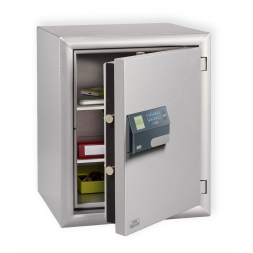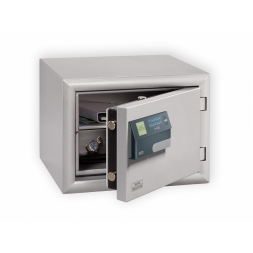
This guide compares the four safe lock types (key, mechanical combination, electronic and biometric), explains the EN 1300 and A2P standards that govern your insurable value, and helps you pick the right option for your sector. You will know which mechanism to favour based on your access needs, budget and insurance requirements.

A safe is never stronger than its lock. You can invest in steel walls several centimetres thick, but if the opening mechanism fails, everything else becomes decorative. Yet the lock is what many organisations consider last, once volume and budget are settled. Which safe lock suits professional use shared across several staff members? Key, code or fingerprint? And what does your insurer actually require? This guide answers those questions, type by type.

What a Safe Lock Is and Why the Choice Matters

A safe lock is the device that controls the opening of the safe and is its main point of attack during a break-in. It determines the real security level, the access model (one or several users) and the certification class of the safe, which in turn caps the maximum value your insurer will cover.

The lock plays two roles at once. It is the daily interface that must stay simple for authorised users, and it is the barrier a burglar will try to defeat by picking, drilling or manipulation. The right balance sits between smooth access for your teams and certified resistance to opening attempts. Before comparing the models in our safes and locks range, it helps to understand the four lock families and their logic.

The 4 Types of Safe Lock

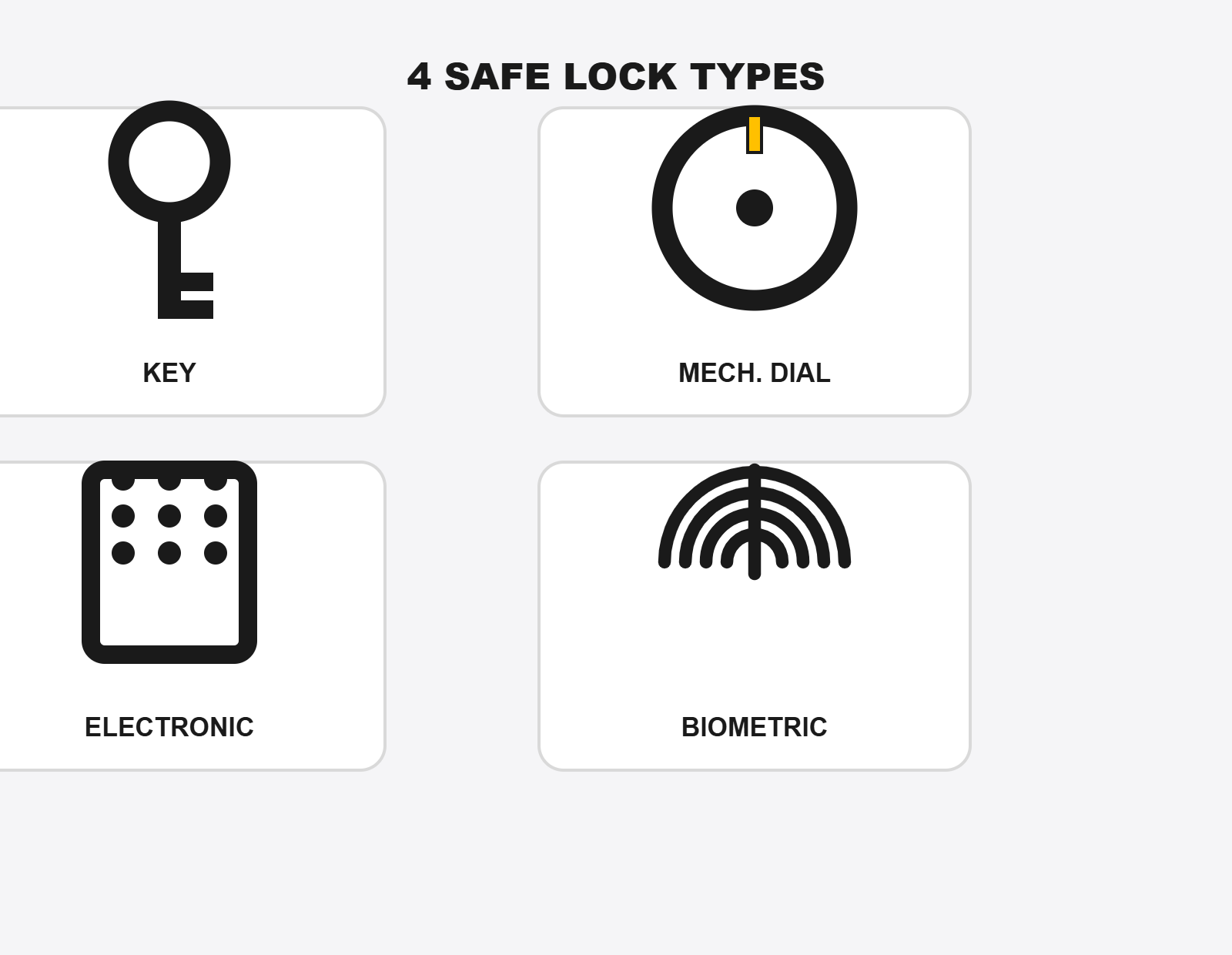
There are four main safe lock types: the key lock, the mechanical combination lock, the electronic lock and the biometric lock. They differ in how they open, how they handle multiple users and their security level, from the simplest to the most advanced.

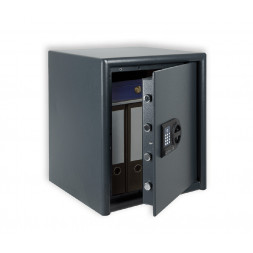
1. The Key Lock

  • Best for: rarely shared access, one or two identified key holders, no staff rotation.
  • Strength: full mechanical reliability, no battery, lowest entry cost.
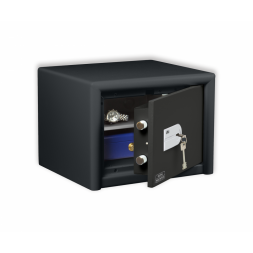
  • Limit: keys get lost, copied and stolen; each duplicate is an untraceable extra access.

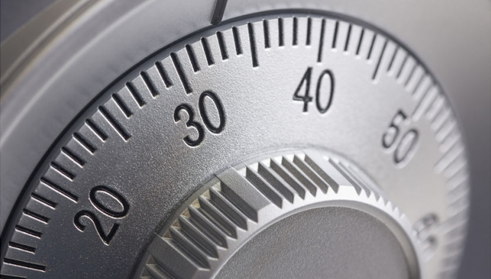
2. The Mechanical Combination Lock

  • Best for: sensitive sites that want to remove the physical key without relying on electronics.
  • Strength: nothing to carry or secure, high resistance to manipulation, immune to power failure.
  • Limit: single code rarely changed, slower opening, code can be forgotten.

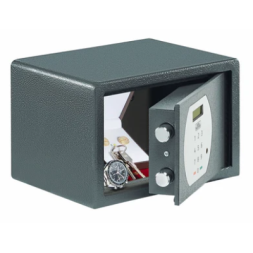
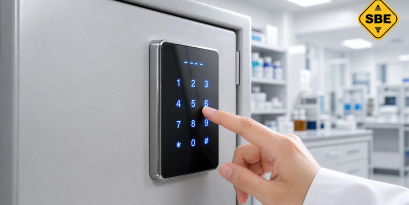
3. The Electronic Lock

  • Best for: access shared across staff, team rotation, changing a code after a departure.
  • Strength: flexible access management, multiple changeable codes, fast opening, backup code.
  • Limit: depends on batteries that need periodic replacement.

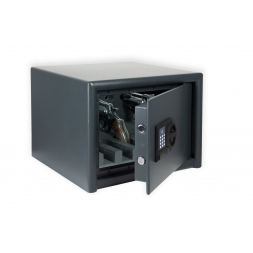
4. The Biometric Lock

  • Best for: fast named access, several trusted people, opening traceability.
  • Strength: opening with no code or key to remember, non-transferable fingerprint, strictly personal access.
  • Limit: highest investment, reliance on electronics and batteries.

Key locks equip entry-level models, the programmable electronic lock is the default whenever access must be shared and tracked, and the biometric version answers the most demanding uses. Find these mechanisms across our safes and locks range.

Mechanical or Electronic Safe Lock: Which to Choose?

Choose a mechanical lock (key or dial) for simple, single, power-independent access, and an electronic or biometric lock as soon as several people need access, access rights must change over time, or a security delay is required. The access-management priority settles the choice more reliably than budget alone.

In practice, the real cost comes after the purchase. A key lock means managing duplicates and keeping them secure, since every copy becomes an untraceable access, whereas an electronic lock only needs a battery change once or twice a year.

Day to day, the electronic lock also saves time at every team change: revoking a code takes seconds, while changing a key lock means calling in a professional and reissuing keys. So keep mechanical locks for stable, low-headcount access, and move to an electronic or biometric lock as soon as the list of authorised people changes, or you need to prove who opened the safe, and when.

If your priority is…Recommended typeWhy
Lowest cost and electronics-free reliabilityKey lockNo battery, proven mechanism, entry price
Removing the physical key without electronicsMechanical combination lockNothing to carry, strong resistance to manipulation
Sharing access across several staffElectronic lockMultiple changeable codes, delay, lockout after attempts
Fast, personal named accessBiometric lockNon-transferable fingerprint, instant opening

Standards and Certification: EN 1300 and A2P Explained

The EN 1300 standard classifies safe locks by their resistance to break-in (classes A to D, from entry level to the highest). A2P certification, issued in France by CNPP, attests to that resistance; for the safe itself, the EN 1143-1 standard sets the product class and, with it, the maximum value your policy will insure.

Two frameworks complement each other and are often confused. The first covers the lock alone, the second the complete safe.

The EN 1300 standard classifies high-security locks by resistance level. CNPP, the reference certification body, states that it covers "the ability to resist destructive attacks and fine or logical opening attempts" (CNPP, A2P framework, 2025). In France, A2P lock certification turns these requirements into timed resistance levels: A2P BP1 (at least 5 minutes), BP2 (at least 10 minutes) and BP3 (at least 15 minutes).

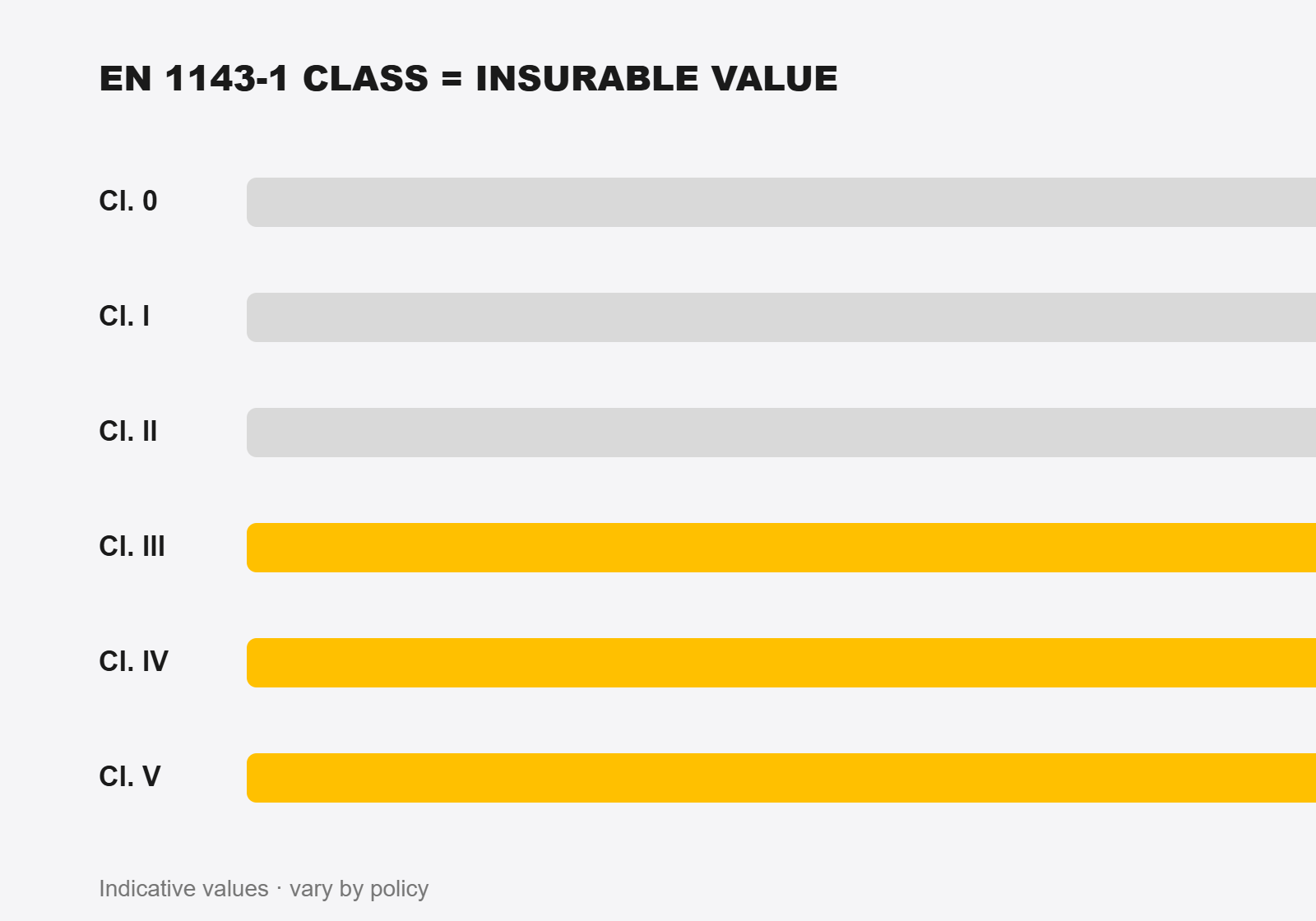
The EN 1143-1 standard classifies the safe as a whole (walls, lock, anchoring) by its resistance to break-in. This class directly sets the amount your insurer will cover. The figures below are indicative and vary by policy.

Class (EN 1143-1)Indicative insurable value
Class 0≈ £/€ 8,000
Class I≈ £/€ 25,000
Class II≈ £/€ 35,000
Class III≈ £/€ 55,000
Class IV≈ £/€ 110,000
Class V≈ £/€ 200,000
Class VI≈ £/€ 300,000

SBE note: always check the class required by your insurance policy before buying. An under-rated safe can leave your business with no compensation after a theft, whatever the amount actually stored. Fire protection is governed by a separate family of standards (EN 1047-1, EN 15659), independent of break-in resistance.

How to Choose Your Safe Lock by Sector

The right lock type depends on three criteria: how many people need access, the value to protect (so the target insurance class) and the need to trace openings. Individual use is fine with a key; shared, evolving access calls for a certified electronic or biometric lock.

  • Banking, finance and cash-handling retail: prioritise a high insurance class and a time-delay lock, which discourages theft under duress. Look at the safes and locks with certified electronic locks.
  • Healthcare, pharmacy and laboratories: fast named access to sensitive goods, often by several practitioners. A multi-code electronic or biometric lock meets the access-traceability need.
  • Government, defence and regulated professions: strict clearance management. A programmable electronic lock makes it easy to revoke an access after a departure, with no key to re-cut.
  • Hospitality and shared offices: frequent user rotation and small volumes. A small electronic-lock safe covers most room or workstation needs.
  • SMEs and IT security: beyond the safe, secondary access points can be secured with security seals and padlocks, while a dedicated laptop security range protects mobile IT assets.

Key Takeaways

The choice comes down to three questions: how many people access the safe, what value you must insure, and whether you need to trace openings. A key suits individual, budget-conscious use; a mechanical dial removes the key without electronics; an electronic lock manages multiple, evolving access; biometrics add instant named access. In every case, let the certification class required by your insurer outweigh convenience alone. Chosen well, the safe lock becomes the strong link in your security setup, never its weak point.

Updated August 2026.

Related products

Continue reading...
These articles too might interest you.

How to open an electronic code safe ?

How to open an electronic code safe, both in normal operation and when the safe is blocked ? It details how the keypad and locking mechanism work, the difference between master code and user code, and the main causes of failure (forgotten PIN, dead batteries, lockout after several wrong attempts, hardware malfunction). You will find concrete solutions to open a blocked safe (emergency key, temporary external power supply, contacting the manufacturer, calling a professional locksmith) as well as the procedure to change or reset your code. The article ends with best practices to avoid being locked out again (storing emergency keys safely, replacing batteries preventively, choosing a memorable code, keeping the serial number, and proof of purchase).  
Product News
Melissa Oumaouche
11128 views

How to open a combination safe?

Opening a combination safe requires method, not force. Dial rotation, disc alignment, direction of manipulation: this guide details every step to unlock your safe without stress or mistakes. You'll also discover the common pitfalls that jam the lock and how to avoid them. Forgotten code, lost emergency key, disc lock maintenance or switching to an electronic model: this article covers every scenario to support you in your daily use. Browse our selection of digital safes on SBE Direct.
Product News
Melissa Oumaouche
5795 views

How to best choose your office safe?

Commercial and industrial premises are the first target for thieves because they contain a large amount of computer equipment, confidential documents and sometimes money. Every year, more than 17,000 cases of burglary are recorded, with an average value of €2,900. These thefts, which account for more than 40% of burglaries in France, are only increasing in this period of health crisis when companies are deserted by employees to telework, leaving the way clear for thieves. It is therefore essential to secure company property as much as possible with a burglar-proof and fire-proof safe. SBE Direct offers a wide range of cost-effective security safes made in Germany. Available in various sizes, with a choice of locks, our security safes can meet any need.

SBE advise you
12151 views

FAQ

Which safe lock is the most secure?

The biometric lock is currently the hardest to defeat, because a fingerprint cannot be copied or lent. In terms of certified break-in resistance, though, what matters is not the lock type but its certification: a high-class EN 1300 lock or A2P BP3 (at least 15 minutes of resistance) offers the best level, whether code or biometric. For demanding professional use, a certified electronic or biometric lock remains the safest choice.

Key or code lock: which should I choose for professional use?

For access shared across several staff, the electronic code lock wins: it lets you create and revoke codes without re-cutting keys, and add a time delay. The key lock keeps its value for individual, infrequent access with no staff rotation and a tight budget. The deciding factor is not price but the number of users and how often access must change.

What is an A2P-certified lock?

A2P certification is issued in France by CNPP, an independent certification body. For a lock, it attests to a minimum break-in resistance time: A2P BP1 (5 minutes), BP2 (10 minutes) or BP3 (15 minutes). Backed by the European EN 1300 standard, this certification is often required by insurance policies to guarantee cover for the goods stored in the safe.

What should I do if I forget the code or lose the key of a safe?

Most electronic-lock safes come with a backup key or master code to keep in a safe place, outside the safe. If the safe is fully locked out, only an approved professional should open it, to preserve the safe and, where possible, the warranty. Never improvise drilling: you would destroy the safe and void the insurance.

Can you change a safe lock?

Yes, but only through a locksmith or specialist, and only with a lock of at least equivalent class. Replacing a certified lock with a non-approved model voids the safe's certification and, with it, the insurance cover. On a recent safe under warranty, go through the manufacturer or reseller so you do not break the warranty.

Choose the safe that matches your insurance

Key, code, electronic or biometric locks. Models certified to EN 1300 and A2P.

View safes and locks →
See the author's articles
Melissa Oumaouche

With over 5 years of experience in creating content optimized for search engines, Mélissa is currently Marketing & Product Manager at SBE Direct, where she leads the product catalogue positioning across the e-commerce website and marketplaces, as well as the SEO content strategy in coordination with the marketing team she oversees.

We use cookies to improve your experience.