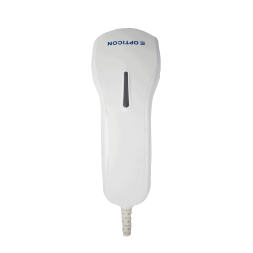
Barcode Readers

Barcode Readers

Optimize your traceability and inventory management with a high-performance barcode scanner. SBE Direct offers a wide selection of professional readers designed to meet all your requirements. Benefit from the guidance of our experts to find the best value for money. From intensive stocktaking to fast checkout, discover reliable and ergonomic tools to simplify your daily operations.

Read more ↓
Wired barcode scanners - SBE Direct - SBE Direct

What is a barcode scanner used for?

A barcode scanner converts a code into alphanumeric data, eliminating the need for manual keyboard entry. It automates data collection with a simple scan.

Here are its main areas of application:

  • Stock management: real-time control of incoming and outgoing items with each barcode scan
  • Inventory: ultra-fast item counting and elimination of entry errors
  • Checkout: smooth transactions and reduced waiting time for customers
  • Logistics: rigorous shipment tracking, from order preparation to delivery
  • Traceability: lifecycle tracking of equipment, medical devices, or IT assets

Discover in more detail how to optimize your stock management with a barcode scanner

How do you choose a barcode scanner?

Purchasing a barcode reader is an investment in your company's productivity. With many models available on the market, it's essential to assess your working environment and the type of data you handle.

Before finalising your purchase, you should review the device's key features:

  • Reading speed
  • Compatibility with your IT systems
  • Overall ergonomics of the device

These criteria will guide you in choosing a barcode reader suited to your business.

Wired or wireless (Bluetooth) handheld scanner?

The choice between a wired connection and wireless connectivity depends directly on your mobility needs.

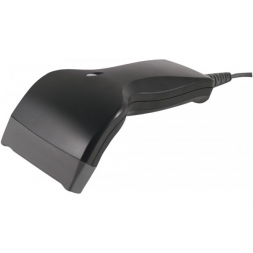
  • A wired model connects via USB to your computer or workstation.

It is cost-effective, easy to use (plug-and-play), and never runs out of battery, making it perfect for a fixed workstation.

  • Conversely, a wireless barcode scanner offers complete freedom of movement.

By opting for a Bluetooth scanner, the operator can move freely within a radius of several dozen metres around its base. This is the ideal option for scanning heavy or bulky items that cannot be lifted.

1D or 2D / QR code scanner?

Scanning technology is the heart of your device. A standard 1D scanner is designed to read only traditional linear codes, i.e. series of vertical bars such as EAN 13. This is more than sufficient for most retail applications.

However, data storage needs are evolving. A 2D barcode scanner is equipped with an imaging sensor capable of decoding complex matrices.

Please note: if your products are identified with QR codes, you will need a QR code scanner to extract the encrypted information instantly.

Resistance and ergonomics: intensive use, IP standard, rugged

The environment determines the required level of durability. In an office or shop, a standard plastic casing (usually with a sleek black design) is generally sufficient. Ergonomics then become the priority to prevent muscle fatigue during repetitive scanning.

However, for the logistics or industrial sectors, the equipment must withstand dust, humidity and drops onto concrete. In these cases, you should turn to ruggedised barcode readers certified with a protection rating (high IP standard), guaranteeing their durability in demanding environments.

The different types of barcode scanners

The SBE Direct catalogue is designed to meet specific business needs. Each product category has distinct features to make things easier for your staff, whether they're in-store or in the warehouse.

Wireless barcode scanner with memory – inventory

Designed for mass counting operations, the inventory scanner has internal memory. It can scan thousands of references out of network range, then offload the data in bulk once placed back on its base.

Our advice: for more advanced needs requiring data to be viewed on a built-in screen or quantities to be entered manually via a keypad, it's often worth investing in a genuine standalone handheld terminal.

Countertop barcode scanner – checkout

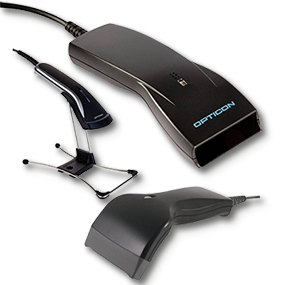
This type of model, such as the Quickscan range, is widely used in retail and pharmacies. A checkout scanner is generally very lightweight and designed for responsive, instant barcode scanning.

Often referred to as a barcode scanner gun, it can be supplied with a stand.

When placed on its stand, it switches to automatic reading mode (hands-free), allowing the cashier to pass items through on the fly without pressing the trigger.

Douchette code-barre pour usage mobile

Field professionals, such as delivery drivers or maintenance technicians, need discreet, ultra-portable equipment. The pocket-sized handheld barcode scanner or mini scan reader is perfectly suited to this need.

These small readers pair easily via Bluetooth with a smartphone or tablet (iOS, Android, Windows). They turn any professional smartphone or touchscreen tablet into a powerful optical scanning station.

Major barcode scanner brands

The selection brings together four manufacturers specialising in automatic identification: Zebra, Honeywell, Datalogic and Opticon. The choice between them depends on usage and budget, a trade-off covered in detail in our comparison of the best professional barcode reader.

Why order your barcode scanner from SBE Direct?

Present in B2B identification and traceability since 1992 (over 30 years), SBE Direct keeps a selection of readers in stock, ready to ship. The offering also covers the wider ecosystem: manufacturing barcode labels and setting up compatible asset management software. Technical advisors can prepare a quote based on your needs.

FAQ

Which barcode scanner should I choose for my activity?

The choice depends directly on your sector:

  • For retail businesses, a standard wired countertop model is more than sufficient.
  • For logistics or large warehouses, a rugged wireless barcode scanner is recommended.
  • For teams working on the move outdoors, a compact Bluetooth model paired with a smartphone will be the most suitable.
What is the difference between a 1D and a 2D scanner?

A 1D scanner only reads traditional formats made up of vertical bars (such as EAN-13 or Code 39).

A 2D scanner, thanks to its imaging sensor, can read both 1D codes and complex two-dimensional matrix codes such as QR Codes or Data Matrix.

Does a barcode scanner require software to work?

No, it does not require any specific software to function technically. When connected via USB, it acts like a virtual keyboard and automatically types the scanned numbers on the screen.

However, to actually use this data (stock updates, checkout processing), you will need your own POS software, ERP system, or Excel spreadsheet.

Wired or Bluetooth barcode scanner: which should you choose?

Choose a wired device if the operator works at a fixed station (cash register, reception desk). It is more cost-effective and does not require battery management.

Opt for Bluetooth if items are bulky, heavy, or if you need to move freely through aisles without being restricted by a cable.

Filtrer

We use cookies to improve your experience.