Plastic Tags

Plastic Tags

The identification plate permanently marks equipment: reference, serial number, technical data, or logo. Fixed using adhesive, rivets, or screws, it remains legible on machines, electrical cabinets, or installations exposed to shocks, heat, or chemicals.

Depending on the application, it is available in anodized aluminium, stainless steel, or brass, laser-engraved or mechanically engraved for permanent marking. The manufacturer’s plate complies with the requirements of the Machinery Directive 2006/42/EC; the custom engraved plate covers internal identification and traceability.

Read more ↓
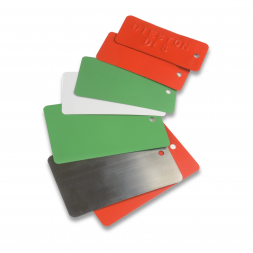
Industrial marking solutions: PVC & metal plates | SBE Direct

Identification plate: definition and role

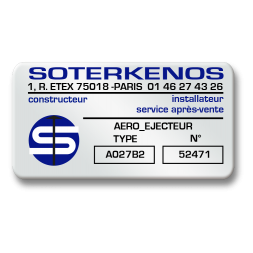
An identification plate is a rigid or semi-rigid plate attached to an object, machine, or building. Depending on the selected format, it features engraved or printed information such as the manufacturer’s name, serial number, technical specifications, or logo.

Also known as a nameplate, it is used to identify equipment, support maintenance tracking, and comply with applicable standards, including the Machinery Directive 2006/42/EC for manufacturer’s plates.

Unlike a paper label, it is designed for long-term durability. Suitable for both indoor and outdoor use, it remains legible despite exposure to UV rays, moisture, and temperature fluctuations.

What is a company plaque used for?

A manufacturer’s nameplate serves both an informational and a branding purpose. From an operational perspective, it helps identify and catalogue machines and equipment across an industrial site, ensuring efficient asset management and traceability.

From a branding perspective, it acts as a signature. A custom nameplate displaying your logo enhances your company’s professional image and reinforces credibility with customers and business partners.

It also contributes to user safety. By displaying safety instructions or load limits—for example, for lifting operations using a sling—it helps prevent accidents and guides operators in the correct use of equipment.

Why choose an industrial identification plate?

En environnement de production, la plaque d'identification industrielle doit résister aux projections chimiques, aux frottements mécaniques et à la corrosion. Une plaque inadaptée s'efface ou se décolle, et une référence illisible ralentit la chaîne ou provoque une erreur d'identification.

L'aluminium anodisé et l'inox répondent à ces contraintes : gravés au laser ou en mécanique, ils restent lisibles là où une étiquette imprimée s'altère. Gravé, le marquage industriel ne s'efface pas avec l'usure et maintient la traçabilité des équipements sur toute leur durée de vie.

The different types of plates available from SBE Direct

The choice of material depends on the final environment in which the plate will be used. Each material offers distinct physical properties that should be carefully considered before placing an order.

  • HDPE identification plate: flexibility for curved surfaces
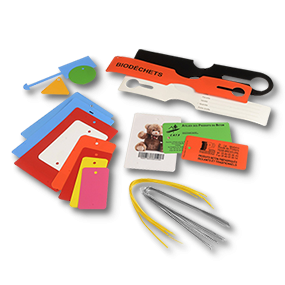
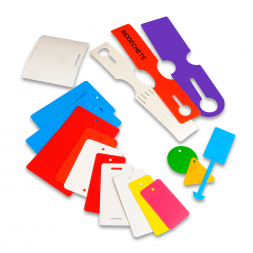
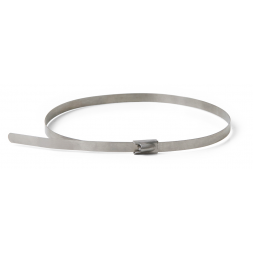
    The HDPE identification plate is made from 100% recyclable plastic and is available in 10 colours. Its flexibility allows it to be applied to non-flat surfaces—such as poles, transformers, electrical equipment, or trees—and cut into custom shapes (oval, rectangular, arrow, etc.). It can be secured using metal ties, nails, screws, staples, or cable ties.
  • Long-life polyethylene plate: permanent engraving
    The long-life polyethylene identification plate is laser engraved directly into the material, ensuring the information cannot fade or wear away, even in exposed outdoor environments. It is specifically designed for the telecommunications sector, including utility poles, conduits, and cable bundles, and can be fixed using stainless steel or plastic cable ties, screws, or nails.
  • Painted steel plate: durability in demanding environments
    The painted steel identification plate offers high-quality printing (screen printing or cold stamping) without requiring maintenance, both indoors and outdoors. It remains slightly flexible, making it suitable for curved surfaces while maintaining excellent long-term durability.
  • Anodised aluminium plate: premium long-lasting performance
    The anodised aluminium plate is our premium solution for the most demanding environments. The colour is embedded into the anodised layer, providing outstanding resistance to UV exposure, solvents, oils, and temperature fluctuations. Rigid by design, it requires a flat surface and can be mounted using a high-performance residue-free adhesive or fixed with screws or nails.
  • Polyester plate: a cost-effective and customisable solution
    The polyester manufacturer label with 3M double-sided adhesive combines flexibility and protection. A thick crystal-clear overlay protects the printed information while making manual removal difficult. It is the ideal solution for indoor machinery or surfaces that cannot be drilled.
MaterialRecommended useResistanceKey benefits
Anodised aluminiumIndustrial applications, outdoor signageUV rays, solvents, oils, extreme temperature variationsLightweight, corrosion-resistant, premium appearance
Stainless steelFood processing, marine environmentsCorrosion, chemicalsHygienic, excellent performance in humid environments
Painted steelHarsh environments, curved surfacesWeathering, impactsMaintenance-free, suitable for indoor and outdoor use
HDPEIndoor signage, warehouses, curved surfacesWeather-resistant (indoor and outdoor)Cost-effective, flexible, available in 10 colours
Long-life polyethyleneUtility poles, conduits, telecommunicationsProlonged outdoor exposureMaterial-engraved marking, permanent durability
PolyesterElectronics, small equipmentScratches, moderate UV exposure (crystal-clear protective layer)Strong adhesive, ultra-thin, difficult to remove

How do you install a company plaque?

Installing your industrial identification plate correctly is essential to ensure it remains securely attached over time. Two main mounting methods are available, depending on the application surface.

Rivet or screw fixing is the most secure option for machinery exposed to strong vibrations. Simply order your plates with pre-drilled holes to make installation quick and easy.

The alternative is high-performance adhesive mounting. This is the ideal solution for surfaces that cannot be drilled. Modern industrial labels use advanced acrylic adhesives capable of forming an exceptionally strong bond with the application surface.

Standards and regulations: what you need to know

Installing an identification plate is not only a matter of internal organisation it is often a legal requirement. European regulations require the CE marking to demonstrate that a product complies with applicable safety requirements.

For machinery, the plate must include the manufacturer's name, year of manufacture, model, and rated power. Failure to provide this information may result in penalties during safety inspections.

For public buildings and facilities, signage must also comply with accessibility standards, including requirements for character size and visual contrast, ensuring information remains clear and readable for everyone.

FAQ

What is a manufacturer’s nameplate?

A manufacturer’s nameplate is a rigid plate attached to equipment to identify its manufacturer and display its technical specifications. It ensures product traceability while enhancing the company’s brand image over the long term.

Is a manufacturer’s plate mandatory?

Yes. A manufacturer’s plate is mandatory for industrial equipment and vehicles placed on the market within the European Union. It must display the required identification and approval information to demonstrate compliance with applicable safety regulations, including the CE marking.

How much does a professional nameplate cost?

The cost of a professional nameplate depends on the selected material (such as brass, aluminium, or acrylic) as well as its dimensions and level of customisation. SBE Direct offers solutions to suit a wide range of budgets, with volume discounts available for larger orders.

Is a professional nameplate mandatory?

Not in every case. A professional nameplate is not legally required for all businesses, but it is strongly recommended. It helps clearly identify the location of your office or practice, making it easier for customers and visitors to find you.

Comment garantir la conformité aux réglementations et aux normes de sécurité lors de la gestion de nos immobilisations et de nos documents ?

Pour répondre aux exigences légales, assurez-vous d’une gestion rigoureuse des immobilisations et des données. Nos solutions facilitent la documentation complète de vos actifs et garantissent une conformité continue avec les normes en vigueur.

Quelles sont les solutions personnalisées disponibles pour répondre à nos besoins uniques en matière de gestion des immobilisations ?

Vos enjeux sont spécifiques, vos solutions doivent l’être aussi. En modulant nos offres selon vos contraintes métiers, nous vous permettons de disposer d’outils flexibles et performants, parfaitement alignés sur vos priorités et vos attentes.

Comment pouvons-nous minimiser les risques liés à la perte ou au vol de biens et de documents importants ?

Pour éviter pertes et vols, misez sur la traçabilité en temps réel avec des outils d’identification sécurisés. L’utilisation d’étiquetages résistants et inviolables, couplée à des processus rigoureux, garantit une protection renforcée de vos immobilisations.

Existe-t-il des mesures de sécurité spécifiques à mettre en place pour protéger nos documents confidentiels contre les cybermenaces ?

La protection de vos documents sensibles passe par un chiffrement des données, des sauvegardes automatisées et des accès restreints. Des solutions cloud sécurisées ou on-premise assurent une protection robuste contre les menaces numériques.

Comment rationaliser nos processus de gestion des immobilisations pour gagner du temps et réduire les coûts ?

Standardisez vos procédures et automatisez vos inventaires pour gagner du temps et réduire les erreurs. Grâce à un logiciel centralisé, vous disposez d’une vue d’ensemble précise et accessible, simplifiant ainsi la gestion quotidienne de vos actifs.

Quelles sont les références et les retours d'expérience d'autres administrations qui ont réussi à résoudre des défis similaires en matière de gestion et de sécurité des immobilisations et des documents ?

Des institutions prestigieuses comme l’Élysée, le Sénat ou les ministères ont déjà relevé leurs défis grâce à nos solutions. Elles ont gagné en efficacité, sécurité et traçabilité. Inspirez-vous de ces retours d’expérience pour moderniser votre gestion des immobilisations.

We use cookies to improve your experience.