Security Seals

Security Seals

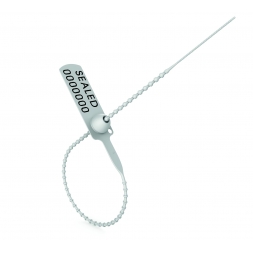
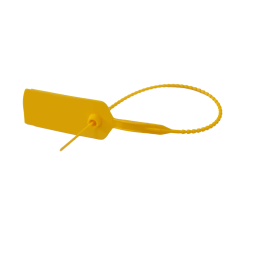
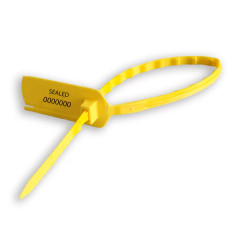
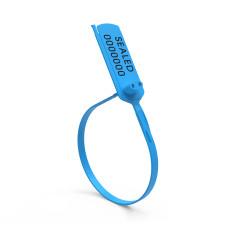
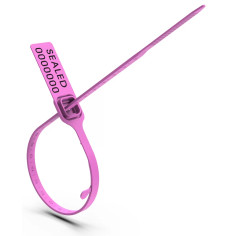
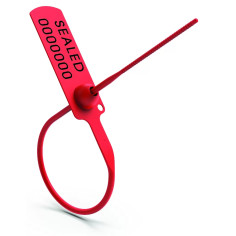
A plastic seal does not physically prevent opening; its purpose is to make any opening impossible to conceal. Each seal carries a unique serial number: if someone breaks it to access your goods, they will have to replace it with another one, which will inevitably have a different number. The anomaly is immediately visible during inspection. It is this simple principle that makes security seals the most cost-effective traceability solution on the market.

Read more ↓
Plastic seal: numbered & customizable | SBE Direct

Neuf modèles, du scellé temporaire au scellé ultra-résistant

The right seal depends above all on the tensile strength it needs to withstand. At the lower end of the range, the Demetra seal (35 N) is intentionally less resistant: designed to be broken by hand, it is suitable for frequent inspections in chemical or food processing environments. At the opposite end, the Zeus seal with its 6 mm notched flat stem withstands 530 N, equivalent to 53 kg, making it the strongest model in the range, designed for trucks and containers.

Between these two extremes, each reference meets a specific professional requirement. The Poseidon seal (210 N), permanently laser-engraved and equipped with an easy-opening system, is widely used in the medical sector. The Apollo seal (220 N) and its notched stem reduce the risk of breakage during mail deliveries. For higher-security applications, the metal insert models Ermes (390 N, transport and banking), Ares (215 N), and Eracle (up to 455 mm) combine a metal locking mechanism with a recyclable plastic body.

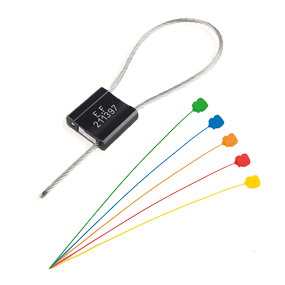
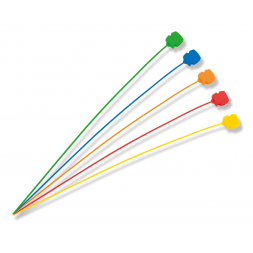
For your meters, circuit breakers, valves, and fire extinguishers, the plastic colored sealing lead with stem remains the most economical solution. It is closed using sealing pliers and is available in 8 colors. Find the complete range in our sealing leads category.

Comparison: which plastic seal for which use?

ModelStrengthTypical useSpecific feature
Demetra35 NFrequent inspections (chemical, food industries)Hand breakable
Poseidon210 NMedicalLaser engraving, easy opening
Ares215 NHeavy-duty applicationsMetal insert
Apollo220 NMail, deliveriesNotched stem
Ermes390 NTransport, bankingMetal insert, easy opening
Eracle220 NHeavy-duty use, long reach (up to 455 mm)Metal insert, 3 sizes
Efesto220 NReinforced compact formatMetal insert
Zeus530 NTrucks, containers6 mm flat notched stem

Numbering, customization, and compliance of the plastic seal

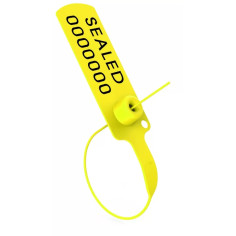
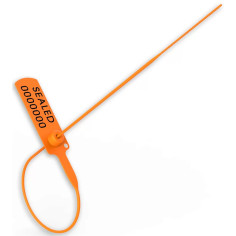
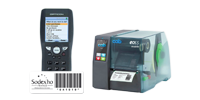
All our seals are supplied as standard with the SEALED marking followed by 7 digits. You can go further with customization options: logo, company name, extended sequential numbering, barcode, and five colors to choose from. Printing is carried out by laser or thermal transfer depending on the model, on a 33 x 19 mm marking area. Allow an additional 4 to 6 weeks for a customized order, as well as plate-making fees for the first production run.

Regarding standards, ISO 17712 classifies seals into three levels: “I” for indicative, “S” for security, and “H” for high security. This classification is often mandatory for international container transit. Our seals are manufactured in Europe using recyclable plastic.

Plastic seal: a range to be tailored to your surfaces

Plastic seals are suitable wherever there is a point of passage: handles, rings, bag zippers, container doors. On flat surfaces such as cardboard, casings, or envelopes, adhesive seals take over, with a visible VOID effect in the event of removal. For logistics flows requiring higher resistance, choose our security transport seals and our padlock seals, which combine physical locking with proof of integrity.

What budget should be planned?

Our plastic seals are packaged in packs of 1,000 and start at €129 excl. VAT, up to €806 excl. VAT for long and customized versions. Prices become significantly more attractive from 5 and then 10 packs onwards. The plastic sealing lead with stem is available at €165 excl. VAT per pack of 1,200 units. Request a free sample before ordering.

Frequently Asked Questions

How to choose the right seal length?

Measure the complete circumference of the passage point, then add a tightening margin. If the seal is too long, it leaves slack and makes fraudulent handling easier; if it is too short, it cannot be closed. Our models range from 190 to 455 mm, with most available in both short and long versions to cover both situations.

Can a plastic seal replace a padlock?

No. A seal is a tamper-evident indicator, not a physical security barrier: most plastic seals can be cut with scissors. It proves that an opening has occurred, but it does not prevent it. If you need both functions at the same time, choose a padlock seal.

Is a specific tool required to install a seal?

Not for progressive tightening seals: simply insert the tail into the locking head and pull firmly; the mechanism locks automatically. However, pull-through lead seals require a sealing plier to compress and secure the head.

We use cookies to improve your experience.