The Basics: HF, UHF and NFC – What Are We Talking About?

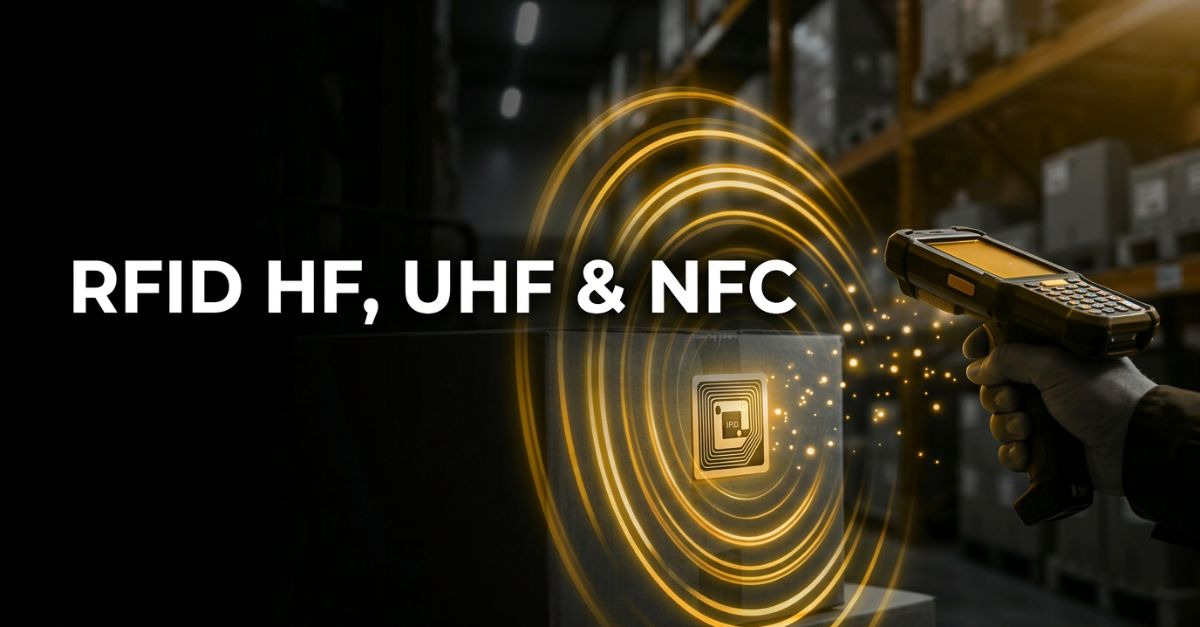
RFID relies on several frequency bands. Among the most widely used technologies in business, three stand out for common professional applications: RFID HF, RFID UHF and NFC.

Before comparing them, one essential point to clarify: NFC (Near Field Communication) is not an independent frequency. It is a variant of RFID HF (13.56 MHz), deliberately limited to a few centimetres to secure data exchanges with a smartphone.

In other words: all NFC is RFID HF, but not all RFID HF is NFC.

TechnologyFrequencyRead RangeTypical Use
RFID HF13.56 MHzA few cm to 1 mBadges, libraries, archives
RFID UHF860–960 MHz3 to 12+ metresInventory, logistics, stock management
NFC13.56 MHz0 to 10 cmPayment, authentication, smartphone

RFID HF: Controlled Close-Range Identification

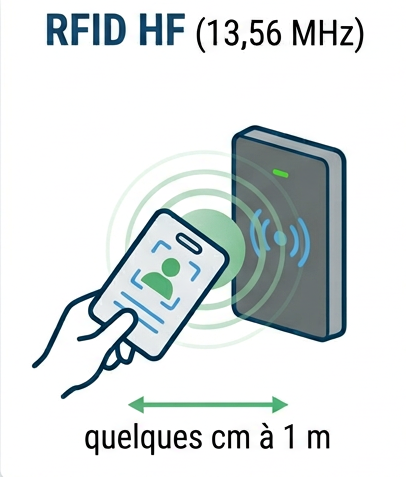
RFID HF operates at 13.56 MHz with a read range of a few centimetres to approximately 1 metre. This deliberately limited distance is an advantage: it reduces the risk of unwanted reads and guarantees controlled interaction, which is essential in secure identification systems. Its data transfer rate reaches 25 to 100 Kbits/s, which is sufficient for individual item use cases.

RFID HF is the go-to technology for employee badges and access cards, transit cards, files and archives, and corporate access control systems.

NFC: RFID HF for Smartphones

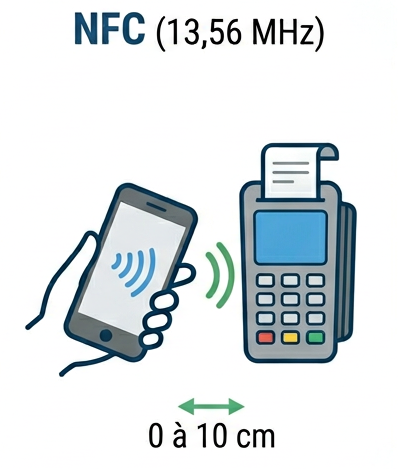
NFC uses the same frequency as RFID HF (13.56 MHz), but reduces the range to 0–10 cm to ensure a deliberate and secure interaction. It operates in one-to-one mode: the smartphone approaches the chip, reads the data, and the exchange is complete.

This is why NFC has become the standard for contactless payment, authentication and interactive marketing. Its limitation is clear: it cannot read multiple tags simultaneously, and is therefore not suited to high-volume management.

RFID UHF: The Reference Technology for Professional Inventory

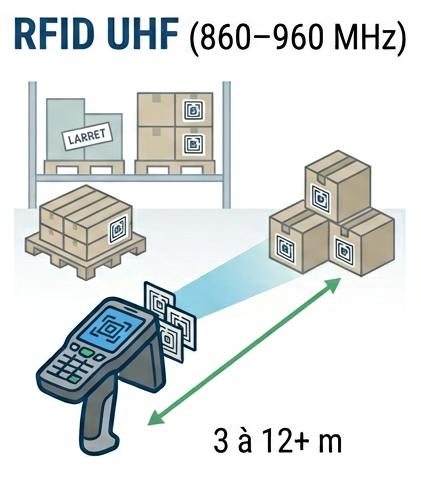
RFID UHF (Ultra High Frequency) operates between 860 and 960 MHz in Europe, the standard frequency is 868 MHz. Its read range reaches 3 to 12 metres depending on the hardware, and up to 15 metres for fixed long-range readers. This is what sets it radically apart from the other two technologies.

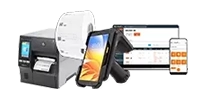
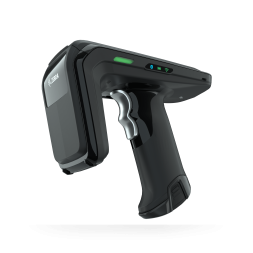
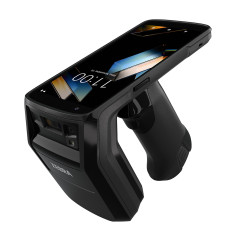
In practice, a portable RFID terminal such as the Zebra TC22R reads up to 700 tags simultaneously, with a data transfer rate reaching 650 Kbits/s. An inventory that used to take several hours with a traditional barcode scanner can now be completed in just a few minutes. For warehouses, logistics and retail, the fast RFID solution for asset inventory relies almost exclusively on this technology.

Performance Comparison: What the Numbers Say

Read speed and volume directly determine the operational feasibility of an RFID project.

CriteriaRFID HFRFID UHFNFC
RangeUp to 1 m3 to 12+ m0 to 10 cm
Simultaneous readsLimited700+ tags1 tag (one-to-one)
Data transfer rate25–100 Kbits/sUp to 650 Kbits/s106–424 Kbits/s
Metal/water interferenceLowSensitive (improved)Low

Badges and Access Control: The Domain of HF and NFC

For employee badges, student cards, transit passes and access control systems, RFID HF and NFC are the natural fit. Their controlled close-range reading is a feature, not a limitation: it ensures no card is read without the holder's knowledge, which is a security prerequisite in most professional environments.

Software to Leverage Your RFID Data

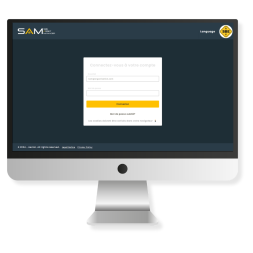
Whatever technology is deployed, the collected data must be centralised and put to use. The SAM – SBE Asset Manager and ScanAsset RFID software connect your readers, terminals and databases to manage your inventories in real time and track your assets with precision. They adapt to your RFID technology — HF, UHF or NFC — not the other way around.

To go further, check out our guide Understanding RFID in 10 Key Points.

Which Technology Should You Choose for Your Use Case?

Your NeedRecommended Technology
Access badges, cards, archivesRFID HF
Fast inventory, stock management, logisticsRFID UHF
Contactless payment, smartphone authenticationNFC
Large-scale asset trackingRFID UHF

The right choice is not a question of technology, but of use case. The SBE Direct team will guide you in defining the solution best suited to your environment and deploying your RFID project end to end.

Continue reading...
These articles too might interest you.

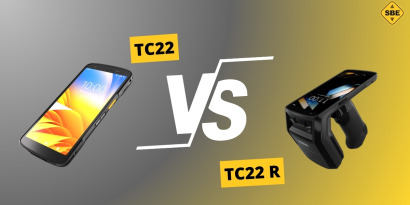
Zebra TC22 or TC22R: which RFID terminal should you choose?

Looking for a portable Zebra RFID terminal for your business? The difference between the TC22 and TC22R comes down to real-world use: inventory frequency, volume of assets to track, and performance goals. This guide helps you choose which Zebra Android terminal best fits your actual needs.

Product News
Tanya Bicki
957 views

Label printer: the right choice

You need to print your own labels, but with the different printing technologies, roll sizes, compatible software, and types of ribbons, it’s often difficult to know where to start. No worries: by answering just a few simple questions, you’ll know exactly which label printer is right for you.
SBE advise you
Tanya Bicki
3293 views

Understanding RFID in 10 points

With the massive development of RFID products, it is important to understand how the technology works and how to use it in the most efficient way. How does the technology work? What is the most effective support in terms of how it is used? What chip to choose? To best find your way among the wide range of media and chips, here are a few simple points to which SBE responds:

SBE advise you
370863 views

We use cookies to improve your experience.