RFID answers a problem few companies know how to tackle: proving, at every stage, that a product is genuine and not a fake. This is no minor issue. According to the OECD-EUIPO report "Mapping Global Trade in Fakes 2025", global trade in counterfeit goods reached 467 billion dollars, or 2.3 % of world trade. Behind that figure lie lost sales, a damaged brand and, in some sectors, a real risk to consumer safety. How can a radio-frequency chip make a product almost impossible to falsify? Which markets should you protect first? And why are holograms and barcodes no longer enough? This guide answers those questions.

Counterfeiting in figures: a fast-growing threat

$467bn

of counterfeit goods in global trade (OECD-EUIPO, May 2025)

4.7 %

of European Union imports, close to 99 billion euros

9 %

of the total value seized across the continent is concentrated in France

Counterfeiting today accounts for up to 2.3 % of world trade, or 467 billion dollars of counterfeit goods, according to the OECD-EUIPO report published on 7 May 2025. No sector with strong brand value is spared, from fashion to spare parts, medicines and electronics.

The European Union is a prime target: up to 4.7 % of its imports, close to 99 billion euros, are believed to be counterfeit. France alone accounts for around 9 % of the total value seized across the continent. China and Hong Kong remain the main economies of origin, with 45 % of reported seizures.

Luxury illustrates the scale of the phenomenon. According to the authentication platform Legitique, counterfeit goods represented around 8 % of global luxury sales in 2023. Faced with counterfeiters who produce faster and offload their stock on legitimate platforms, the fight can no longer rest on visual inspection alone. This is where RFID technology comes in.

Which products should you protect with RFID? Applications by market

RFID protects high-value products first, along with those carrying a health risk or subject to traceability regulations. Six markets concentrate most of the stakes, each with its own constraints.

Clothing

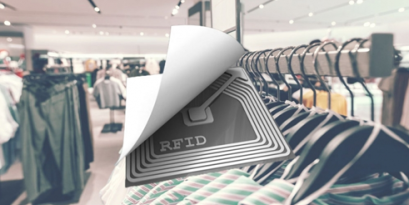
Textiles are one of the earliest users of RFID. An RFID label sewn or heat-sealed into a garment makes it possible to authenticate the item, track the supply chain and tell an original from a copy at the till. Fashion retail has adopted bulk reading on a large scale, scanning several hundred items per second.

Automotive parts

Counterfeit spare parts (brake pads, filters, sensors) create a direct safety problem. A UHF RFID chip applied to the part or its packaging links every reference to a verifiable unique identifier, from manufacturer to garage. The workshop confirms the origin of the part before fitting it.

Medicines

Medicines are a special case, because they fall under regulatory serialisation (a unique identifier and an anti-tampering device are required at European level). RFID plays a complementary role, tracking the cold chain and making hospital distribution more reliable. The stakes here are not only commercial: a counterfeit medicine puts lives at risk.

Wines and spirits

In premium wines and spirits, fraud often works through recorking or substituting the contents. An NFC or RFID chip built into the cork or the capsule detects opening and proves the bottle is genuine. The consumer checks in one gesture that the bottle has not been tampered with.

Luxury, watches and cosmetics

Luxury has made RFID a standard. Prada combines three layers: UHF RFID for internal supply-chain tracking, NFC for consumer authentication by smartphone, and a shared ledger (the Aura Blockchain consortium, co-founded by Prada Group) that serves as a trust foundation. The principle extends to watches and cosmetics, where each product receives a digital twin linked to a secure database.

Electronics

Counterfeit components, accessories and semiconductors flood certain distribution channels. An RFID solution with cryptographic authentication makes it possible to verify, at every point in the chain, that a component genuinely comes from the declared manufacturer and not from a parallel channel.

Hologram, barcode, QR code: why are these protections no longer enough?

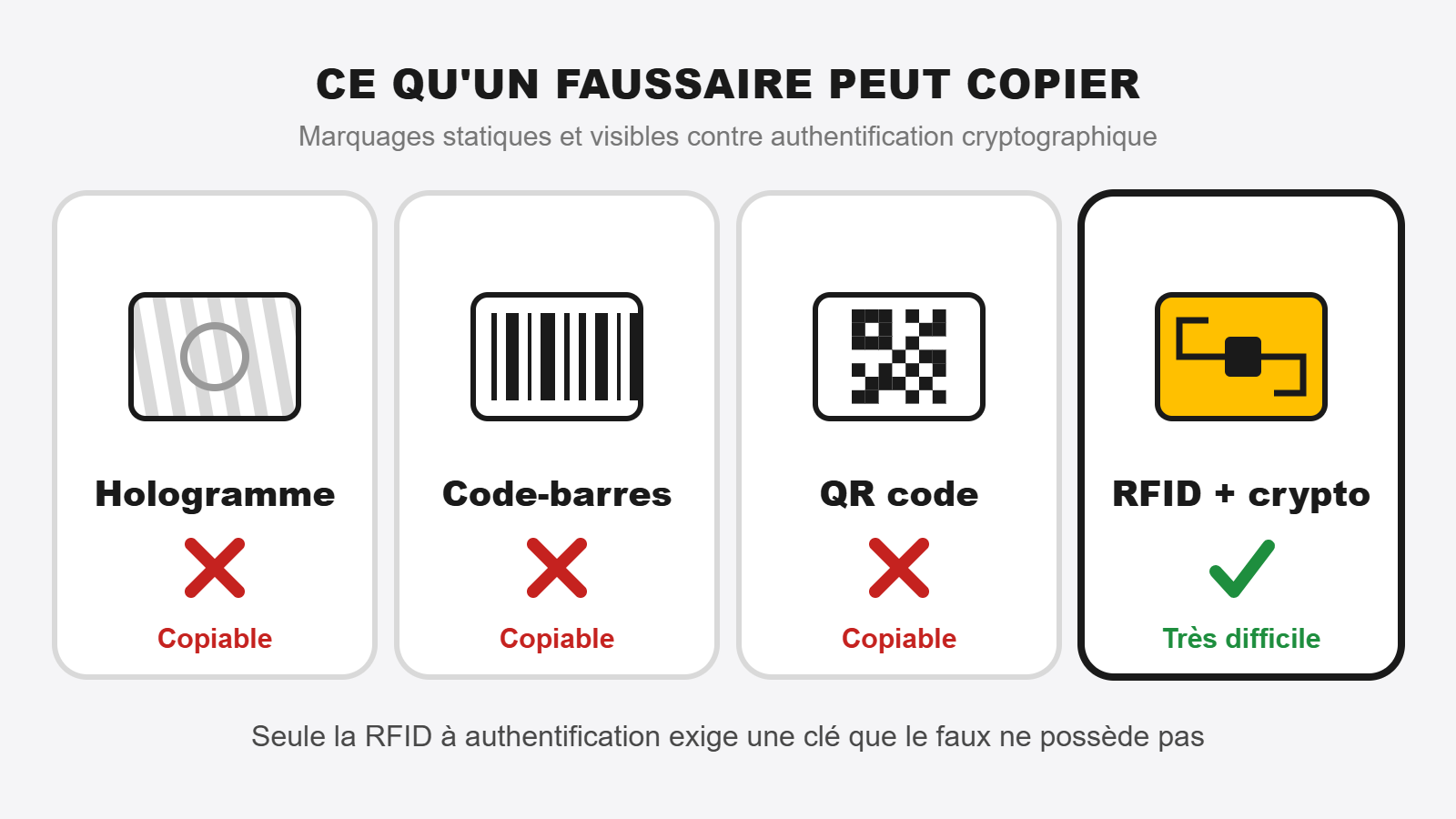
Holograms, barcodes and QR codes share a common weakness: they are visible, static markings, and therefore reproducible. A counterfeiter with a good scanner and a printer copies a QR code or a barcode identically in a few minutes.

The table below summarises the limits of each conventional protection.

Comparison table showing that holograms, barcodes, and QR codes can be copied by counterfeiters, while RFID with cryptographic authentication cannot."
ProtectionWhat it providesMain weaknessCopyable by a counterfeiter
HologramA deterrent visual effectNo verifiable data, imitated in volumeYes
BarcodeIdentifies a product typeIdentical code on every unitYes
QR codeLinks to a web pageStatic content, duplicated as isYes
RFID label with authenticationUnique identifier + cryptographic responseRequires a reader and a secure databaseVery difficult

The QR code keeps its full value for giving the public access to product information. On its own, though, it proves nothing: two bottles, one genuine and one counterfeit, can carry the same QR code. The difference lies in the data and the verification mechanism, not in the printed carrier.

How RFID makes a product tamper-proof

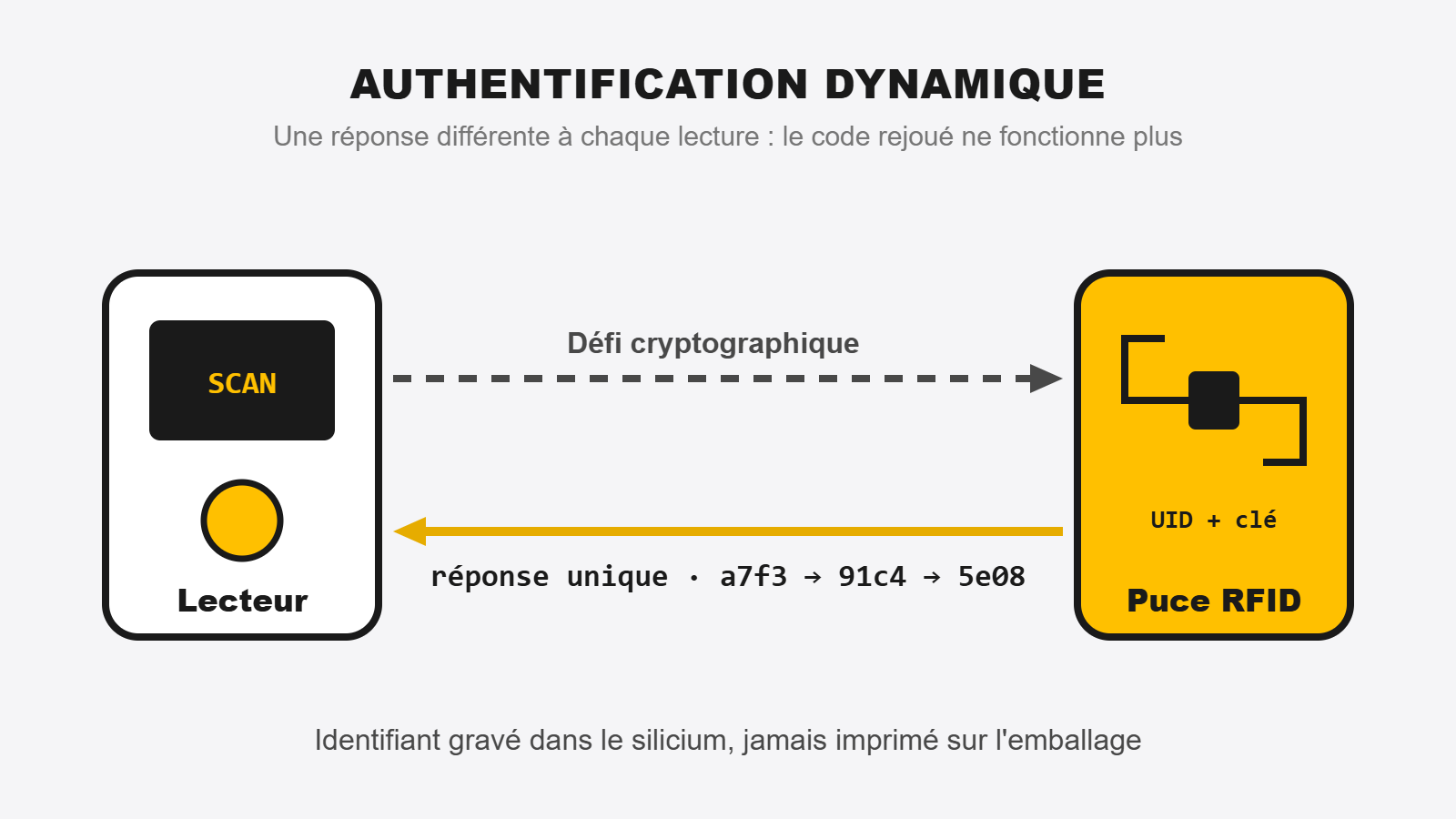
Diagram illustrating RFID security: a unique chip identifier combined with cryptographic authentication that changes at every read, making the tag nearly impossible to counterfeit

RFID makes a product almost impossible to falsify by combining two mechanisms: a unique identifier written into the silicon of the chip, and cryptographic authentication that returns a different response at every read. Neither of these two building blocks can be copied by simple reproduction.

An identifier etched into the chip, not printed on the packaging

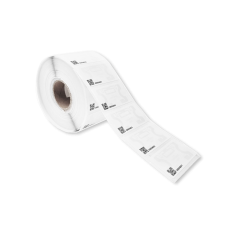
Every RFID chip carries a unique identifier (UID) written during manufacture, in the memory of the component and not on the packaging. Unlike a printed number, this identifier cannot be falsified by altering a graphic. Our UHF RFID labels fitted with Impinj M730 chips illustrate this principle: compliant with ISO 18000-63 (EPC Gen2), they carry an encoded identifier and read at up to 8 to 10 metres, with no contact and no line of sight.

A code that changes with every scan, like a bank card code

The most secure chips go further with dynamic authentication. The principle recalls that of a bank card: at every read, the reader sends a cryptographic challenge to the chip, which returns a different response each time. An intercepted code replayed later no longer works. This is the mechanism chosen by players such as Impinj, whose chips with a cryptographic key let the reader query an authentication database to confirm, or not, that an item is genuine. Copying the data is no longer enough: without the key, the fake gives itself away.

Track your products from the factory to the customer

RFID turns one-off authentication into continuous traceability. Every read, leaving the factory, entering the warehouse, at the point of sale, records the product's passage and builds a time-stamped history that is hard to falsify.

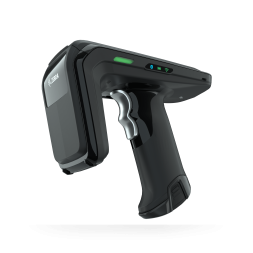
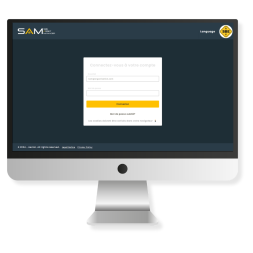
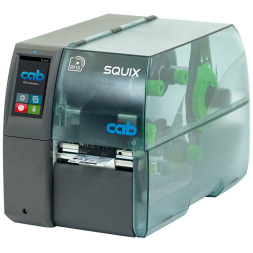
This visibility across the whole supply chain has a direct consequence for the fight against counterfeiting: a product appearing where it should not be, or skipping a logical step, signals an injection of fakes or a leak into a parallel market. A complete RFID system brings together three elements: the label (chip plus antenna), the reader, and the software that puts the data to work. To read tags in volume, fixed or handheld RFID readers take over from the labels, in the warehouse as much as in the shop.

Tamper-proof labels and seals: detecting opening and removal

A tamper-proof RFID label adds physical proof of handling to the digital proof. Designed to destroy itself or cut the signal if anyone tries to peel it off, it makes any attempt at opening or transfer to another product visible.

This is an essential building block against a common fraud: recovering a genuine label to stick it on a fake. A chip destroyed on removal, or a VOID-message adhesive that leaves an irreversible trace, neutralises that attack. Combined with RFID traceability, these security labels cover both the authenticity of the data and the physical integrity of the product. The RFID technology and traceability range and the customisable RFID labels answer these uses, from checkout control to sealing a sensitive parcel.

Beyond authentication: the hidden benefits of RFID

Beyond the fight against counterfeiting, RFID delivers immediate operational gains: faster stocktakes, reduced losses and real-time visibility of inventory. The same label that authenticates a product also serves to count and locate it.

In practice, contactless reading replaces manual counting: a company scans hundreds of items in a few seconds instead of several hours. The benefits stack up: strongly improved inventory accuracy, fewer stock-outs, less shrinkage, and usable product data to steer distribution. This dual usefulness, security and productivity, explains why a single RFID solution pays for itself faster than a purely anti-fraud device. To go further into how it works, our guide Understanding RFID in 10 points details frequencies, ranges and costs.

RFID and the Digital Product Passport: preparing for the 2027 European requirement

RFID prepares companies directly for the Digital Product Passport (DPP), the European requirement that from 2027 imposes a digital identity card on many products. The RFID chip is one of the data carriers authorised to carry that unique identifier.

The logic is clear. The DPP requires a unique identifier that is persistent and readable throughout the life of the product, exactly what a durable RFID label provides. Standard EN 18220:2026 on data carriers indeed recognises RFID alongside the QR code and the DataMatrix. Investing today in an RFID anti-counterfeiting solution therefore builds part of the infrastructure the DPP will require tomorrow. 

Rolling out an RFID anti-counterfeiting solution in 5 steps

Rolling out an RFID anti-counterfeiting solution cannot be improvised: it is a project to scope before buying any hardware. Here is a five-step method to move forward with confidence.

  1. Target the products to protect. Prioritise high-value references, those carrying a health risk, or the most copied ones. There is no need to equip everything at once.
  2. Choose the frequency and the chip. Decide between UHF (bulk reading at a distance), HF and NFC (consumer verification by smartphone) according to your use. Plan for cryptographic authentication on the most sensitive products.
  3. Test performance in real conditions. Validate reading on your materials (metal, liquids) and the persistence of the label in your environment before any mass rollout.
  4. Integrate readers and software. Connect your labels to suitable readers and to a management system able to use the traceability data across the whole chain.
  5. Industrialise and train. Roll out in batches, train teams on verification and monitor the indicators (read rate, anomalies detected) to improve protection continuously.

The order matters: a chip badly chosen at step 2 weakens everything else. Free samples let you validate your choices in real conditions. With more than 30 years in B2B identification and traceability, these are the trade-offs we equip our customers with every day, from the label through to stock tracking.

Updated July 2026.

Protect your products against counterfeiting

UHF and NFC RFID labels, readers and tamper-proof seals. Free samples to validate your choices.

View the RFID range →

Continue reading...
These articles too might interest you.

RFID: Understand the Technology, Choose the Right System and Apply It in Your Business

RFID identifies your assets and people without contact, through packaging or a pocket. From the access badge to the pallet label, a chip and a reader are enough to read hundreds of items per second, where the barcode requires a visual read, one at a time. Discover how it works, its frequencies (LF, HF, UHF), its advantages and limitations, a comparison with NFC and the barcode, and how to choose the right RFID system for your business.
SBE advise you
Melissa Oumaouche
374537 views

Digital Product Passport (DPP): what to expect and how to prepare

The Digital Product Passport (DPP) is becoming a mandatory EU requirement that gives every product a digital identity card composition, origin, durability, recyclability accessible via a QR code, RFID or NFC tag throughout its life cycle. Introduced by the ESPR Regulation (EU) 2024/1781, it rolls out category by category: batteries lead the way on 18 February 2027, followed by textiles, metals and electronics by 2028-2029. Businesses of every size are affected, SMEs included, and the burden of proof sits with the economic operator placing the product on the market.
Product News
Melissa Oumaouche
191 views

RFID and textile labels

The textile and clothing industry produces large quantities and needs to ensure the traceability of large stocks. That’s why companies in this market are adopting RFID (Radio Frequency Identification) to streamline their operations and improve performance. Find out more about the benefits of this technology in this article.

SBE advise you
21591 views

Frequently asked questions

How much does an anti-counterfeiting RFID tag cost?

The price of an RFID tag mainly depends on the frequency, the chip, and the security level. A standard passive UHF tag costs anywhere from a few cents to a few euros per unit, while a cryptographic authentication chip, designed for anti-counterfeiting purposes, sits at a higher price point. Unit cost drops significantly with volume and customization. The right way to think about it isn't the price of the tag alone, but the total system cost (tags, readers, software) relative to the value protected and the losses avoided.

Do you need an app to verify a product's authenticity?

It depends on the technology. An NFC chip can be read directly with a modern smartphone, often without a dedicated app: the consumer simply taps their phone and is taken to the brand's authentication page. A UHF tag, on the other hand, requires a professional reader, making it better suited to bulk verification within the supply chain than to consumer use. Many companies combine both: UHF for internal tracking, NFC for customer interaction.

Is RFID compatible with the Digital Product Passport?

Yes. RFID chips are among the recognized data carriers for holding a Digital Product Passport's unique identifier, alongside QR codes and DataMatrix codes. The European standard EN 18220:2026 governs these carriers and requires them to remain functional throughout the product's entire lifespan, a requirement that a durable RFID tag can meet. Deploying an anti-counterfeiting RFID solution today therefore concretely prepares businesses for the DPP obligation expected to take effect from 2027.

We use cookies to improve your experience.