Hotel Magnetic Key Cards: How They Work and What They Do

Hotel Magnetic Key Cards: How They Work and What They Do

At a hotel front desk, the same action repeats hundreds of times a week: a plastic card is encoded, handed to the guest, then swiped or presented at the room lock. Behind this modest support sits a small information system that governs access security, the comfort of the stay and the way staff are organised. A hotel magnetic key card raises very practical questions for a property manager.

Key takeaways

  • →A key card carries information that lets the lock system check access rights before the door opens.
  • →A magnetic stripe card and an RFID card rely on two different technologies: contact swipe for one, contactless reading for the other.
  • →What a hotel card can do depends directly on the equipment installed in the property.
  • →Compatibility with the locks and the encoder should always be checked before ordering, especially in volume.

What Is a Hotel Magnetic Key Card?

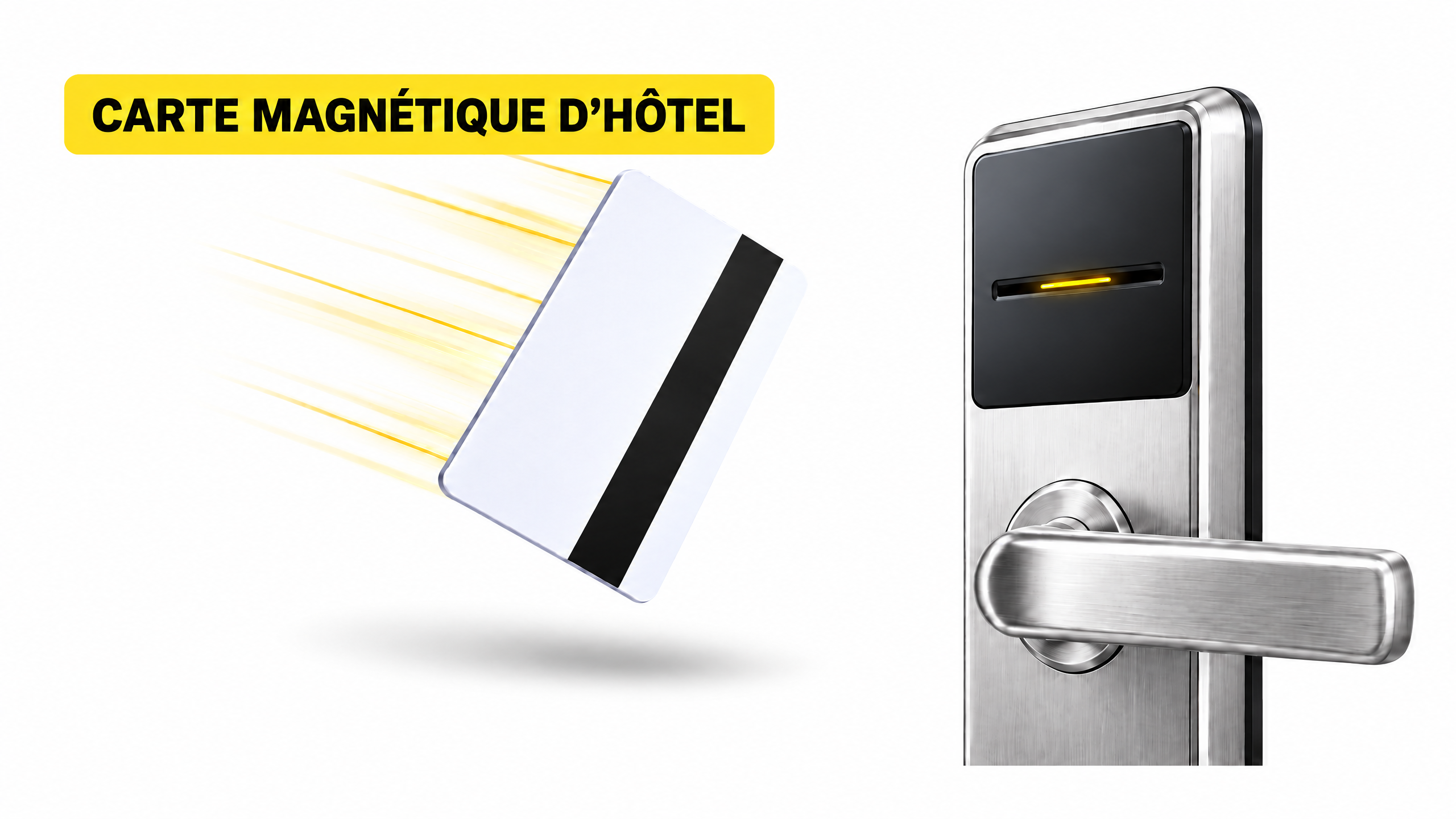
A hotel magnetic key card is a bank-card-sized card that acts as an electronic key to a room. A magnetic stripe, or a chip, stores an access code tied to a room and a length of stay. The lock reads that code, checks the rights granted, then unlocks the door.

The magnetic stripe card is the original version of this electronic key. The dark stripe on the back is a thin layer of magnetic particles on which an encoder writes data. According to ISO/IEC 7810:2019, this support follows the ID-1 format of 85.6 mm by 54 mm with a thickness of 0.76 mm, the exact dimensions of a bank card.

In everyday language, the term magnetic card is often used for every room card, including those that no longer carry a stripe at all. It is a convenient but misleading shortcut. Two families must be told apart from the outset: the magnetic stripe card, which is swiped or inserted into a reader by contact, and the RFID card, which is simply presented to a contactless reader.

This distinction drives everything else: the reading hardware, guest comfort, security and the cost of replacements. Both families exist on the same plastic support, the encodable PVC cards, supplied in magnetic stripe, RFID or barcode versions depending on the hotel's equipment.

The gesture is the same for the guest, the technology underneath is not: the lock decides whether to insert or simply present.

How Does a Hotel Key Card Work?

A hotel key card works in three stages: the front desk encodes the card with the rights for the stay, the lock reads that data and checks the authorisations, then validity expires on the set date. No information opens the door until the lock has recognised a valid access right.

Encoding the Card at the Front Desk

It is the software-plus-encoder pair that makes the key: the card alone opens nothing until it has been written.

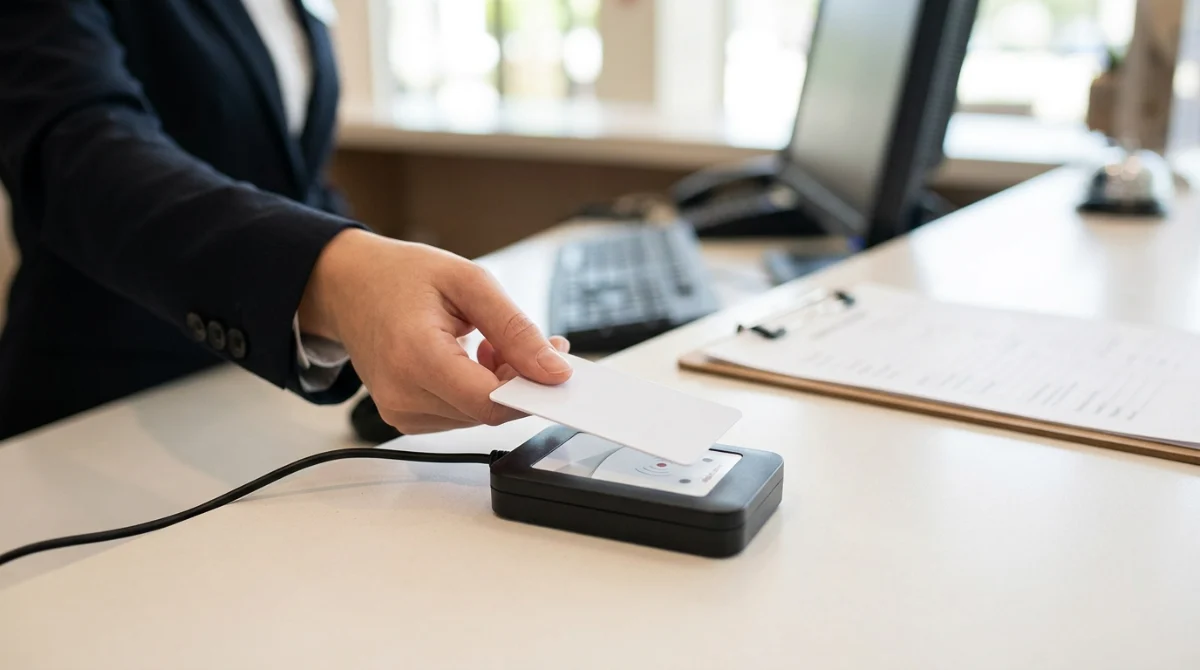
Encoding is the step that turns a blank card into a room key. A property management software drives an encoder: it writes the authorised areas, the assigned room and the validity period, dates and times included, onto the card. It is this software-plus-encoder pair that makes the key, not the card alone.

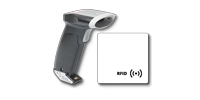
Three separate operations often sit on the same card. Printing the logo and artwork is a graphics task done beforehand. Electronic encoding writes the technical access data. Assigning rights, finally, links the card to a specific stay at check-in. For contactless installations, a contactless RFID reader and encoder reads and writes cards at low frequency 125 kHz and high frequency 13.56 MHz.

How the Lock Reads the Card

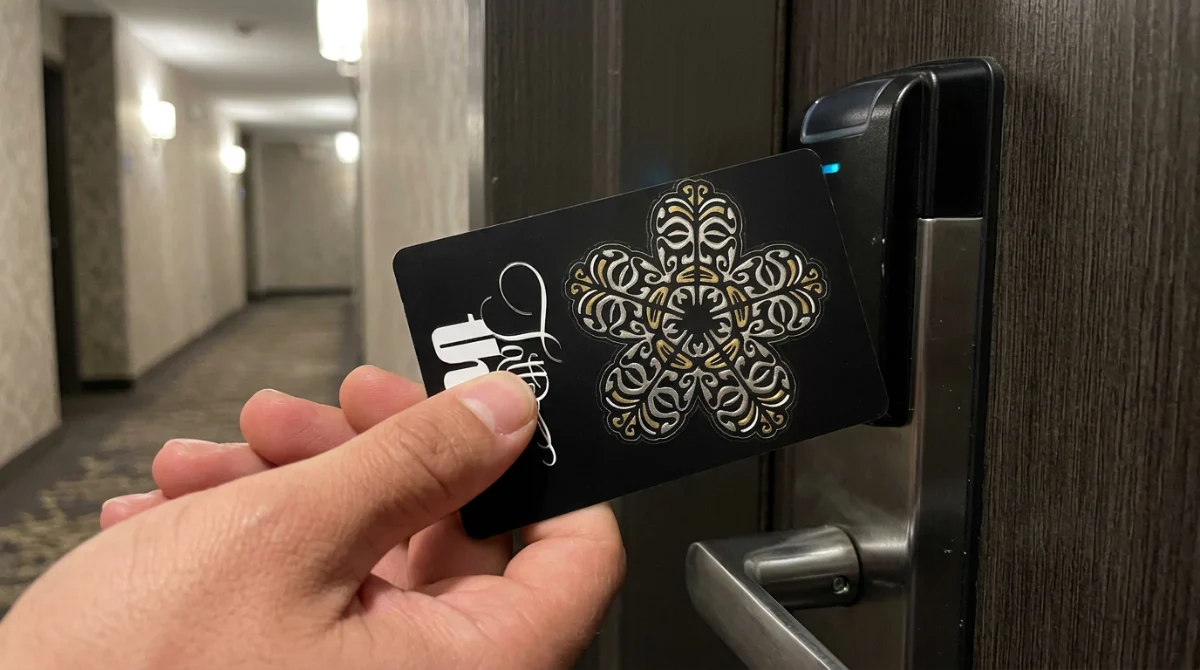
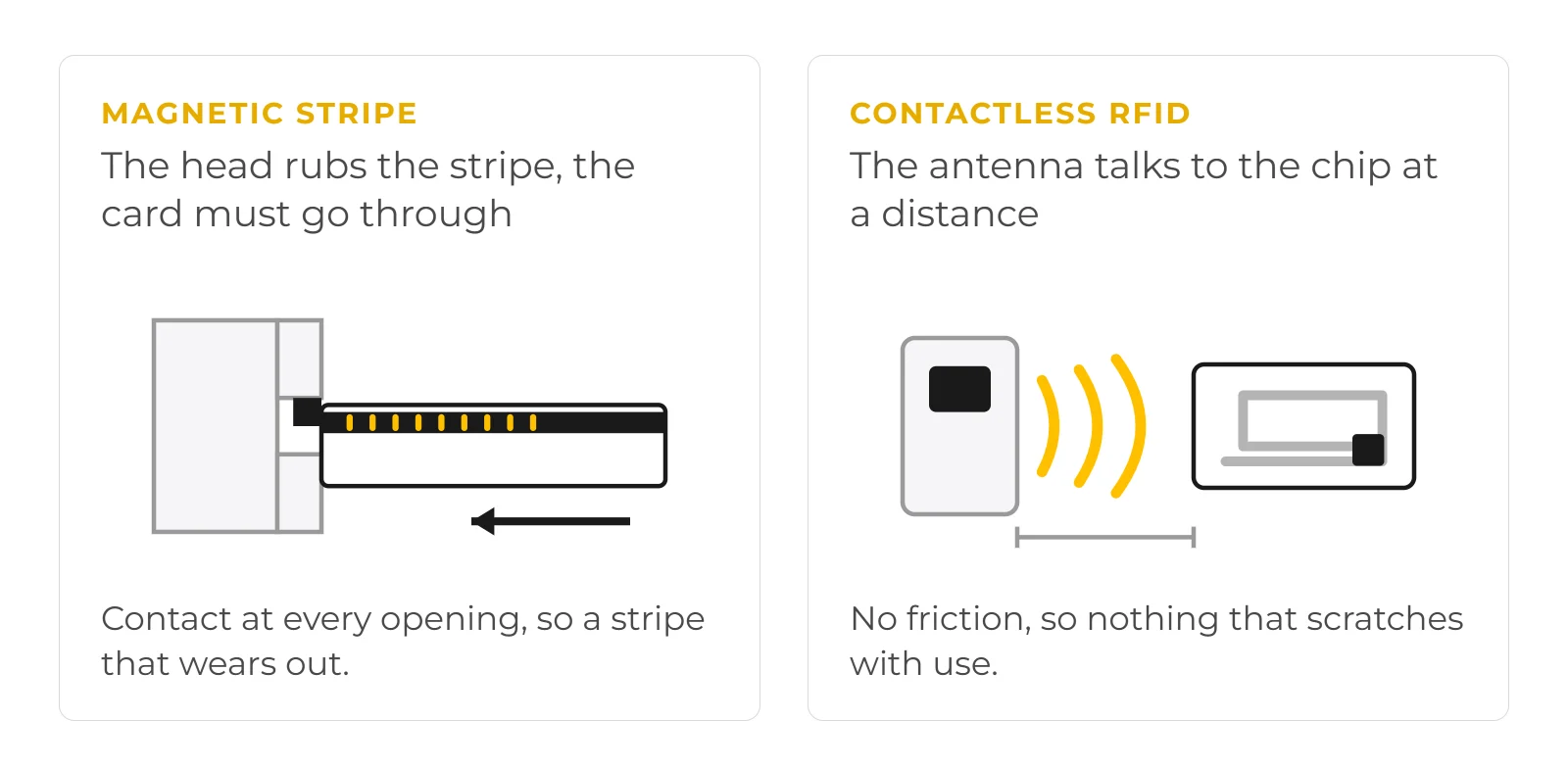
At the moment of opening, the lock reads the card according to its technology. For a magnetic stripe, the read head picks up the data written on the tracks as the card passes through. For an RFID chip, communication is established without contact, by radio frequency, between the chip and the reader's antenna.

The stripe has to rub the head to be read, the chip is read a few centimetres away: everything else follows from that gap.

According to ISO/IEC 7811, a magnetic stripe holds up to three tracks with standardised uses. According to the specifications of the magnetic stripe card reader listed by SBE Direct, reading covers tracks 1 and 2 over a USB interface, in line with the ISO 7810 to 7813 and AAMVA standards. In both cases, the lock does more than read: it compares the code with the stored access right before releasing the mechanism. Hotels equipped for contactless rely on badge readers matched to the frequency of their locks.

Expiry and Reuse After the Stay

A card's validity expires on the dates and times set at encoding. When the guest leaves, the card commands nothing: its code points to a finished stay. Extending a stay means re-encoding the card with a new end date. Reassigning a card to a new guest means encoding it again.

One nuance deserves attention. Remote cancellation of a card depends on the installed system. On a networked installation, the front desk invalidates a card from its workstation. On some standalone installations, where each lock manages its own rights, invalidating a lost card requires direct action at the lock concerned, usually by encoding a new card that cancels the previous one.

What Does a Hotel Card Do Beyond Opening the Room?

A hotel card can open far more than the room. Depending on the rights encoded and the readers installed, it gives access to shared areas, activates room equipment, structures staff access and, sometimes, identifies the guest for certain services. Each use depends on a dedicated reader and an authorisation written on the card.

Access to Authorised Areas and Services

Pool, spa, gym, car park or a lift limited to certain floors: each zone can require a valid card. All it takes is a reader at the entrance to the area and an access right added to the card. A guest on a wellness package opens the spa, a standard-room guest does not. Rights are set guest by guest.

Activating Certain Room Electrics

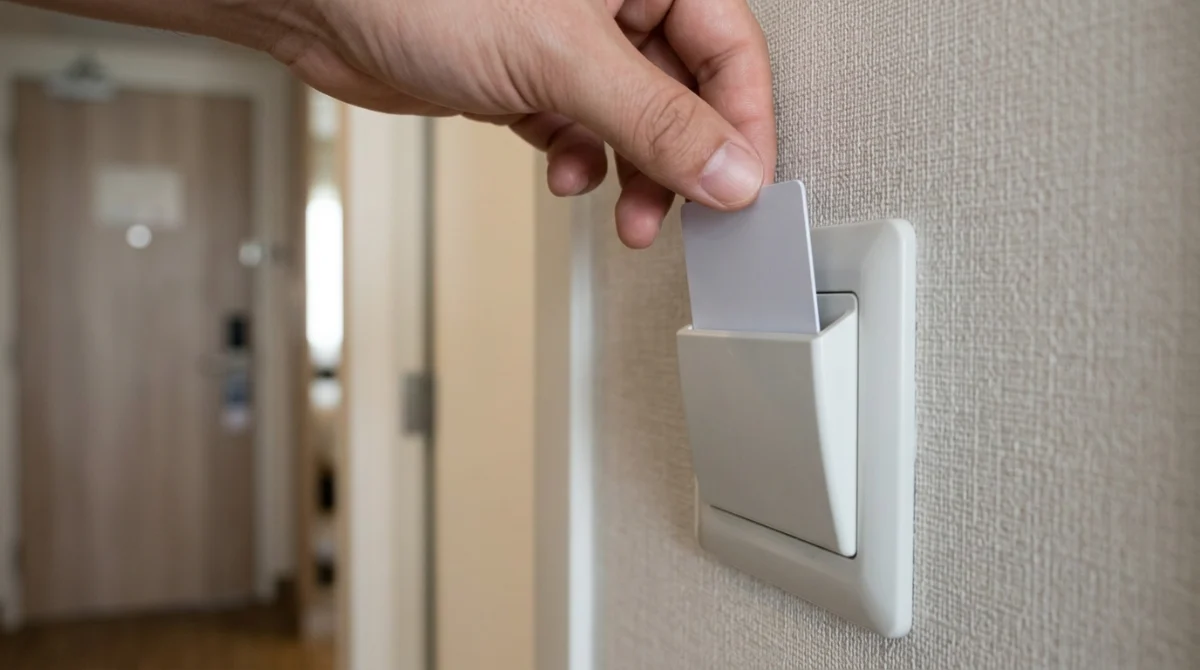
At the entrance to many rooms, a holder takes the card to switch on the electricity. Two principles coexist. The simplest models detect the presence of a card, any card, and cut the power on removal.

More advanced models check the compatibility or the data of the card before powering the room, which stops a guest leaving a random card in the holder to keep the air conditioning on while away.

A simple holder accepts any card, an advanced one checks which: the difference shows on the electricity bill.

Managing Staff Access

The same technology organises internal access. Reception, housekeeping and maintenance receive differentiated rights by zone and by time: a housekeeping card opens the rooms in its sector during the day, a maintenance card opens the technical rooms. These service cards follow the same logic as the business badges used for access control.

Identifying the Guest for Internal Services

Where the hotel system allows it, the card can link a guest to services or to room billing. This function depends on the hotel's software and on the readers installed at service points. Without it, the card keeps its primary role as an access key.

Magnetic or RFID Card: What Differs for a Hotel?

The difference comes down first to the reading method: physical contact with a stripe, or a radio exchange a few centimetres away. That single detail changes day-to-day convenience, wear on the card, the real level of security and the bill over three to five years. Here are the twelve criteria to look at before signing a quote.

Criterion Magnetic stripe card RFID card (contactless)
Reading methodThe card is swiped or inserted into a slot, stripe facing the read head: contact is mandatory.Radio exchange at 13.56 MHz (ISO/IEC 14443, NFC-compatible): the card is read a few centimetres away, without taking it out of a pocket.
Ease of useA precise gesture to repeat at every opening: right way round, right side up, pushed all the way in. A guest in a hurry will try three times in the corridor.No gesture to learn, no orientation to get right: present the card, the door opens. A clear gain for families and guests loaded with luggage.
Wear on the cardThe stripe wears out with repeated insertions: scratches, delamination, grime (sand, sun cream, poolside). Sooner or later the card has to be re-encoded or replaced.No friction. The weak point lies elsewhere: a card that is bent, punched or put through the wash breaks the antenna. Treated properly, it outlasts a stripe.
DemagnetisationThe stripe is wiped by contact with a magnet, a speaker, a magnetic tablet case or a phone. It is the number one failure at the front desk, hence the value of a HiCo stripe (approx. 2,750 Oe) rather than LoCo (approx. 300 Oe).Immune to magnetic fields. The only limits: a metal mass pressed against the card, or a stack of cards that confuses the read. No data is lost.
SecurityData stored in the clear on the stripe (room number, dates). Copying it is within reach of anyone with a reader-encoder costing a few tens of euros. The only real protection: cryptography on the lock side and property-specific keys.Encryption depends on the chip: CRYPTO1 for MIFARE Classic (broken), AES for DESFire EV2/EV3. Beware of installations that do nothing more than read the UID, which can be cloned with an NFC smartphone.
CompatibilityThe de facto standard for forty years: virtually every lock, encoder and PMS accepts it. The safe choice for an older estate.Several chip types (MIFARE Classic 1K/4K, DESFire, NFC): frequency and protocol need checking. A batch of "RFID" cards will not necessarily talk to your locks. Test card + encoder + lock together before ordering.
Total costOne of the cheapest cards on the market (around €0.50 to €1.50 each in volume). Hidden cost: frequent replacements and time spent at reception.A more expensive card (often €2 to €5 depending on the chip). Fewer replacements, fewer maintenance calls: the maths runs over three to five years, not on the unit price of the blank.
Card reuse and recyclingRe-encodable hundreds of times as long as the stripe holds up. At end of life, PVC plus a composite stripe: no common recycling stream, so it goes to general waste.Also re-encodable, with a chip that is virtually indestructible. Recycling is trickier, as the copper or aluminium antenna is embedded in the PVC. Versions in recycled PET, wood or bamboo do exist.
Battery life and maintenanceBattery-powered lock (four AA, one to two years) or mains-powered. Simple electronics, but the read head gets dirty: clean with isopropyl alcohol and keep an eye on the mechanical parts.Higher standby consumption, as the reader polls continuously: batteries to change more often, unless the lock is mains-powered or energy-harvesting. Remote diagnostics and updates are possible.
Handling a lost cardIn standalone mode, the lost card stays valid until it expires or until a cancellation card is presented to the lock. On a networked system, invalidation propagates within minutes.Same logic, but recent systems are more often natively networked: near-instant revocation, an audit trail of entries and key rotation without visiting every door.
Card customisationFour-colour printing, lamination, foiling, numbering. The magnetic stripe takes a band out of the printable area and imposes a reading orientation on the design.The chip is invisible: printing is possible across the whole card. Avoid metallic inks and thick varnishes over the antenna, as they reduce range. Short runs are feasible with a desktop encoder.
Upgrade path to mobile keysA technical dead end: moving to smartphones means changing locks, cards and encoder.A 13.56 MHz lock is already the building block for NFC and Bluetooth. With a compatible model, the same door accepts a card, a phone and a smartwatch: it is the stepping stone to the mobile key.

Key points

  • →RFID is not inherently tamper-proof. ISO/IEC 14443 describes a radio communication, not a level of security. MIFARE Classic's CRYPTO1 has been broken since 2008, and many hotels read nothing more than the card's UID, which can be cloned with an NFC smartphone. DESFire EV2/EV3, with property-specific keys and fast revocation, genuinely changes the picture.
  • →Changing the cards is not enough to go contactless. The lock is what decides the reading method. Without replacing or upgrading the locks and the encoder, your 13.56 MHz cards will have nobody to talk to. Conversely, a HiCo card written badly on an encoder set to LoCo will not open reliably.

How to Choose the Right Cards for Your Hotel?

The right choice always starts from the installation in place. Before ordering, record the exact references of the locks, the encoder and the software, then tell a simple reorder apart from a modernisation project. A test on a few cards comes before any volume order.

Check the Locks, the Encoder and the Software

A card is only as good as its compatibility with the hardware that reads and encodes it. Record the brands and models of the locks, the type of front-desk encoder and the software that drives it. A reorder reuses an already validated support; a modernisation opens the choice of technology. In both cases, order a sample first and test a full cycle, from encoding to opening, before committing to a volume.

Choose a HiCo or LoCo Magnetic Stripe

For a magnetic stripe card, coercivity sets the stripe's resistance to erasure. It is measured in oersteds. A LoCo stripe, of low coercivity, sits around 300 oersteds: easier to encode, more sensitive to stray fields. A HiCo stripe, of high coercivity, sits between 2,750 and 4,000 oersteds: more resistant, better suited to cards reused many times. The choice follows the requirements of the installation and the capabilities of the encoder, which must be able to write on the chosen stripe type.

Assess Durability and Cost Over Time

The price of a card is not judged per unit but over time. Take into account the support, the frequency of reuse, the loss rate, replacements and the upkeep of the readers. An economical blank PVC card suits a high turnover, while a more robust card pays off on repeated use. Price factors depend on the support, the quantity and the personalisation, with no universal rate that fits every property.

Define Your Personalisation Needs

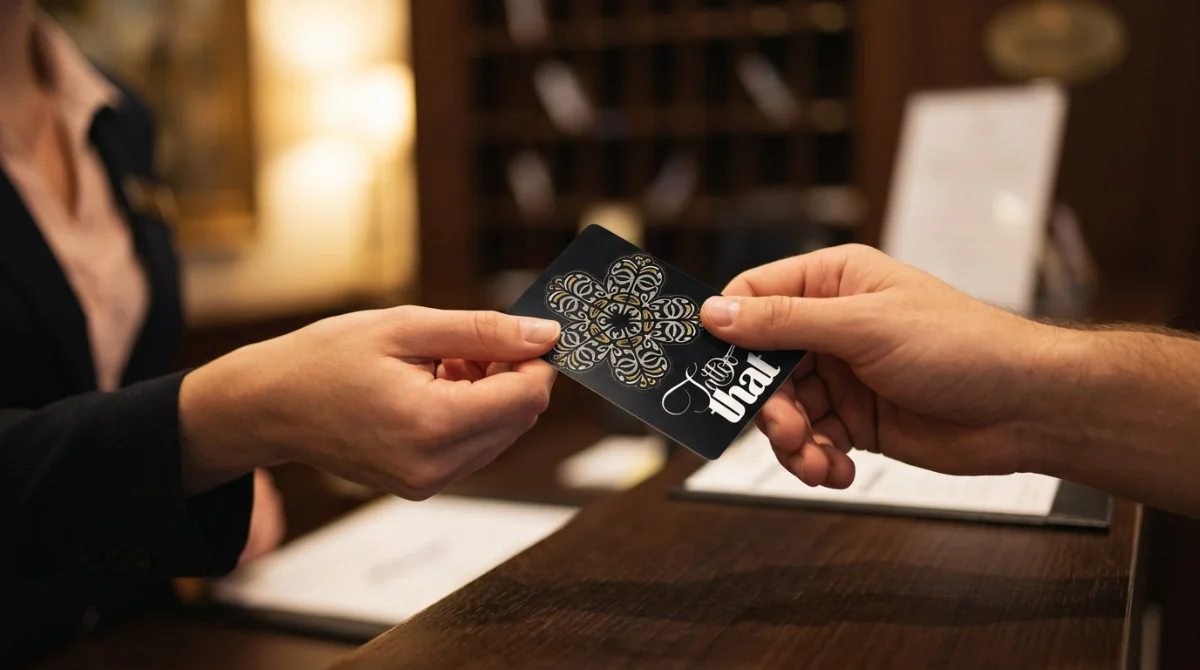
The card is the first object the guest takes away: it carries the property's identity as much as its access right.

The card is also a communication support. Logo, property colours, usage instructions, contact details or a QR code to the hotel's services can appear on it.

A personalised PVC card carries these elements while keeping readability, and a personalised RFID card combines visual identity with contactless. Keep the technical areas, stripe or chip, clear so as not to hinder reading.

Why Has a Hotel Card Stopped Working?

A hotel card stops working for three main reasons: a damaged or demagnetised stripe, expired or wrongly encoded rights, or a problem with the reader and the lock. The card is not always at fault, and a check at the front desk settles it quickly.

A Damaged or Demagnetised Magnetic Stripe

A stripe can be scratched, soiled or lose its data through repeated contact with a magnetic field. Magnetic bag clasps, some magnetic holders or storing the card against another striped card are common causes. The phone, often blamed, is only one factor among several. Storing the card flat, away from magnets, extends its life.

Expired Rights or Unsuitable Encoding

A card can also be physically intact yet hold no valid right. A stay extended without updating the end date, a wrong assignment at encoding or a card of a type incompatible with the lock all produce the same result: the door stays shut. Re-encoding at the front desk resolves most of these cases.

A Reader or Lock Problem

The lock and its reader can also be the cause: a weak battery, a dirty read head, a tired mechanism. Before concluding that the card is dead, a test with a service card rules the hardware in or out. The useful reflex is to direct the guest to the front desk, which diagnoses the issue and issues a valid card if needed.

What Is Next for Hotel Key Cards?

Key cards are evolving on three fronts: materials, software integration and the mobile key. All these paths depend on the property's equipment and spread only at the pace at which locks are renewed.

Supports are changing. Cards in wood or recycled materials are appearing, subject to checking their durability, composition and compatibility with the readers. Integration is also progressing between stay management and card issuing, to cut handling at the front desk. Finally, the mobile key on a smartphone is growing where locks support it, as a complement to the card rather than an immediate replacement. These developments concern the hotel market as a whole and are not a specific SBE Direct offering where they are not confirmed.

Choosing a hotel magnetic key card comes down to aligning three things: the technology of the locks in place, the comfort expected for the guest and the cost of the support over time. A magnetic stripe card protects an existing investment; an RFID card smooths entry and opens multiple uses. In both cases, the rule stays the same: record the hardware references, test a sample, then order in volume. For cards that are compatible, encodable and personalised to your locks, request a free quote and samples from SBE Direct before choosing your hotel magnetic key card.

FAQ on Hotel Magnetic Key Cards

Can a hotel card be reused for several stays?▾

Yes. A compatible card is re-encoded for each new guest: the front desk overwrites the old access data and writes a new stay. This is the very principle of rechargeable cards, which lowers the cost compared with disposable cards. The limit comes from physical wear: a magnetic stripe degrades with insertions, whereas an RFID card, with no mechanical contact, withstands more cycles. In practice, a hotel replaces its cards when reading becomes unreliable or when the artwork is too worn.

What should you do if you lose your room card?▾

Report the loss to the front desk straight away. On a networked installation, the lost card is invalidated and a new card is encoded at once. On a standalone installation, where each lock manages its own rights, staff re-encode a new card that cancels the previous one on its first use at the lock. In both cases, the old card stops opening the room. A spare blank PVC card at the front desk allows a key to be reissued in seconds.

Can a phone demagnetise a hotel card?▾

The risk exists but is often overstated. A magnetic stripe card is erased by prolonged contact with a strong magnetic field, such as a magnetic bag clasp or phone case. The phone alone, placed next to the card, is a minor factor. An RFID card is not affected by demagnetisation, since it holds no stripe. For a magnetic stripe, storing it flat and away from magnets is enough to limit the problem.

Does the card hold the guest's personal or bank details?▾

No, in the vast majority of cases. A hotel key card stores an access code tied to a room and a length of stay, not the guest's identity or bank details. That information stays in the hotel's management software, not on the card. A card found after a stay therefore reveals no sensitive data. Room-billing functions, where they exist, run through the hotel system and not through any bank data stored on the card.

Can you replace a magnetic card with an RFID card without changing the equipment?▾

No. An RFID card requires locks and readers able to communicate without contact, as well as an encoder suited to the chip frequency. Replacing only the cards is not enough: a magnetic stripe lock will not read a contactless chip. Going contactless is a modernisation project covering the locks, the encoder and the cards. The right approach is to record the references of the locks, then test a compatible RFID card before any rollout.

Cards that match your locks?

Send us the references of your locks and your encoder, and we will settle the support and the personalisation with you.

See the PVC cards →
Melissa Oumaouche
See the author's articles
Melissa Oumaouche

With over 5 years of experience in creating content optimized for search engines, Mélissa is currently Marketing & Product Manager at SBE Direct, where she leads the product catalogue positioning across the e-commerce website and marketplaces, as well as the SEO content strategy in coordination with the marketing team she oversees.

We use cookies to improve your experience.