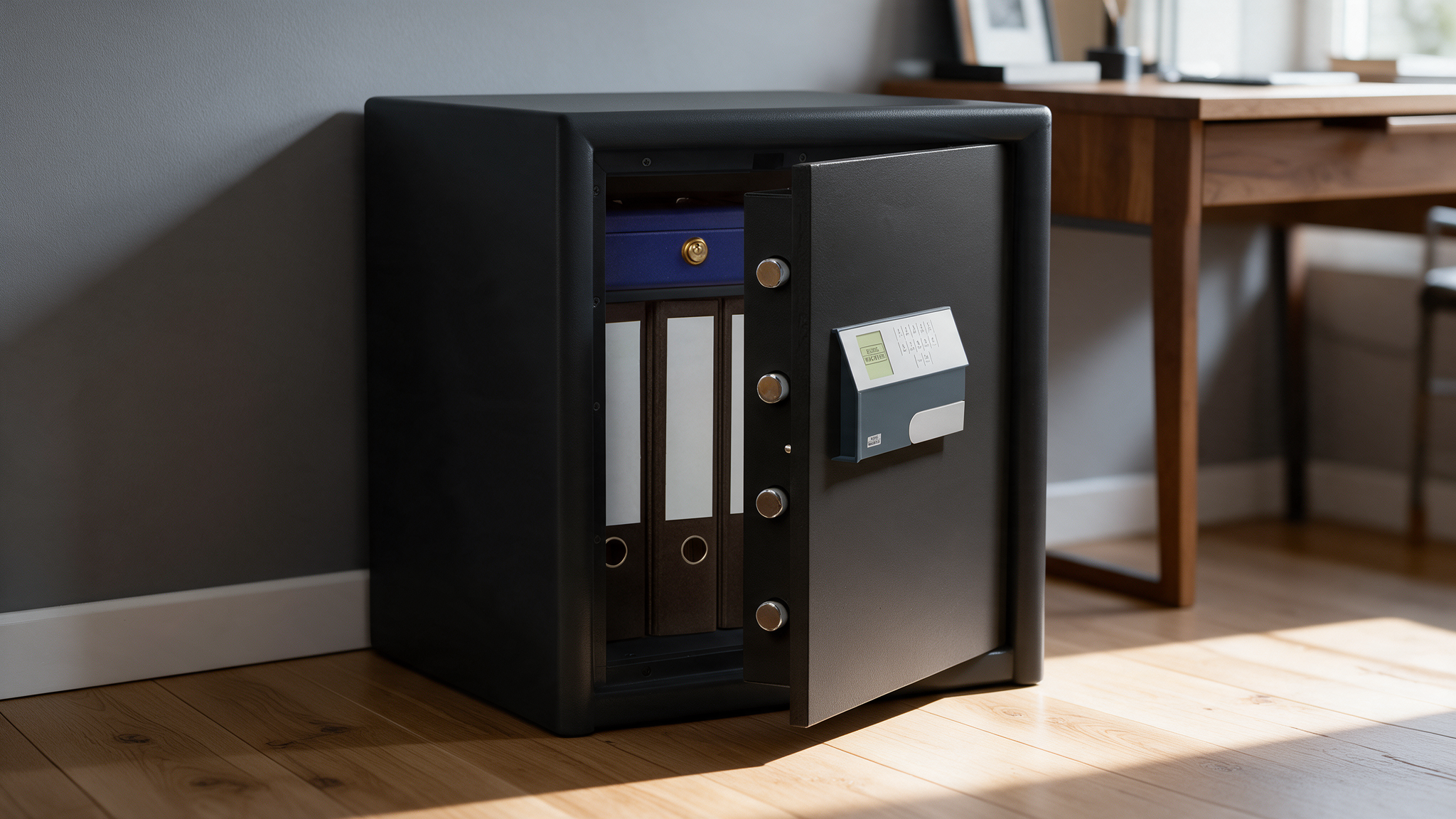
Choosing an A2P safe means choosing a security solution that insurers recognise and that has been laboratory tested. This French certification proves that a safe can resist break-in attempts, a decisive criterion to protect your valuables and to obtain insurance cover. In this guide, we explain what the A2P standard really means, how its resistance grades and stars work, which fire protection to consider, and how to select the model that fits your needs.
What Is an A2P Certified Safe?
A2P certification, short for Assurance Prévention Protection (insurance, prevention, protection), is a French label that guarantees the security level and burglary resistance of a safe. An A2P approved safe passes a series of strict anti-burglary tests before it is approved. The label reassures private users and professionals, and also insurance companies, which use it to set the amounts they will pay after a burglary.
The Role of CNPP in A2P Certification
The A2P label is issued by CNPP (Centre national de prévention et de protection), an independent laboratory created in 1956. The A2P mark has existed since 1984 and is today based on the specific reference document H71, dedicated to safes, strongroom doors, strongrooms and safe locks. CNPP continuously adapts its tests to the new techniques and tools used by burglars, which makes the certification an evolving and reliable reference on the European market.
The European Standard EN 1143-1 and Anti-Burglary Tests
To be A2P certified, a safe must meet the requirements of the European standard EN 1143-1, which covers the burglary resistance of safes, ATMs, strongroom doors and strongrooms. The standard EN 1143-2 covers deposit systems, while the standard EN 1300 classifies high security locks. Each product goes through drilling resistance tests on the armour, plus partial access and full access tests, with precise timing: this resistance time determines the grade that is given.
A2P Safe Versus Standard Safe: What Is the Difference?
A safe without approval can look solid, but it has not passed any independent test. An A2P certified model, on the contrary, guarantees a measured resistance against attacks carried out with a full tool set. The difference is major for insurance: without certification, your insurer can refuse to pay for stolen goods or apply a very low ceiling. An A2P safe is therefore both a security investment and a financial one.
A2P Stars: The Resistance Levels of the Lock
For the locking system, the A2P label uses three star categories, which correspond to how long the lock resists a break-in attempt:
→A2P 1 star: 5 minutes of resistance;
→A2P 2 stars: 10 minutes of resistance;
→A2P 3 stars: 15 minutes of resistance.
These times are measured in unfavourable conditions, where the burglar has all the necessary tools. The lock is therefore one of the elements to consider when you buy a safe, together with its resistance grade. The characteristics of the different locking systems are detailed in our overview of the 4 types of safe lock.
A2P Safe Grades and Insurable Values
The overall resistance level of an insurance approved safe is expressed as a grade, from 0 to 6. Each grade corresponds to an insurable amount, which is indicative and varies between insurance companies.
Grade
Designation
Indicative insurable value
0
A2P CSE
~€8,000
1
A2P 1E
~€25,000
2
A2P 2E
~€35,000
3
A2P 3E
~€55,000
4
A2P 4E
~€110,000
5
A2P 5E
~€200,000
6
A2P 6E
~€300,000
A2P Grade 0 Safe (CSE)
Grade 0, also called A2P CSE, covers basic security solutions for home use. With an insurable value of about €8,000, it is suitable to protect important papers (passport, will, deeds), jewellery of moderate value, cash or collectors' items. It is an affordable option for a limited budget.
A2P Grade 1 Safe
The A2P grade 1 safe offers reinforced protection up to about €25,000. It suits personal use as well as commercial use, to secure jewellery, cash, essential documents and data media. It is often the preferred choice for households with goods of intermediate value.
Grade 2 Safe
The grade 2 safe covers an insurable value of about €35,000. It is intended for private users who own high value items, and also for professionals who want to secure cash before a bank deposit, confidential documents or sensitive equipment.
A2P Grade 3 Safe
The A2P grade 3 safe gives a high level of protection for an insurable amount of up to €55,000. It answers professional needs that require a substantial security level: valuables, sensitive documents, expensive equipment or weapons.
Grade 4, 5 and 6 Safes
The higher grades cover values from €110,000 (grade 4) to €300,000 (grade 6). They are recommended for very sensitive environments: banks, jewellery shops, currency exchange offices, casinos or police stations. These safes protect exceptional goods such as works of art, precious metals, diamonds or highly confidential files.
Equivalence Between A2P Grades and EN 1143-1 Grades
A frequent point of confusion: the French designations (grade, stars) exist together with the European grades of the standard EN 1143-1. On the plate of a certified safe you will find both an "A2P class" mention and an "EN 1143 grade" mention. These two items of information indicate the same performance level, and the equivalence is given in the technical rules of the H71 reference document.
Always check both mentions to confirm the real protection level.
The Advanced Options of the EN 1143-1 Standard
For high risk environments, the EN 1143-1 standard offers additional certification options, which prove resistance to specific attacks.
Option T2: Resistance to Power Tools
The T2 option introduces a higher requirement level with an extended tool list, which includes latest generation power tools that are more powerful and more aggressive. A safe that claims the T2 option shows that it can keep its structural integrity against wider attack scenarios, which reproduce the techniques actually observed in the field. This option is particularly suitable for bank branches and exposed commercial premises.
Options EX, GAS and CD: Explosives, Gas and Core Drilling
Three other options target specific threats:
→Option EX: resistance to solid explosives, which evaluates the capacity to absorb the shock wave;
→Option GAS: resistance to explosive gas attacks, a frequent technique on cash dispensers;
→Option CD: resistance to core drilling, done with diamond core bits and heavy drilling equipment.
These options are mainly relevant for banking sites and environments with high criminal exposure.
A2P Safe and Fire Resistance
Burglary resistance and fire resistance are two separate characteristics. A fire resistant safe protects your content during a fire. The standard EN 1047-1 certifies resistance above 1,000 °C for 60 or 120 minutes, with a thermal shock test and a drop test, while the internal temperature stays below 52 °C. The standard EN 15659 (LFS30P, LFS60P) protects paper documents for 30 or 60 minutes at 170 °C.
When fire protection is one of your criteria, you must therefore check the standard that matches the type of content to protect. The different protection levels are in particular to consider to choose the right fire resistant safe. To combine burglary resistance and fire protection, a model such as the Combiline small fire resistant safe is a suitable solution for certain needs.
How Do You Choose Your A2P Safe?
The choice of a safe is based on several criteria: the value of the goods to protect, the resistance level you need, the locking system, the dimensions and the installation type. Together, these parameters let you select a model that really matches the planned use. The safe range brings together different solutions according to the security levels and configurations you need.
Estimate the Value of the Goods to Protect
First step: estimate the total value of the items to secure. This estimate determines the correct A2P grade, because each grade corresponds to an insurable ceiling. An oversized safe is an unnecessary extra cost, while an undersized model puts your compensation at risk.
Several locking systems exist: key lock, mechanical combination (no battery, changeable code), electronic lock (the most common) or biometric fingerprint lock. Each solution has its advantages. A mechanical combination removes any risk of a lost key; it can suit users who want a system that needs no electrical power. The specific features of this operation are to consider when you plan to open a mechanical combination safe.
Dimensions, Volume and Fixing Type
Choose the volume in litres according to the items to store: small models for documents and jewellery, up to large safes for bulky items. Also plan the fixing type (to the floor, to the wall or both). For usual domestic needs and when the available space is limited, small safes keep the footprint small while they give you a secure space.
Free Standing, Built-In or Wall Safe
According to the H71 reference document, a free standing safe gets its resistance only from its original construction. A built-in safe (in the floor or in the wall) gets part of its protection from the materials added during installation. This choice has a direct effect on the installation method.
A2P Safe and Home Insurance
The insurable amounts given for each grade are indicative and vary between insurers. Before any purchase, check with your company the exact nature of the theft cover offered.
In many contracts, A2P certification is a condition for compensation: without an approved safe, payment for your valuables can be refused.
Installation and Fixing of an A2P Safe
A safe keeps its certified security level only if it is correctly installed. The fixing must be done in accordance with the installation instructions, which are checked during certification. A careless installation makes it easier to tear the safe out. For heavy or built-in models, use a professional to guarantee an optimal installation.
How to Identify a Genuinely A2P Certified Safe
A genuinely certified safe has a metal A2P identification plate, riveted on the inner face of the door, which gives the licence holder, the A2P class, the EN 1143 grade and the year of manufacture. An information label can come with the product.
The right to use the A2P mark is granted for a renewable period of 4 years: this guarantees regular control by CNPP.
Conclusion
To choose an A2P safe correctly, four criteria are essential: the resistance grade that matches the value of your goods, the number of stars on the lock, the fire protection you may need and compliance with your insurance requirements. A2P certification, issued by CNPP, remains the key reference to guarantee effective protection against break-ins. For a choice that fits your situation exactly, ask a professional for support.
FAQ
Which A2P safe grade for a private user?▾
For home use, a grade 0 (CSE) or a grade 1 is generally sufficient, and covers values from €8,000 to €25,000. The choice depends on the value of your jewellery, cash and documents.
How long does an A2P safe resist?▾
For the lock, resistance goes from 5 minutes (1 star) to 15 minutes (3 stars). Overall, the higher the grade, the longer the burglary resistance time.
Is an A2P safe mandatory to be insured?▾
It is not a legal obligation, but many insurers require one to cover valuables. The certification often determines the amount paid after a theft.
Where can you buy an A2P certified safe?▾
Choose specialist resellers that offer recognised brands and real expertise. At SBE Direct, you will find certified safes in several grades and personalised support.
Which A2P grade for your valuables?
Compare our safes by grade, lock and fire protection.