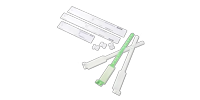
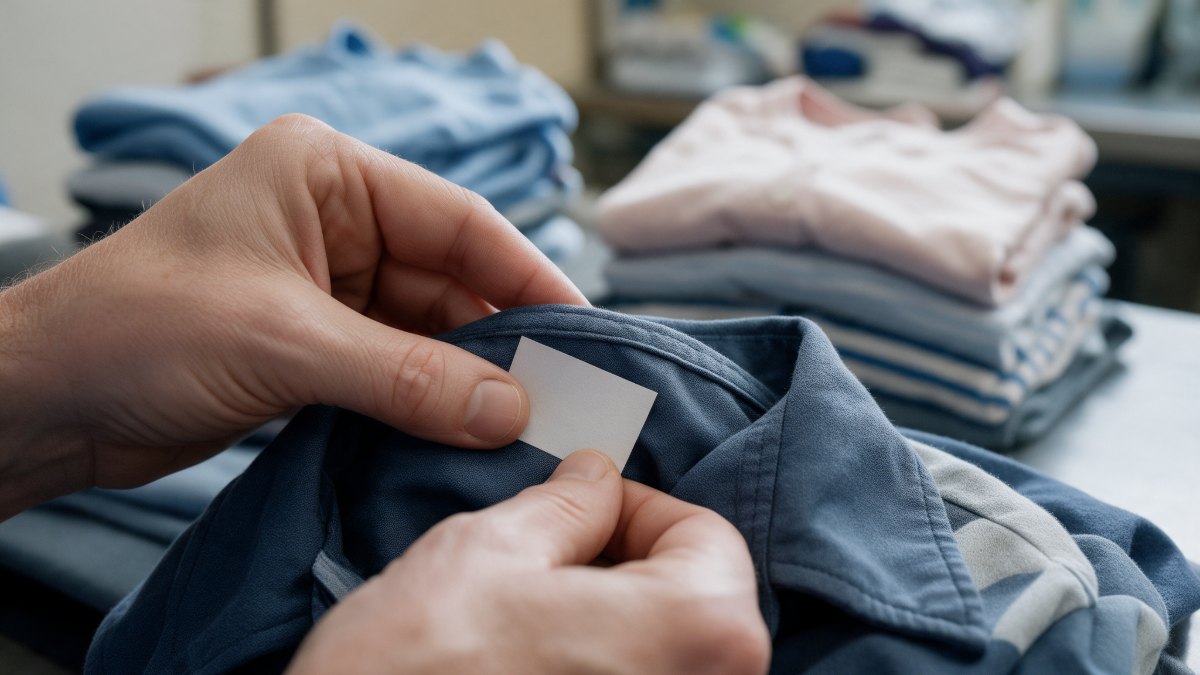
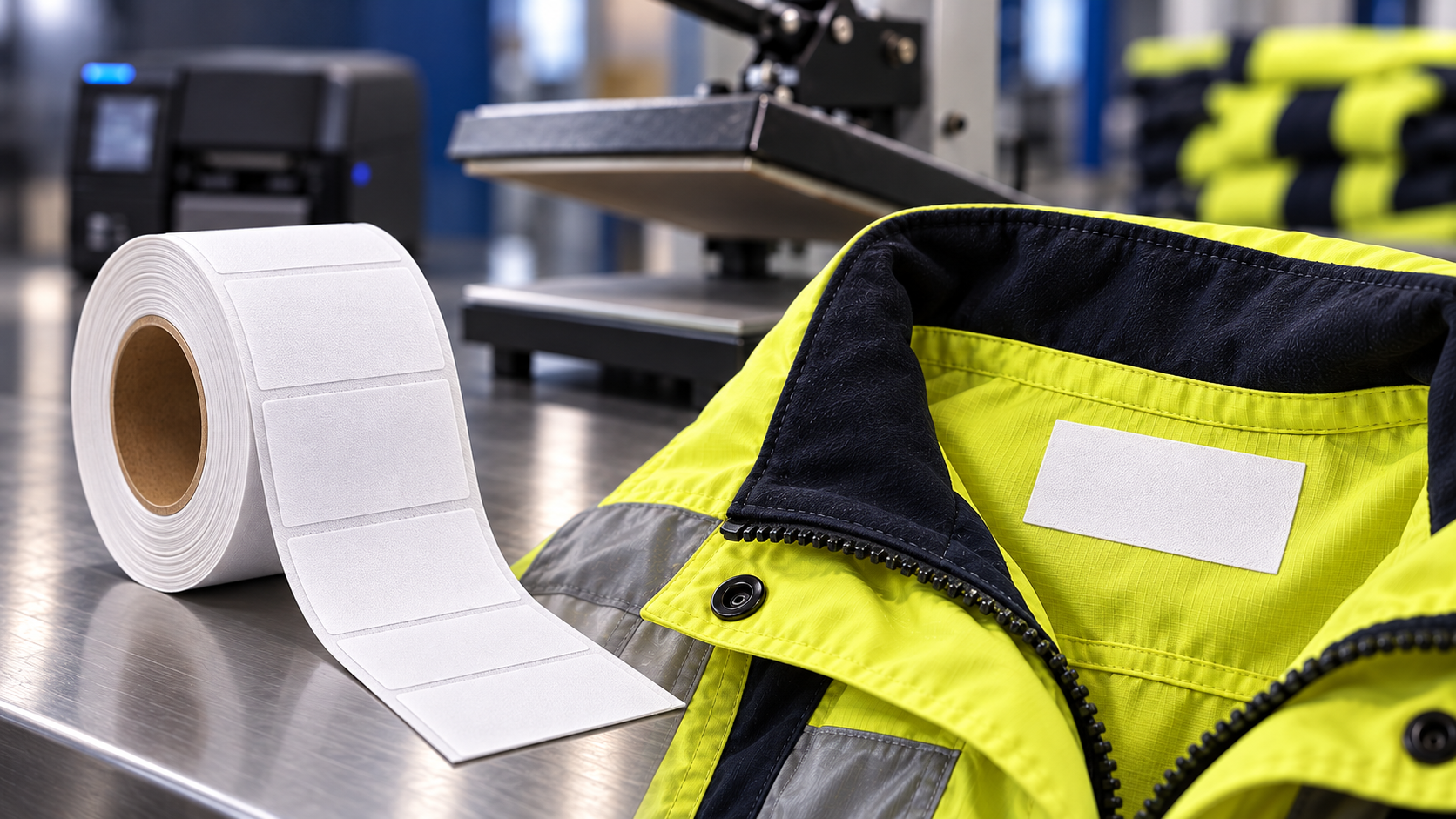
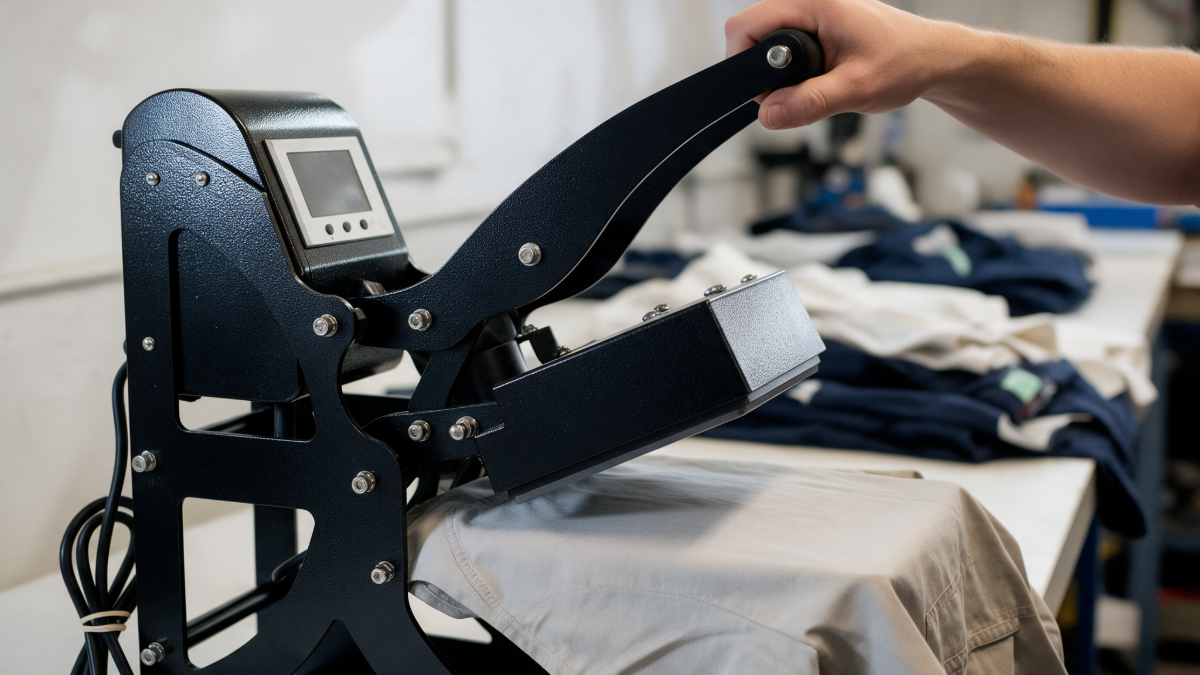
For durable marking, choose an iron-on label suited to your textiles and your laundry conditions. Fixed with an iron or a heat press, it withstands repeated washing according to the product specifications. At SBE Direct, some self-adhesive and iron-on labels for workwear withstand washing up to 90 °C. For fast or temporary marking, the self-adhesive version goes on in seconds, without an iron, on the surface indicated by the manufacturer.
Your choice rests on three criteria: the volume of garments to mark, the washing temperature, and the expected lifespan. This guide helps you decide according to your activity, from care homes to nurseries and industrial laundries.
Key takeaways
→Iron-on label: applied with an iron or a heat press, it suits durable marking on compatible textiles. Its wash resistance depends on the reference you choose.
→Self-adhesive label: applied in seconds without an iron, on the care label, it suits temporary marking and non-ironable textiles, with resistance limited to 40-60 °C.
→Regulations: in French care homes (EHPAD), marking residents' personal laundry has been mandatory since 1 January 2023 (decree no. 2022-734).
→Hybrid option: the SBE Direct self-adhesive and iron-on label combines instant application with permanent bonding, rated for washing at 90 °C.
Self-Adhesive vs Iron-On: The Comparison
Criterion
Iron-on label
Self-adhesive label
Fixing method
Heat + pressure (iron or heat press)
Simple finger pressure
Surface
Directly onto the fabric
Onto the brand or care label
Application time
10 to 20 seconds
2 to 3 seconds
Machine wash resistance
Depending on the reference: up to 90 °C
Moderate: 40 to 60 °C depending on the product
Tumble dryer / calender
Yes
Variable
Lifespan
That of the garment
A few weeks to a few months
Removal
Difficult (can be covered over)
Easy
Non-ironable textiles
No
Yes (padded jackets, synthetics, wool)
Ideal use
Care homes, uniforms, hotel linen
Temporary marking, events, quick fixes
A third option exists: the sew-on label. It is the most resistant to extreme treatments (washing above 60 °C, autoclave, dry cleaning), but also the slowest to apply.
→Application by simple pressure for immediate marking
→Heat fixing with an iron or a press for permanent marking
→Maximum resistance: washing at 90 °C, drying at 185 °C, ironing at 230 °C, calender pass
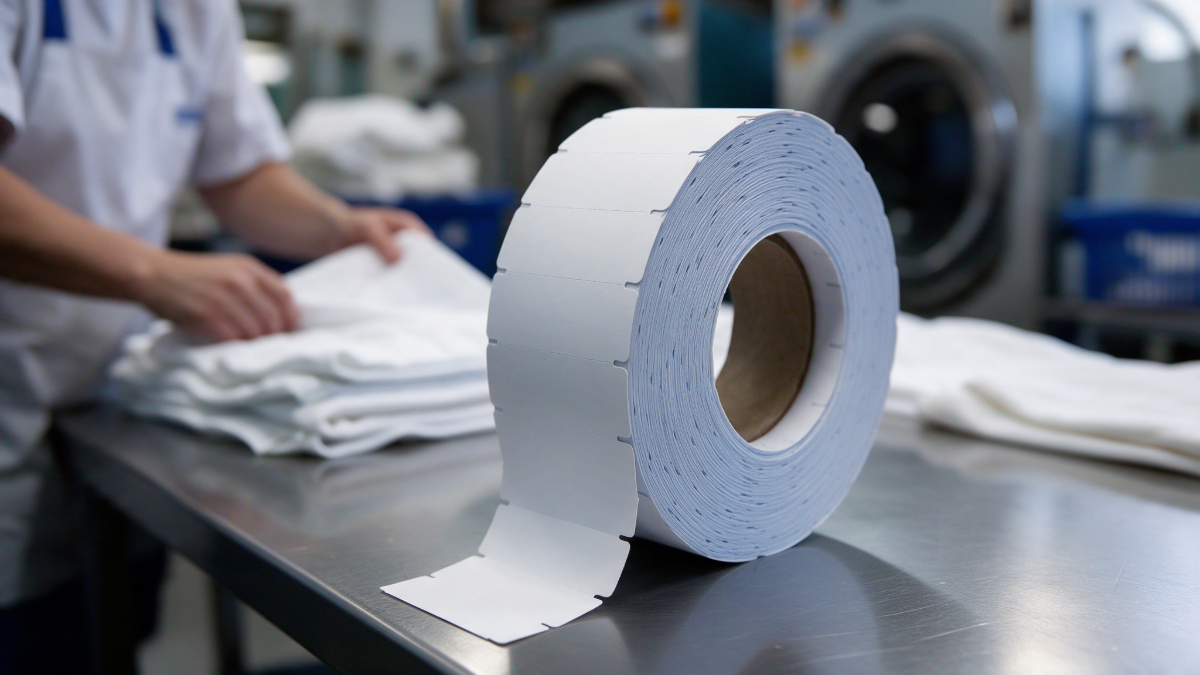
→4 sizes: from 41 × 14 mm (3,000 labels per roll) to 84 × 36 mm (1,315 labels), blank, printed in 1 colour or in four-colour process.
A single product therefore covers both emergency marking and durable marking.
How Do Iron-On and Self-Adhesive Labels Work?
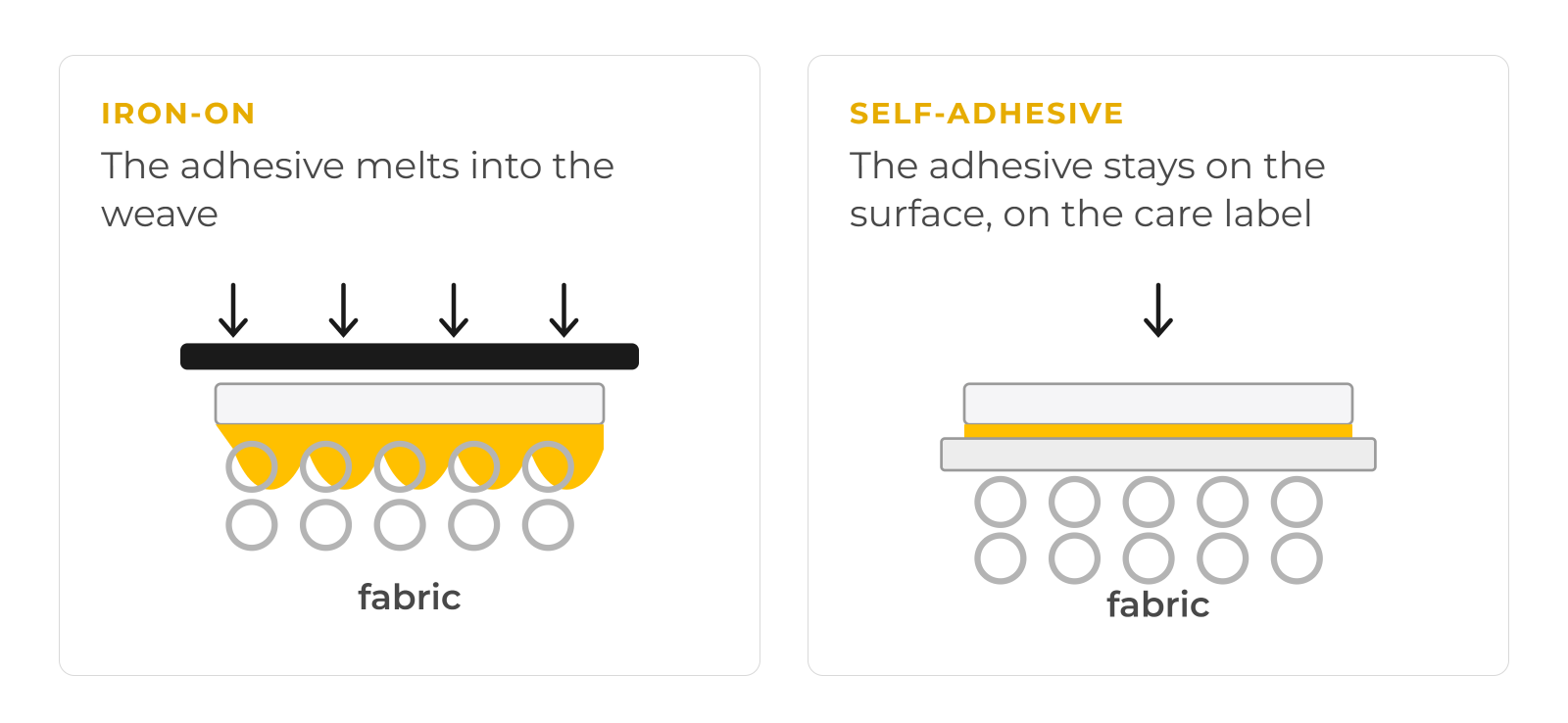
The iron-on label carries a hot-melt adhesive on its back. Under heat and pressure, this adhesive melts and penetrates the weave of the fabric. As it cools, it becomes one with the fibres. A successful application shows as a slight transparency of the fabric under the label.
The self-adhesive label uses a pressure-sensitive adhesive, like a conventional sticker. On raw fabric, these adhesives bond poorly to the knit. Self-adhesive clothing labels are therefore applied to the care label, a smooth polyester or satin surface. Some models fold back on themselves and stick to each other around the label, like a plaster.
Iron-On Labels: When Are They Essential?
Do They Really Hold Up in an Industrial Laundry?
Yes, provided you choose a product designed for that use. Consumer iron-on labels, intended for children's clothing, are generally rated up to 60 °C. In collective settings, laundry goes through high-temperature machine washing, tunnel drying and calendering. Our iron-on labels for garments are built for these intensive cycles.
Can They Be Applied to Every Textile?
No. They suit textiles that tolerate ironing: cotton, polyester, polycotton, most workwear. Avoid water-repellent materials, silk, fine synthetics and heat-sensitive wools. For those garments, prefer the self-adhesive label or the sew-on label.
What If the Garment Changes Owner?
A properly applied iron-on label is almost impossible to remove cleanly. You simply apply a new label over the old one. This is common practice when reassigning a uniform to a new employee, or when passing children's clothing on.
Self-Adhesive Labels: When Are They Enough?
Do They Survive the Washing Machine?
Yes, if applied to a clean, dry and smooth surface, and if you wait 24 hours before the first wash. Their hold remains below that of an iron-on label, especially above 40 °C or with intensive drying. They are therefore not suited to an industrial laundry flow.
When Are They the Right Choice?
→Temporary marking: seminars, events, group holidays, one-off loans of uniforms
→Emergencies: items arriving unmarked on the day of admission or the first day of school
→No equipment: no iron or press on site
Spare self-adhesive labels can also mark objects: bottles, boxes, lockers, accessories. For professional assets exposed to impact or chemicals, prefer heavy duty asset tags.
What Is Their Weak Point?
They depend on the care label. If that label has been cut off, which is common on children's clothing because it scratches, the self-adhesive label has no surface left to bond to.
Which Label Should You Choose for Your Sector?
Care Homes and Retirement Homes
Since 1 January 2023, marking and laundering residents' personal clothing form part of the minimum service package in French care homes (decree no. 2022-734 of 28 April 2022). Garments go through the laundry every week and often look alike from one resident to the next. Our advice: the iron-on label, ideally printed in-house with the resident's first name and surname on admission. Keep the sew-on label for delicate textiles (compression stockings, tights).
Hospitals, Clinics and Laundries
High-temperature washing, disinfection, calendering: only high-resistance iron-on labels or sew-on labels last over time. Add a barcode to track every item through the laundry circuit.
Hotels, Catering and Corporate Uniforms
To assign a uniform to each employee, the large-format iron-on label with a logo is the obvious choice. It shows name, department, size and brand identity. The butterfly format folds over an edge (collar, hem, sleeve) and stays legible on both sides, which helps sorting in the linen room.
Nurseries, Schools, Holiday Centres and Local Authorities
For the establishment's own linen (nap sheets, bibs, towels), the iron-on label is the most durable. For each child's belongings brought in by families, the self-adhesive label puts a first name on in seconds. In a nursery, a pictogram on the label helps children who cannot yet read recognise their clothes.
Industry and Construction
Workwear is washed often, sometimes at high temperature. Choose the iron-on label for cotton or polycotton garments. For technical or treated PPE (high-visibility, water-repellent), check heat tolerance first, or you risk damaging the retroreflective bands. Safety footwear is better marked with a sticker or a dedicated label on the insole.
Printing In-House or Ordering Custom Labels?
Fewer than a few hundred items per year: order pre-printed custom labels (logo, text, barcode). No equipment investment.
Continuous flow of named laundry: print your labels in-house to produce the required information on demand. Choose your consumables according to the fixing method: sewing or heat bonding.
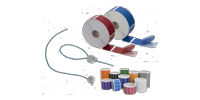
→15 rolls of non-adhesive nylon textile labels, intended for thermal transfer (TTh) printing and then sewing
→A USB cable, a CD with the Cablabel S3 software and a user manual
Thermal transfer here refers to the printing technique: the labels supplied are sew-on, not heat-bonded. You will also find rolls of sew-on textile labels sold separately.
To print iron-on labels, have the compatibility of the printer and the ribbon with your chosen material confirmed. Also plan for suitable application equipment, such as a heat press, which is not included in this kit.
Customisation Options and Label Design
An effective textile label is legible in one second by the laundry operator, the carer or the child. Here are the options to settle before ordering or printing.
Choosing the Size and Shape
→Small size (41 × 14 mm): first name and surname of the resident or child, ideal on collars and small garments.
→Large size (84 × 23 mm or 84 × 36 mm): logo, size and barcode, for staff uniforms.
→Butterfly format: folded over an edge, it shows information on both sides.
Using Colour
Colours are not only decorative. A colour code speeds up sorting: one shade per floor, per department or per linen type (resident, staff, flat linen). The coloured iron-on label allows this visual sorting without even reading the text. For printing, you have three options:
→No printing: blank labels for you to print yourself
→1 colour: simple text and logo, the most economical choice
→Four-colour process: logo in true colours, to showcase your employer or hotel brand.
Customising the Content
Depending on your use, you can customise:
→First name and surname of the wearer
→Room, locker or payroll number
→Logo of the establishment
→Garment size
→Barcode or QR code for laundry traceability
→Pictogram for children who cannot yet read.
Our Design Rules for Maximum Legibility
→Strong contrast: black text on a white or light background, no pale colour on a coloured background.
→Simple sans serif typeface, in bold, never below 6 points.
→One priority piece of information: the first name or the number must stand out, the rest is secondary.
→Safety margin of 1 to 2 mm around the text, so nothing is lost when cutting.
→Barcode tested before the production run: scan a first sample after a machine wash.
How to Apply an Iron-On Label Correctly
With an Iron (Small Volumes)
→Wash the garment first, without fabric softener, then let it dry completely.
→Lay it flat on a hard, crease-free surface.
→Place the label printed side up, inside the garment, in an area with little friction.
→Cover it with a sheet of baking paper.
→Set the iron to the cotton setting, without steam.
→Press firmly for 15 to 20 seconds, without sliding the iron.
→Remove the paper, let it cool, then test a corner: if it lifts, press again for 10 seconds with the paper.
→Wait 24 to 48 hours before the first machine wash.
With a Heat Press (Professional Use)
An iron quickly reaches its limits at volume: uneven temperature, variable pressure, operator fatigue. A heat press guarantees an identical application on every item. Allow 170 to 200 °C for 10 to 15 seconds under firm pressure as a general rule. Always follow the product data sheet and the heat tolerance of the textile. To go further: everything you need to know about the textile heat press.
Equip Yourself With SBE Direct
Since 1992, SBE Direct has supported more than 16,000 companies, large accounts and public bodies in identifying their assets. For your textile labels:
→Free samples to test the hold on your own textiles before deciding
→Volume discounts of up to 70% depending on quantities
→Custom labels: logo, text, barcode, 1 colour or four-colour process
→Fast delivery with dispatch within 24/48 h, and a free quotation.
FAQ
What is the difference between a self-adhesive and an iron-on label?
The iron-on label is fixed with an iron, directly into the fabric, and lasts as long as the garment. The self-adhesive label bonds cold onto the care label. It is faster to apply, but less resistant to washing.
Which label lasts longest in the wash?
The iron-on label, and the sew-on label even more so. Professional iron-on labels withstand machine washing sometimes up to 90 °C, tumble drying and calendering.
Which label should you choose for children's clothing?
The iron-on label for frequently washed garments, especially if the care label has been cut off. Self-adhesive labels suit quick first-name marking or non-ironable textiles. In nurseries and schools, the iron-on label remains the benchmark.
Do self-adhesive labels stick directly to fabric?
Not durably. They bond to a smooth surface, such as the brand or care label. On knits or raw cotton, they come off at the first wash.
Can an iron-on label be used on a synthetic garment?
Yes on polyester and polycotton, which tolerate ironing. No on water-repellent fabrics, fine synthetics or any textile whose care label forbids ironing.
How long should you wait before washing the garment?
24 hours for a self-adhesive label, 24 to 48 hours for an iron-on label, the time the adhesive needs to stabilise.
Is laundry marking mandatory in French care homes?
Yes. Since 1 January 2023, marking and laundering residents' personal clothing form part of the minimum service package, for contracts signed from that date.
Mark your laundry with the right label
Free samples, a quote within 24 hours and fast dispatch.
With over 5 years of experience in creating content optimized for search engines, Mélissa is currently Marketing & Product Manager at SBE Direct, where she leads the product catalogue positioning across the e-commerce website and marketplaces, as well as the SEO content strategy in coordination with the marketing team she oversees.