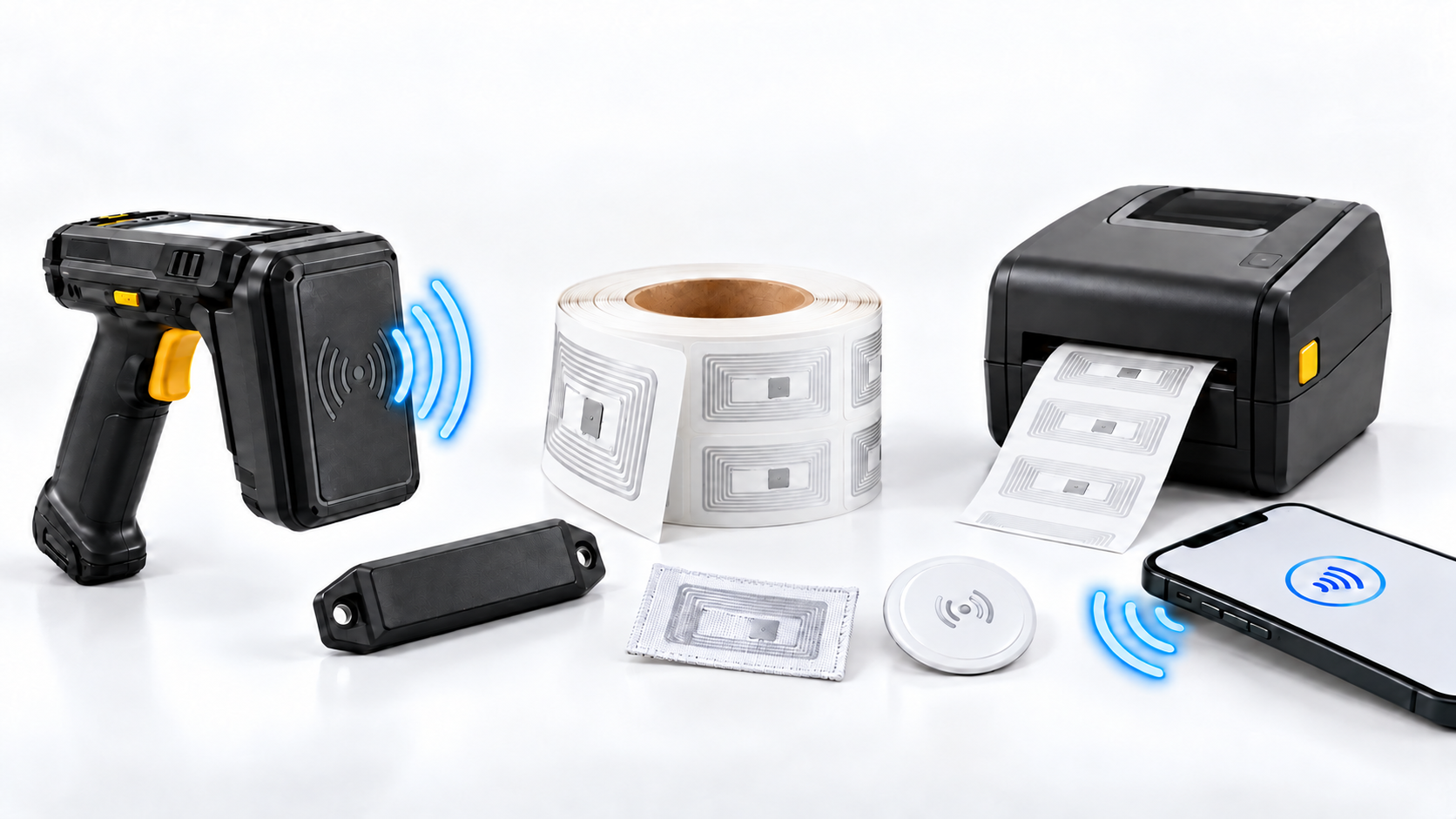
The choice of RFID tag depends first on your real use case: inventory, equipment tracking, linen traceability or smartphone lookups. The criteria that genuinely matter (HF, NFC or UHF technology, mounting surface, encoding, compatibility) and a method to validate your choice before ordering point to the right family, along with the matching SBE Direct solutions.
Choosing an RFID tag is not just about comparing unit prices. A tag that is wrong for its surface or its environment reads poorly, peels off or returns unusable data, and the project fails in the field. Do you need HF, NFC or UHF? Which tag holds on metal, survives laundry cycles or reads at several metres? Blank or already encoded? The answers, criterion by criterion, secure your choice before ordering and help you make the most of your RFID technology and traceability.
What is an RFID tag and how does it work?
An RFID tag combines a chip and an antenna. The chip stores an identifier, and sometimes data; the antenna exchanges that information with a reader via radio waves, with no contact and no direct line of sight.
It identifies, locates and tracks an object at a distance, from a few centimetres to several metres depending on the technology.
A chip and an antenna to identify an object remotely
The chip holds a unique identifier (UID or EPC code) and a memory area of varying size. The antenna captures the radio field emitted by the reader, powers the chip in the passive case, then returns the data. No battery is required for the vast majority of business identification uses.
Tag, inlay and RFID label: what are the differences?
The inlay is the chip and antenna placed on a thin film, in raw form. The tag is the generic term for the RFID device. The RFID label is an inlay integrated into a printable, adhesive carrier, ready to apply and personalise. For industrial use, a rigid tag is used when the carrier must withstand demanding conditions.
Passive, active or battery-assisted tags
→Passive: no battery, powered by the reader. It is the most common, the cheapest, and suited to identification and inventory.
→Active: fitted with its own battery, it transmits over long distances and suits the real-time tracking of containers or large assets. Its cost is significantly higher.
→Battery-assisted (semi-passive): a battery powers the chip but not the transmission, to improve read reliability in harsh environments.
Passive UHF tags dominate logistics volumes, with a unit cost often between 0.05 and 0.50 euro depending on format and quantity.
Which use case do you want to cover with your RFID tags?
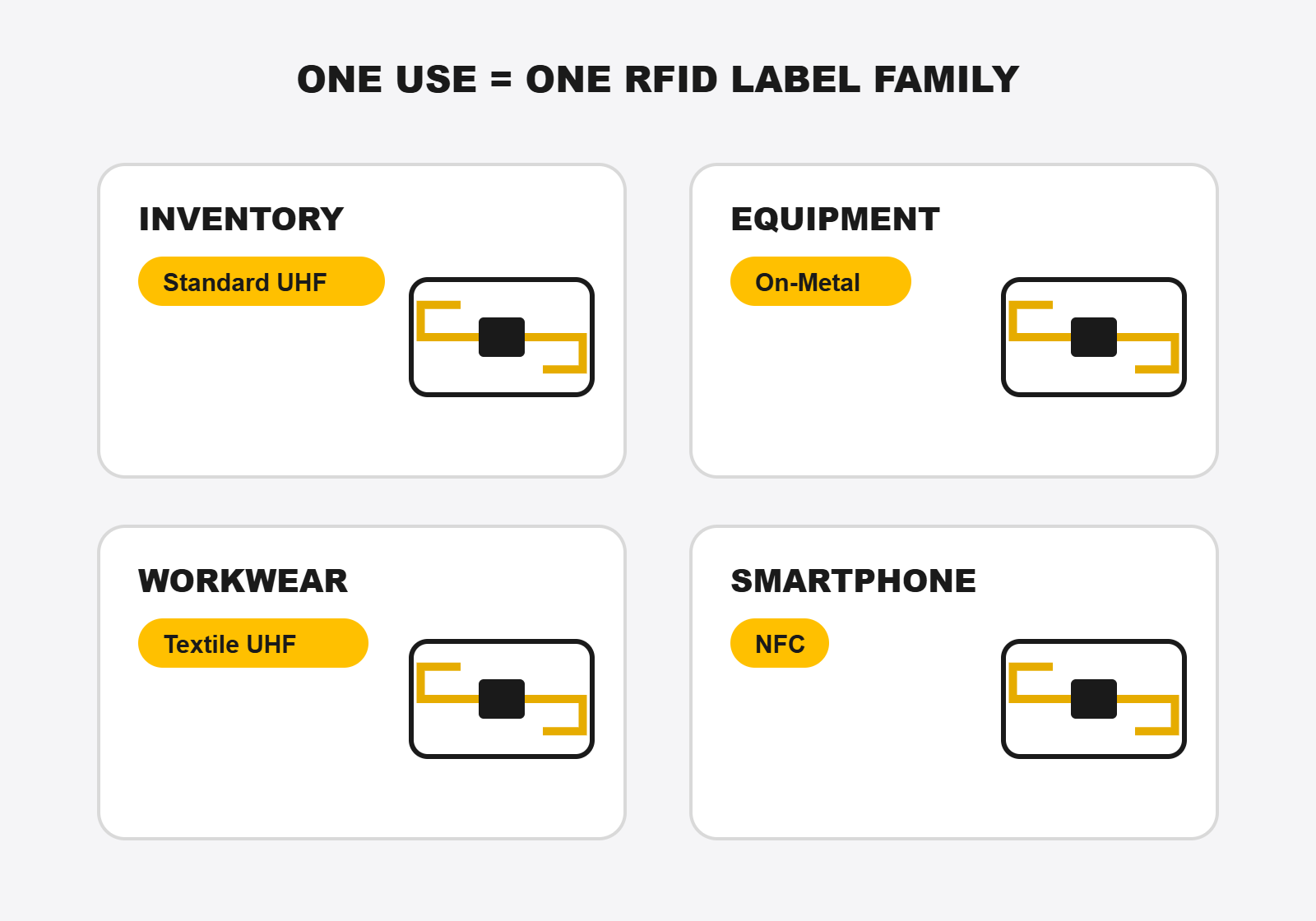
The right starting point is not the technology but the use case. Define first what you want to achieve: running inventories, tracking equipment, tracing workwear or giving access to information via smartphone. Each use case points to a different technology, format and encoding method.
Running inventories and managing stock
Inventory requires reading many items quickly, without handling each object. UHF is the clear choice: a single reader pass detects dozens of tags. Standardise the tag position on cartons and units for consistent reads.
Identifying and tracking equipment
For machinery, IT hardware or tooling, the key issues are lifespan and surface behaviour, often metal. Choose robust references and, on metal, versions designed for that material.
Ensuring traceability of linen and workwear
Workwear goes through repeated washing, drying and pressing cycles. You need a tag designed to follow textiles through these cycles, fixed by heat transfer, and a technology that allows batch reading in the laundry.
Looking up information with a smartphone
For a user to read the tag with their phone, the technology must be NFC (a form of HF). A simple tap gives access to a product sheet, a user manual or a traceability record.
HF, NFC or UHF: which technology should you choose?
HF (13.56 MHz) and its NFC variant suit close-range interactions; UHF (865-868 MHz in Europe) reads many tags at several metres. The choice comes down to the useful read distance and the number of items read at once.
Criterion
HF / NFC
UHF
Frequency
13.56 MHz
865-868 MHz (Europe)
Read distance
Close range, from a few centimetres to about 1 metre
Several metres
Reading mode
One tag at a time, close up
Many tags per second, no line of sight
Smartphone reading
Yes, via NFC
No, dedicated reader required
Encryption / authentication
Yes
Limited
Standards
ISO/IEC 14443 and ISO/IEC 15693
ISO/IEC 18000-63:2015 (EPC Gen2), ETSI EN 302 208 band
Which RFID tag should you choose for each surface?
The mounting surface drives performance as much as the technology does. Metal, liquids, cardboard, plastic and textile do not react the same way to radio waves. Match the reference to the real material rather than to a general rule.
Surface
Behaviour with radio waves
Recommended solution
Point to watch
Cardboard or plastic
Surfaces compatible with standard tags
Standard tag suited to the format
Curvature, surface condition and packaging contents; test positioning before fixing it
Metal
Reflects waves, disrupts a standard tag (especially UHF)
On-metal version (suitable antenna and spacer)
Run a trial on the actual equipment
Near liquids
Absorbs waves, degrades reading (especially UHF)
Reference validated in the real configuration
Contents, fill level and tag position; do not choose from the outer material alone
Textile
Must withstand washing, drying and pressing cycles
The SBE Direct range includes standard and on-metal versions, notably in HF/NFC and UHF.
Which technical criteria drive RFID tag performance?
Five technical criteria decide reliability: the read distance you actually need, the antenna format and orientation, resistance to operating conditions, the fixing method and the expected lifespan. Size each one from your field reality, not from a theoretical datasheet.
The read distance you actually need
Define the useful distance and the zone in which objects must be detected. Too short a range causes missed reads; too long a range causes stray reads of neighbouring objects. The right setting covers your zone without spilling beyond it.
Tag format, antenna and orientation
The carrier size and antenna design set the range and sensitivity. The tag orientation relative to the reader affects read quality. A large antenna format favours distance, a small format eases integration.
Resistance to operating conditions
List the constraints to communicate to your supplier:
→Operating and storage temperatures
→Humidity and splashes
→Chemicals
→Abrasion and impacts
→Washing and heat treatments
→Outdoor exposure and UV
Fixing and expected lifespan
Compare adhesive, heat transfer or other fixings depending on the reference and the surface. Distinguish a tag meant for one-off packaging from one that must follow equipment for years: the latter justifies a more resistant carrier and a durable fixing.
How do you check compatibility with your readers and software?
A tag is only worth anything if your equipment can read it, encode it and link its identifier to your data. Check three points: the frequency and protocol of your reader fleet, compatibility with your printer-encoder, and the match between the chip identifier and your information system.
Check the frequency and communication protocol
Your fleet of RFID readers must operate on the same frequency as the tags (HF/NFC or UHF) and support the same protocol. A UHF tag will not be read by an HF reader, and vice versa. Confirm this before any order.
Check compatibility with the printer-encoder
To print and encode in-house, you need RFID printers compatible with the inlay format and the chosen technology. Visible printing and chip encoding happen in a single pass on this type of equipment.
Link identifiers to business data
The chip identifier must correspond to an entry in your system. RFID software links each tag to its object record, history and movements. Without this link, the tag remains a number with no context.
Blank or encoded RFID tag: which should you choose?
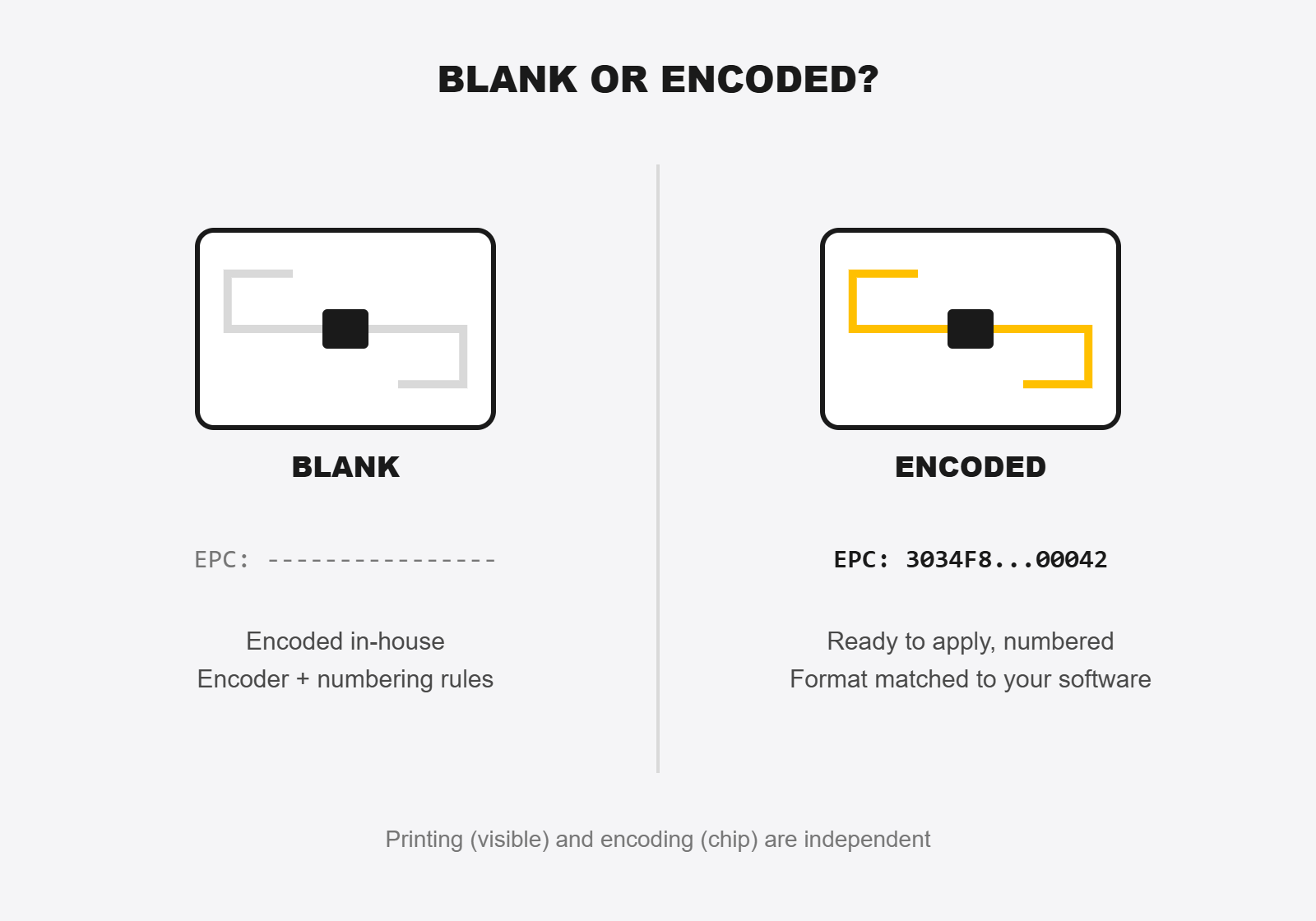
A blank tag is programmed on your premises: it gives full control over your identification rules, but requires an encoder and an organised process. An encoded, numbered tag arrives ready to apply, provided its data format matches your system. The choice depends on your encoding resources and your volume.
Telling printing and encoding apart
Printing places visible information on the carrier (text, logo, barcode). Encoding writes data into the chip. The two are independent: a tag can be printed without being encoded, and vice versa. Clarify what you need before ordering.
Choosing a blank tag to prepare your own data
The blank tag suits you when you control your identification rules. It assumes a compatible encoder, defined numbering rules and a post-write check. Blank HF/NFC RFID tags meet this need when you prepare your own encoding in-house.
Choosing an encoded tag to simplify preparation
Upstream preparation saves time, provided the identifiers and data format match your system. SBE Direct offers customised HF/NFC RFID tags, encoded and numbered to your rules.
Defining the memory and useful protections
Distinguish a simple identifier that points to a database from information stored directly in the chip. Depending on the model, the chip allows rewriting, locking and certain protections. A unique identifier or a password is not a general guarantee against cloning: assess the level of protection you genuinely need.
Which RFID tag should you favour for your application?
The table below turns the previous criteria into a quick decision aid. It matches each application to a solution to study and to the priority check. No reference is universal: always validate the recommendation in your own field.
Application
Solution to study
Priority check
Inventory of cardboard-packed products
Standard UHF tag
Batch reading and carton contents
Identification of metal equipment
On-metal version compatible with the system
Performance on real metal
Smartphone lookup of a product sheet
Compatible NFC tag
Phone, chip and encoded content
Workwear and linen tracking
UHF textile tag
Fixing and care cycles
Identification prepared in-house
Blank tag
Encoding equipment and process
Labelling with identifiers prepared upstream
Encoded, numbered tag
Match with the software
For ready-to-apply UHF inventory, the UHF RFID tag 65 x 35 mm, encoded and numbered illustrates a pre-programmed reference. One product is never suited to every application: start from your use case.
How do you validate your choice before ordering?
Always validate a reference on a representative sample before ordering in volume. Apply the tags to the real objects, in their real conditions, measure read quality, then compare the total cost of the solution rather than the unit price alone. SBE Direct provides free samples for these trials.
Test the tags on a representative sample
Plan trials on real objects, in their usual conditions: storage, movement, stacking or care. A laboratory test does not replace a field test, where the surface, the environment and the operators' handling all come into play.
Measure read quality
Check the objects detected, the missed reads and detections outside the intended zone. Also test encoding and the correct flow of data into the software. A reliable read is measured, not assumed.
Compare the total cost of the solution
Factor in the price of the tags, their preparation, application, equipment, integration and replacements. A cheap but often unreadable tag costs more than a suitable reference. Think in total cost, not unit price.
To move faster, send SBE Direct your use case, your surface, your reading equipment and your constraints: our specialists will select a reference to test.
FAQ
Can every RFID tag be read with a smartphone?▾
No. Only compatible NFC tags can be read with a smartphone, because NFC is built into most phones. UHF tags require a dedicated reader: no ordinary phone reads UHF without an accessory. Before relying on smartphone reading, confirm that your project is based on NFC and not UHF.
What is the difference between an RFID tag and an RFID card?▾
The card and the tag are first of all two physical formats: one rigid, the other flexible and adhesive. Their performance depends on the embedded technology, not the format: both cards and tags exist in HF and in UHF. It would be wrong to reduce the comparison to card equals HF and tag equals UHF. For people-identification uses, look at RFID badges and cards; for asset identification, look at tags.
Can the data on an RFID tag be rewritten?▾
It depends on the chip, the memory area concerned and any locking. Some areas are rewritable, others are fixed after writing, and others can be deliberately locked to prevent any change. Decide from the outset whether you need to rewrite data in operation, then choose a chip whose protections match that use.
Can an RFID tag act as an anti-theft device?▾
RFID identification and anti-theft detection are two distinct functions. An RFID tag identifies an object; a full anti-theft system detects an unauthorised passage and triggers an alarm, which requires dedicated infrastructure and functions. RFID can be part of a security approach, but an identification tag alone does not replace an anti-theft device.
Can RFID, QR code and barcode be combined on one tag?▾
Yes, and it is often worthwhile. RFID allows reading at a distance and in batches, while the barcode and QR code offer immediate, universal visual reading. Combining them on one carrier covers several reading modes. The key is to link these different identifiers to the same object in your system. For the visual part, barcode labels naturally complement RFID.
With over 5 years of experience in creating content optimized for search engines, Mélissa is currently Marketing & Product Manager at SBE Direct, where she leads the product catalogue positioning across the e-commerce website and marketplaces, as well as the SEO content strategy in coordination with the marketing team she oversees.