How to choose a barcode label: the five-step method

How to choose a barcode label: the five-step method

A barcode either reads first time, or it does not. Everything that follows, the pallet left waiting, the stock count done twice, the dispute with the carrier, comes out of that second and a half.

So a barcode label is not picked from a catalogue in price order. It is picked from the scan: at what distance, on what surface, after how long and in what environment does the code have to be read? The facestock, the ribbon and the adhesive all follow from those answers.

The price gap between two facestocks is trivial. A polypropylene label on a roll starts at €0.18 excl. VAT per unit; a laser-engraved aluminium tag costs ten times more. But a single goods-in shift disrupted by failed scans costs more than that difference does over a full year.

The essentials in five lines

  • →The choice starts from the scan (distance, reader, module width), never from the item being labelled.
  • →Three decisions follow on from each other: the facestock, then the print process, and therefore the ribbon, then the adhesive.
  • →A resin ribbon on vellum paper performs worse than a wax ribbon: it is the pairing that counts.
  • →Read quality is measured as a grade (ISO/IEC 15416 for 1D, ISO/IEC 15415 for 2D), not judged by eye.
  • →Cost is compared per label actually scanned, not per roll.

Choosing the symbology itself, EAN-13, GS1-128, DataMatrix, QR, and deciding between barcode and RFID both happen upstream. Here the code is a given: what we are choosing is the facestock, the process and the adhesive.

What Is at Stake: a Failed Scan Is Paid for Three Times

First at the scan itself. Second, at the stock audit. Third, at the customer.

Take a goods-in operation of 400 parcels a day with 3 % of reads rejected. That is twelve parcels keyed in by hand, every morning. Over 220 working days, 2,640 manual entries a year, at two to three minutes each: between 88 and 132 hours spent retyping what the machine should have read. At the fully loaded hourly cost of the operator, the bill runs into thousands of euros, to save a few cents per label.

The difficulty is that a degraded barcode gives no warning. It still reads at 30 cm under the office lamp, and fails at 1.20 m on a fixed conveyor barcode reader at a 30° angle. The difference between those two states cannot be seen: it has to be measured.

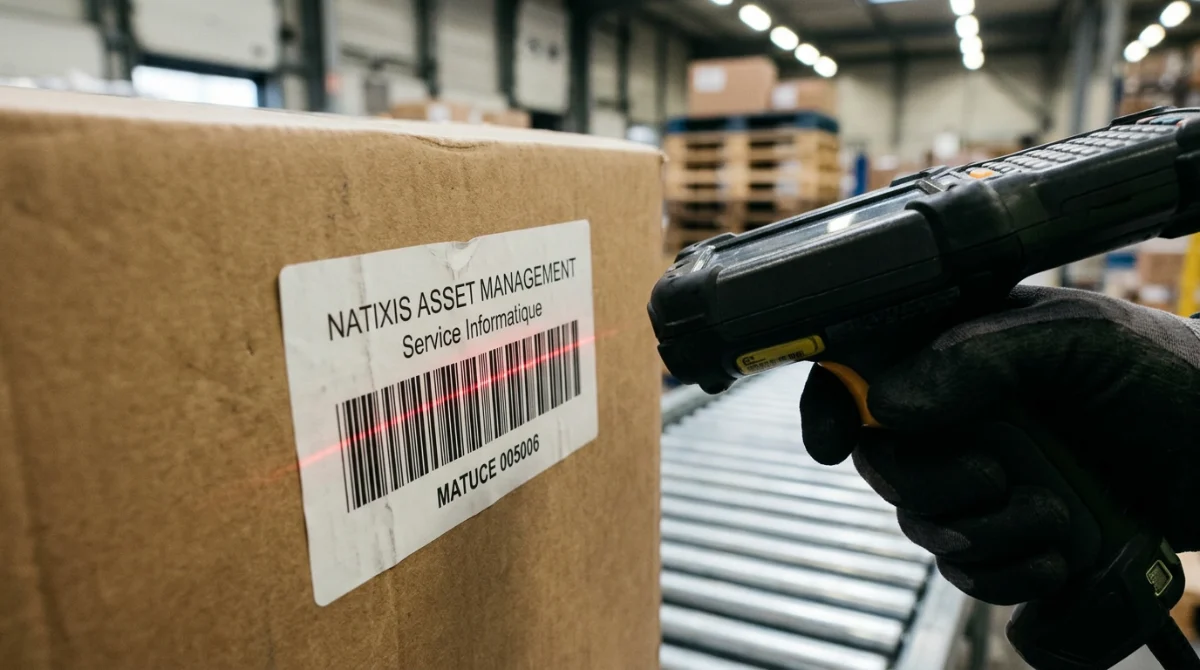
A scan that works first time at goods-in: that is what the choice of material, ribbon and adhesive decides.

The third cost is the one most often forgotten: compliance. An unreadable SSCC, a code placed outside the expected zone or a quiet zone trimmed at print, and the logistics label is rejected at the distribution centre. Some retailers then charge penalties or send the pallet back, and that is no longer a matter of cents.

Step 1 - Frame the Requirement From the Scan

Five questions, asked in this order. They rule out most options before price even comes up.

At What Distance, With Which Reader, at What Speed?

A corded scanner at 10 cm, a fixed reader 1 m above a conveyor running at 2 m/s, a mobile terminal at 40 cm and the end customer's phone camera do not impose the same constraints.

The further away and the faster the read, the wider the module and the taller the bars have to be. A code printed fine to save space is paid for in read rate: the tolerance margin disappears as soon as the reader moves back or the lighting drops.

What X-Dimension, and Can Your Printer Hold It?

The X-dimension is the width of the narrowest module in the symbol; it sets how fine the printing has to be.

  • →For a GS1-128, the GS1 General Specifications give an absolute range of 0.249 to 1.016 mm. The GS1 logistic label guideline works between 0.495 and 0.94 mm, with 0.495 mm recommended and bars at least 31.75 mm high.
  • →At 203 dpi, one dot measures 0.125 mm: a 0.25 mm module sits on two dots, which is the acceptable minimum. At 300 dpi (0.0847 mm per dot), the same module gets three dots.
  • →Below two dots per module the code still looks readable on the proofing screen and becomes fragile in the field: one rub, one variation in print head temperature, and contrast collapses.

That is why the range of label printers is chosen at the same time as the label format, not afterwards. A 203 dpi printer is enough for 100 × 150 mm parcel labels; it is not enough for an 8 mm DataMatrix on a component.

What Surface Will the Label Be Applied To?

Rough recycled board, low surface energy plastic, powder-coated metal, glass, bare wood, greasy drums, small-diameter cable: the surface decides the adhesive and, often, the thickness of the facestock. A rigid 0.8 mm tag does not go onto a 20 mm diameter pipe.

For How Long, and in What Environment?

Three days in a temperate warehouse and ten years on an outdoor transformer do not lead to the same material. Do the maths in years, not in "heavy use": it is the expected service life that justifies moving up to polyester or aluminium, or not.

What Format, What Throughput, What Packaging?

Roll or sheet, usable width, core, winding direction, labels per roll, die-cut. And above all: 50 labels a day or 5,000? At high throughput, pre-printing and industrial thermal transfer win; at low volume, a laser sheet remains the cheapest option.

Step 2 - Choose the Material: What Each Facestock Can Take

No material is "the best". Each one wins on one front and loses on another. The table below ranks facestocks against the stresses actually met in warehouses, workshops and on site.

Material Abrasion Water Solvents Heat UV Cold Cost
Vellum paper (offset, laser, wax TT)●○○●○○●○○●○○●○○●○○€
Thermal paper (direct thermal)●○○●○○●○○●○○●○○●○○€
Polypropylene (PP)●●○●●●●●○●●○●●○●●○€€
Polyester (PET)●●●●●●●●●●●●●●●●●●€€€
Anodised aluminium (laser engraved)●●●●●●●●●●●●●●●●●●€€€€
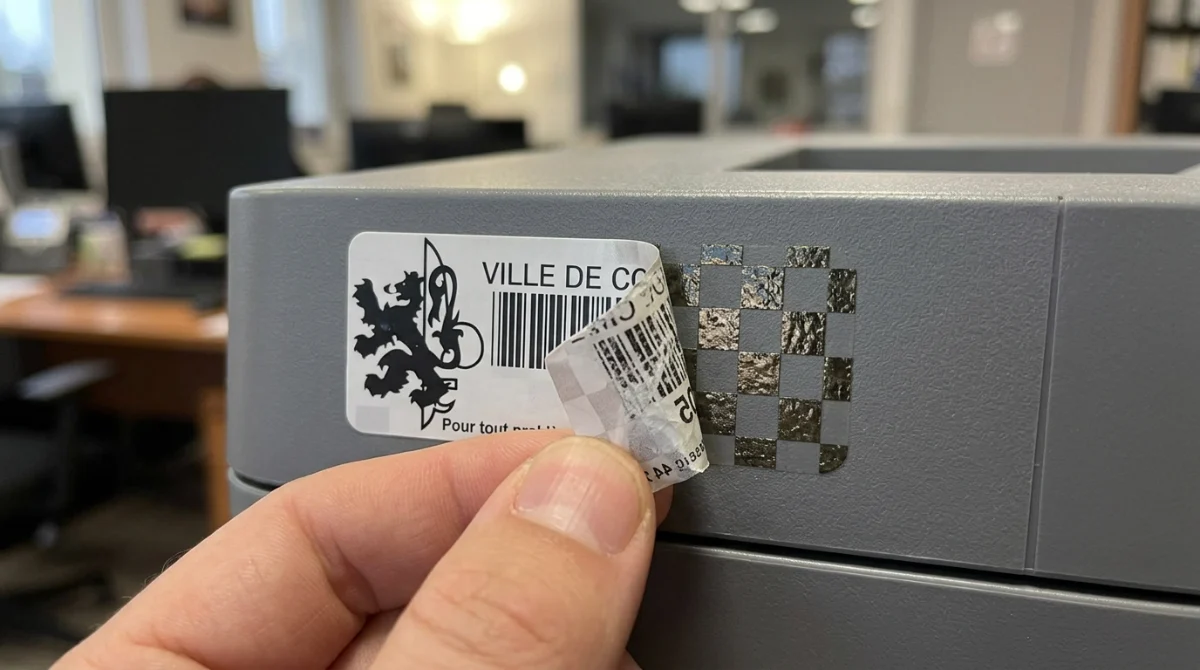
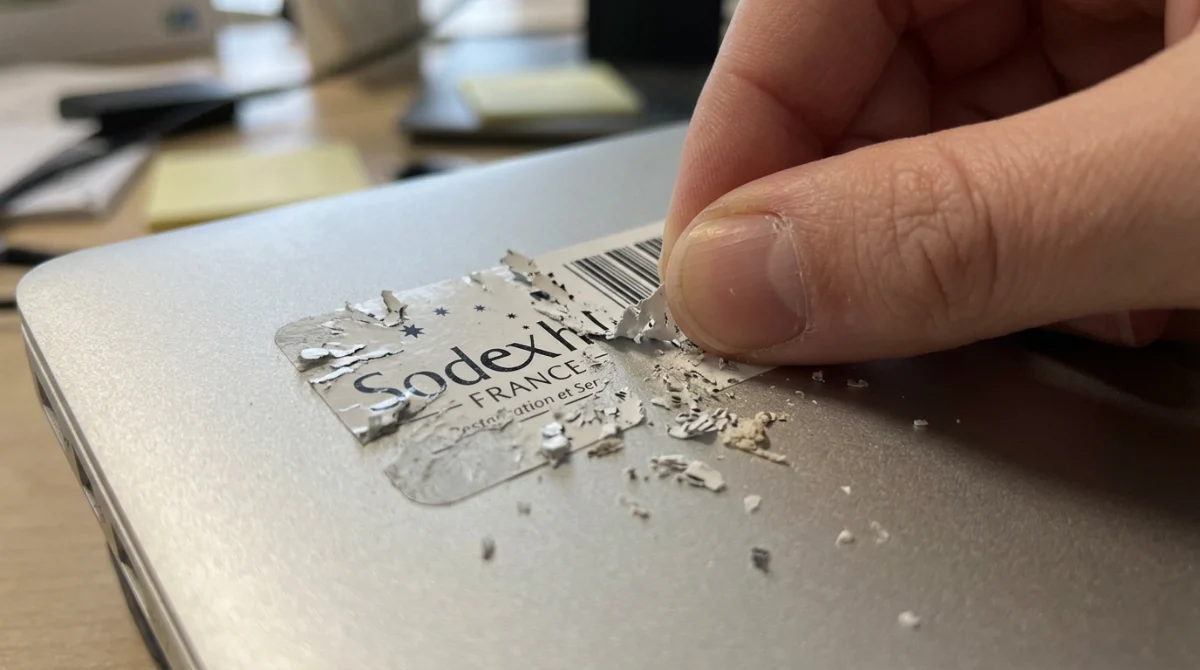
Security: VOID, destructible, tamper-proof●○○●●○●●○●●○●●○●●○€€€

● = low resistance, ●●● = high resistance. Orders of magnitude for standard stock: the exact figure is in each reference's technical data sheet. On security labels, the low abrasion resistance is deliberate, the label is meant to break up if it is peeled off.

Vellum Paper: the Baseline for Temperate Indoor Use

The cheapest, and often enough. It takes laser, offset and wax thermal transfer. Its limit is simple: humidity and rubbing. For a carton shipped within 48 hours, an annual stock count in a dry room or a shelf-edge label, it does the job.

Thermal Paper: Convenient, Disposable

No ribbon, no consumable: the printer heats the paper and the image appears. It is what runs on scales, mobile picking printers and shipping labels. In exchange, the image fades under heat, UV, plasticisers and rubbing: count in months, not years, and check the service life stated by the manufacturer before standardising on it. Keep it for short-lived flows.

Polypropylene: the Logistics All-Rounder

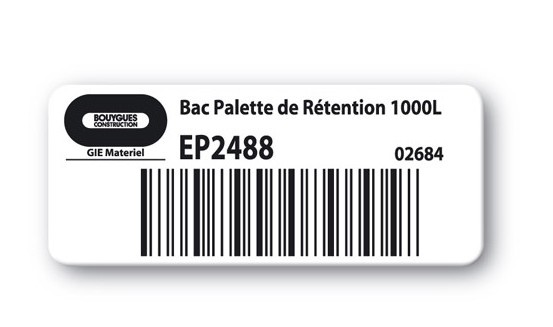
Matt white, flexible, water- and tear-resistant, it takes a wax-resin or resin ribbon and die-cuts cleanly. It is the default material for self-adhesive barcode labels on a roll, for stock counts, parcels and clean workshops. With us it starts at €0.18 excl. VAT per unit in black print, and runs from €0.30 to €1.44 excl. VAT in colour.

Its limits: strong solvents, repeated washing and prolonged sun exposure. For those cases, move up a level.

Polyester: for Solvents, Heat and Abrasion

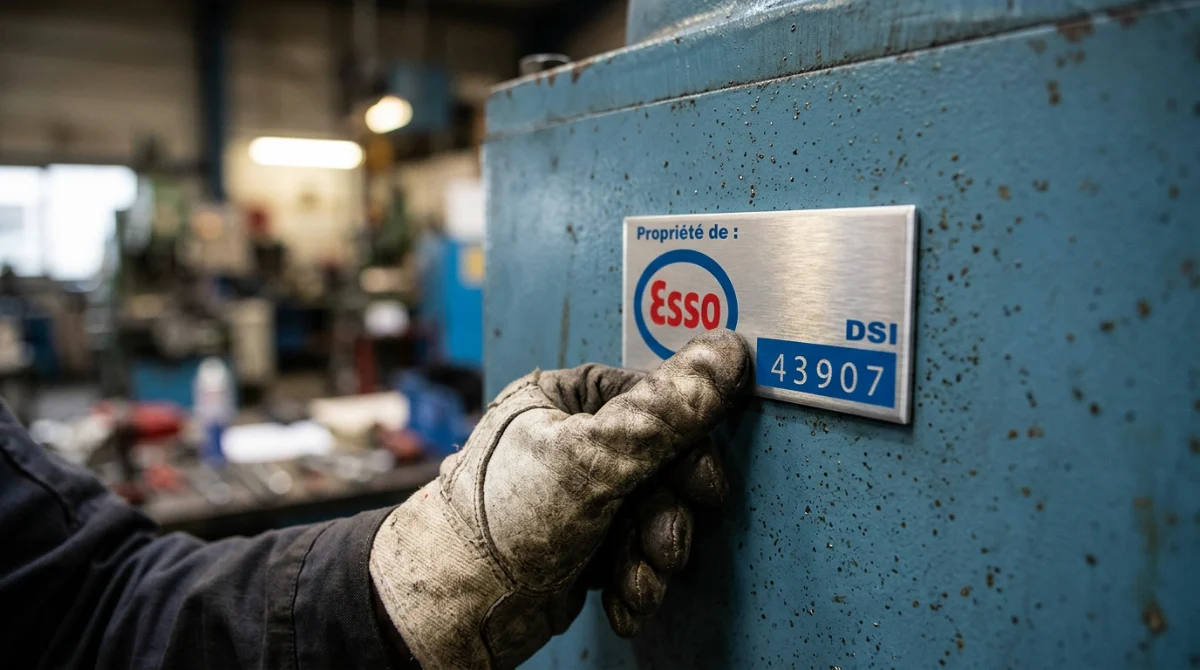
A stiffer, dearer film that holds where polypropylene gives way: degreasing baths, cutting oils, high-pressure cleaning, hot parts. It requires a resin ribbon and a compatible surface. It is found in our heavy duty asset tags, often with double-sided adhesive for textured surfaces.

Anodised Aluminium: Identification That Survives the Site

No ink, no ribbon: the code is laser-engraved into the anodised layer. It does not fade, does not smudge, and resists solvents, heat and UV.

It is the facestock for fixed assets, machines, drums, painted parts and anything that stays outdoors for more than two winters. The range runs from ultra-flexible 0.07 mm foil to a rigid 1 mm plate, from €1.34 to €19.20 excl. VAT depending on format and run, see the laser-engraved aluminium asset tags.

Security Labels: VOID, Destructible, Tamper-Proof

Their job is not to be read for a long time but to prove nothing has been touched. The VOID label leaves a "VOID" pattern behind when removed, the destructible one breaks into pieces, the tamper-proof one bonds permanently. They are used on equipment, seals and sensitive cartons, not on a standard logistics flow, where their cost (€0.19 to €18.00 excl. VAT depending on the model) makes no sense.

Step 3 - Choose the Process, and Therefore the Ribbon

Direct Thermal: No Consumable, Short Service Life

A print head, heat-sensitive paper, nothing else. Minimal running cost, minimal longevity. It is the right choice for a label whose useful life is counted in weeks: delivery note, weighing ticket, picking label.

Thermal Transfer: the Durable Standard

The head heats a ribbon that lays ink onto the facestock. What separates this process from direct thermal printing is above all how the image holds up over time.

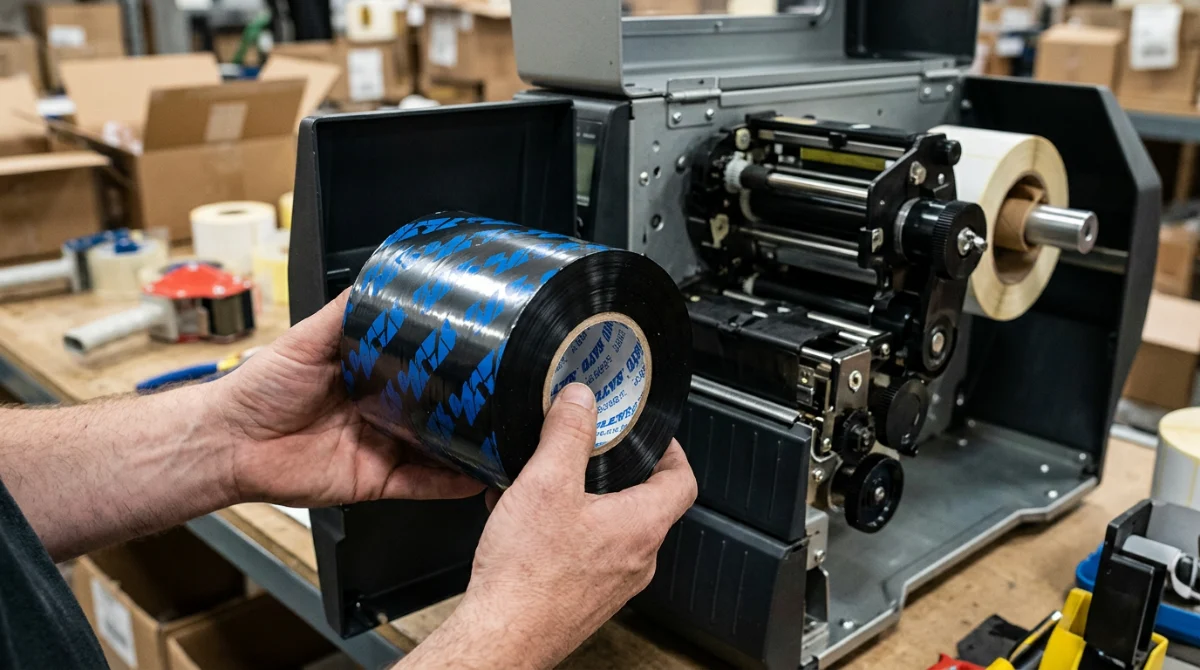
Three ribbon families, and one rule: the ribbon is chosen for the material, not for the budget.

  • →Wax: uncoated or coated paper, indoors, low abrasion. The cheapest.
  • →Wax-resin: coated paper and matt synthetics, mixed use, a good rubbing / chemical compromise.
  • →Resin: polypropylene, polyester, vinyl; heavy abrasion, solvents, heat. The dearest, and the only one that holds on a synthetic film.
  •  

A resin ribbon badly paired with vellum paper gives a worse result than a wax ribbon: the ink does not key. For orders of magnitude, a roll of resin thermal transfer ribbon in 45 mm × 210 m is available at €7.50 excl. VAT in clearance, while industrial 110 mm × 210 m formats run between €39.60 and €44.40 excl. VAT.

Pre-Printing, Laser, Engraving: When the Printer Is Not the Answer

Three cases where you have to step outside the "printer plus roll" logic:

  • →Pre-printing: high volume, stable content, fixed logo and wording. Barcode label printing is run in series at the manufacturer, and the variable data is added on demand.
  • →Office laser: small runs on sheets, where the volume does not justify a dedicated printer.
  • →Laser engraving: on anodised aluminium only, for facestocks that have to last without ink.

The Pairing Rule, in One Sentence

A label that holds is a compatible material and ribbon, printed at the right energy and the right speed. Changing one of the two without rechecking the other recreates the problem.

Step 4 - Choose the Adhesive, Then Check the Application

Acrylic or Rubber: Two Families, Two Jobs

  • →Acrylic: holds over time, resists UV and moderate heat, bonds to metal, glass and hard plastics. Its final strength builds over 24 to 72 hours. In exchange, it bonds poorly to a cold or greasy surface.
  • →Rubber (hotmelt): immediate tack, very good on recycled board, wood and polyethylene, cheaper. It ages badly (yellowing, lifting) and dislikes plasticisers and UV. Some references go down to −20 °C at application, with service performance from −50 to +90 °C, according to manufacturer guides.

For difficult cases, special adhesives exist: deep freeze, low surface energy, high temperature, removable. They are chosen from the technical data sheet, never by deduction.

The Surfaces That Make One Bond in Two Fail

Cold and condensation, oil film or mould-release residue, dusty recycled board, polyethylene and polypropylene, powder coating, curved surfaces, textiles.

On these, a standard adhesive will lift within 48 hours, even when applied perfectly. This is where reinforced-adhesive heavy duty asset tags come in, between €0.36 and €2.15 excl. VAT per unit depending on format.

The Three-Minute Application Test

Degrease the surface, apply the label, press firmly with a squeegee or your thumb over the whole area, pressure is what activates the adhesive, wait 24 hours, then pull. If the label comes away without resistance or leaves a film behind, the problem is not the label: it is the adhesive / surface pairing. No quotation should be signed off without this test.

Step 5 - Validate Before Rolling Out

Three steps, done on one roll, not on a whole pallet.

The pilot. 200 to 500 labels in real conditions: same printer, same energy setting, same operator. Then the trials: cold room, 40 °C, rubbing, cleaning, 48 hours of waiting. What passes in the meeting room often fails on the loading bay.

The measurement. A verifier gives a grade to ISO/IEC 15416 for linear symbols and ISO/IEC 15415 for 2D. The minimum grade depends on the application and on the customer specification: it is read in the applicable specification, not in an average found online. A smartphone, even with a good app, does not measure a grade, it only says "it reads".

The real cost. Compare the cost per label actually scanned: facestock + ribbon + machine time + rework. A 210 m ribbon feeds roughly 2,000 prints on a 100 mm long label, which is a few thousandths of a euro per label. The real cost centre is not there: it is in the rework.

For pilot runs and variable-content requirements, going through a personalised label makes it possible to test the right format before committing to stock.

Summary Table: Use Case, Code, Process, Material, Adhesive

Use case Code Process Material Ribbon Adhesive
Parcels and pallets (SSCC)GS1-128, AI (00)Thermal transferVellum or PPWax-resinPermanent acrylic
Stock counts and fixed assetsInternal code or GS1 DataMatrixThermal transferWhite PPWax-resinPermanent acrylic
Metal parts, foundry, outdoors1D or DataMatrixLaser engravingAnodised aluminiumNoneHigh performance acrylic
Food traceabilityGS1 DataMatrixThermal transferPP or PETResinAcrylic (food contact suitability by reference)
Cold chain, deep freeze1D or DataMatrixThermal transferPP or PETResinDeep-freeze adhesive, cold application
Workshop, baths, solvents1DThermal transferPETResinHigh performance acrylic
Anti-substitution, seals1D or 2DThermal transfer or pre-printedVOIDResinStrong acrylic, non-removable
E-commerce shippingCode 128 + addressDirect thermalEDP thermal paperNone or waxRubber or acrylic
Small equipment, IT assetsQR or DataMatrixThermal transferThin PP or PETResinUltra-adhesive

This table covers the common cases. It does not replace a judgement call on a borderline case, greasy metal at −5 °C, textile washed 60 times, which calls for a technical data sheet and a trial. The barcode label catalogue makes it possible to cross-check material, format and packaging before ordering.

The Most Common Selection Mistakes

  • →Choosing the format before the read distance. You start from the space available on the carton, then discover the module is too fine for the conveyor reader.
  • →Printing a 0.2 mm module on a 203 dpi printer. The code passes on the bench and fails under rubbing. Two dots per module is a floor, not a target.
  • →Keeping thermal paper for long-term use. Three months in a non-air-conditioned warehouse are enough to erase a code that looked perfect on delivery.
  • →Using a wax ribbon on polypropylene. The ink does not bond: the code wipes off the first time a forklift goes past.
  • →Applying a standard adhesive to a cold, damp or greasy surface. Lifting happens within 48 hours, often after the goods are already in stock.
  • →Confusing water resistance with solvent resistance. A label that survives rain can come off at the first alcohol-soaked wipe.
  • →Ordering in volume without a pilot. The only way to validate a material / ribbon / adhesive combination is a trial in real conditions.
  • →Forgetting the recipient's constraints. SSCC placement, quiet zone, bar height, background contrast: a label that is compliant at your site can be rejected at the distribution centre. Internally the same trap closes differently: a code that no longer reads becomes an inventory discrepancy nobody can explain three months later.

Frequently Asked Questions

Which barcode label should I choose for professional use?▾

Start from the scan, not from the product: read distance, surface, service life. For a parcel or a stock count in a temperate indoor environment, a white polypropylene label on a roll with a wax-resin ribbon covers most needs, from €0.18 excl. VAT per unit. Only move up to polyester or aluminium if the environment genuinely requires it.

Thermal paper or thermal transfer: which one?▾

Direct thermal suits short-lived labels, delivery notes, weighing tickets, picking labels, because it uses no ribbon. As soon as the code has to last for months, or resist heat, UV or rubbing, move to thermal transfer: the deposited ink stays stable far longer.

Which label for outdoor or hot environments?▾

Beyond one summer outdoors, no paper label holds. Polypropylene with a resin ribbon covers temperate situations; for hot parts, solvents or several years of exposure, a laser-engraved anodised aluminium barcode tag remains the only option with no ink to lose.

Can barcode labels be printed on an office laser printer?▾

Yes, on sheets, for small volumes and stable content. Watch two points: the print accuracy of an office laser does not always hold a fine module, and toner chips along cut edges. Beyond a few hundred labels a month, a dedicated printer costs less to run.

What label size for a barcode readable at one metre?▾

First you need a sufficient X-dimension: on a GS1-128, work from 0.495 mm upwards, with bars at least 31.75 mm high for reliable reading at distance. A symbol that is too short reads poorly as soon as you move back or the angle opens up. Always validate with the actual reader, at its installed distance.

Does a barcode label survive deep freezing or washing?▾

In deep freeze, yes, provided you choose an adhesive designed for cold application and a synthetic material with a resin ribbon. For washing, only polyester and specific textile labels hold over several cycles. In both cases, a trial on 200 units before ordering avoids discovering the problem in production.

For assets that have to be read without line of sight, RFID tags take over.

Unsure about the material or the adhesive?

Tell us the surface, the read distance and the expected service life, and we will settle the material, ribbon and adhesive combination with you.

See the barcode labels →
Melissa Oumaouche
See the author's articles
Melissa Oumaouche

With over 5 years of experience in creating content optimized for search engines, Mélissa is currently Marketing & Product Manager at SBE Direct, where she leads the product catalogue positioning across the e-commerce website and marketplaces, as well as the SEO content strategy in coordination with the marketing team she oversees.

We use cookies to improve your experience.