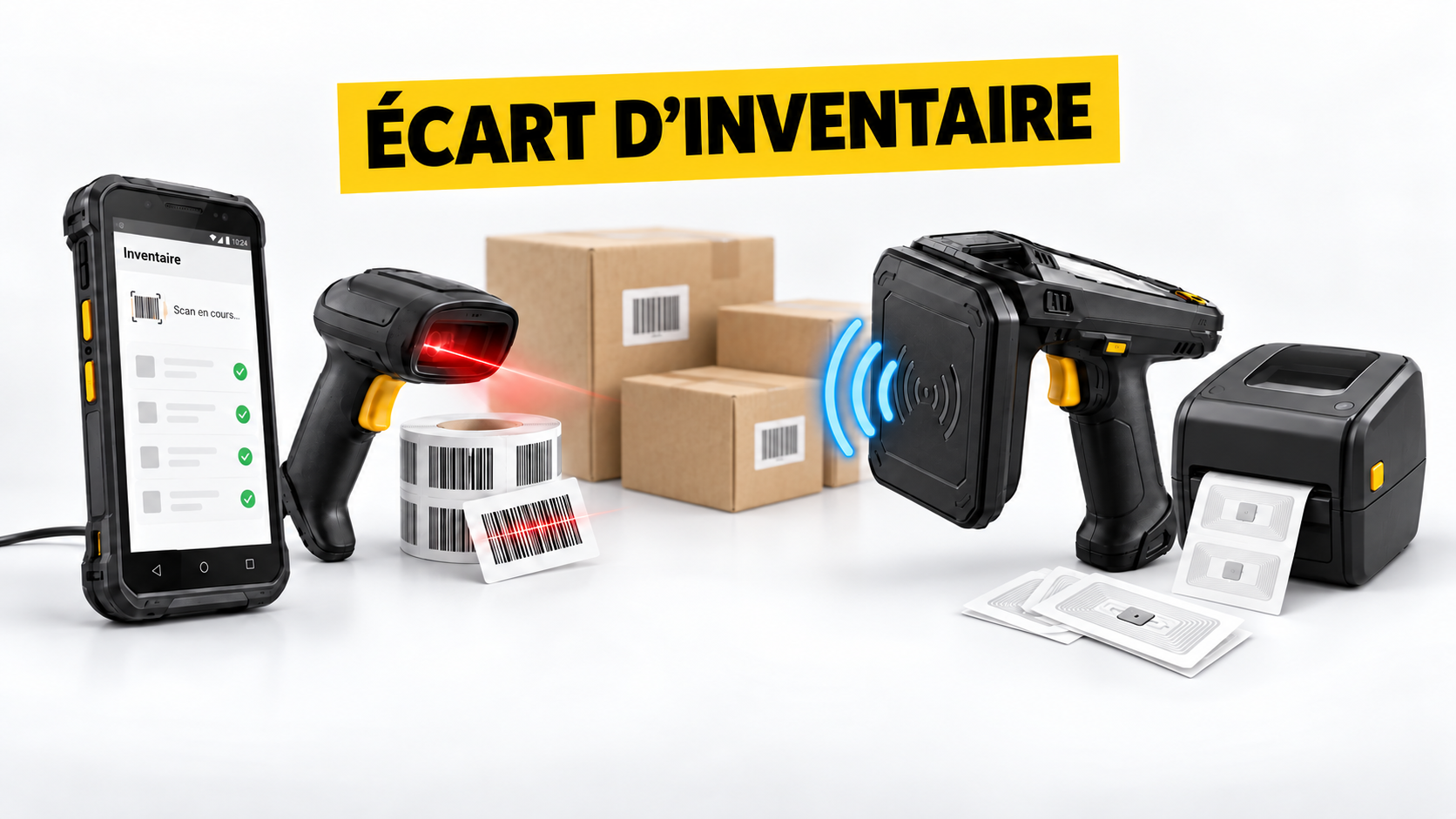
Inventory Discrepancy: Definition, Calculation, and How to Improve Stock Accuracy

Inventory Discrepancy: Definition, Calculation, and How to Improve Stock Accuracy

This guide explains what an inventory discrepancy is, how to calculate it and how to reduce it for good. You will find the calculation formulas, a benchmark of acceptable rates, the most common causes and the identification technologies that make stock reliable.

Key takeaways

  • →An inventory discrepancy is the difference between theoretical stock (recorded in the system) and actual stock (physically counted).
  • →Core formula: discrepancy = actual stock - theoretical stock. Discrepancy rate = (discrepancy / theoretical stock) × 100.
  • →Benchmark thresholds: under 1% excellent, 1 to 2% acceptable, above 2% needs fixing.
  • →Main causes: data-entry errors, theft and shrinkage, logistics errors, damage and expiry.
  • →On RFID-tracked estates, SBE Direct records stock accuracy above 99% and around a 90% drop in counting errors.

In most warehouses, the figure shown by the management software and the quantity actually sitting on the shelves never quite match. That gap between theoretical and actual stock is the inventory discrepancy. It looks harmless while it stays small. It turns costly once it settles in: unexpected stockouts, duplicate orders, accounting provisions, hours lost hunting for items that cannot be found. How many units are really missing from your stock today? How do you measure that gap, where does it come from, and above all how do you bring it back below the tolerance threshold? This complete guide answers these questions, from the calculation through to the inventory labels that make counting reliable.

What Is an Inventory Discrepancy?

An inventory discrepancy is the gap between theoretical stock, recorded in the management system, and actual stock, physically counted during a stocktake. It is expressed in quantity or in value.

A zero discrepancy means the stock data is reliable; a large one reveals a loss of control over goods flows.

Inventory discrepancy and stock discrepancy mean the same thing: the software reports a quantity that the physical count does not confirm. This gap affects every sector that handles goods, from warehousing and manufacturing to retail, healthcare, IT asset management and fixed-asset tracking.

An inventory discrepancy should not be confused with shrinkage. The discrepancy is the measured difference. Shrinkage is the share of that difference that cannot be justified once administrative errors are corrected: the fraction genuinely lost, stolen or vanished without trace. A data-entry inventory error can be corrected; shrinkage cannot.

Positive and Negative Discrepancy: What Is the Difference?

A negative discrepancy means items are missing: actual stock is lower than theoretical stock. A positive discrepancy means a surplus: actual stock exceeds the recorded figure. Both are anomalies to address, because an unexplained surplus distorts the accounts just as much as a shortage.

Type of discrepancyFindingCommon causesMain consequence
Negative discrepancyActual stock < theoretical stockTheft, unrecorded breakage, unlogged issue, picking errorFinancial loss, stockout, over-promising to customers
Positive discrepancyActual stock > theoretical stockUnrecorded receipt, double count, unprocessed return, entry errorOvervalued stock, accounting and tax error, hidden overstock

A negative discrepancy naturally draws attention, since it means a direct loss. A positive one is more insidious: it gives a false sense of comfort and leads to flawed purchasing decisions. In accounting terms, overvalued stock artificially inflates the balance sheet and exposes the company during an audit. Both types must be analysed, documented and reconciled.

How to Calculate an Inventory Discrepancy

Calculating an inventory discrepancy starts with a simple subtraction: discrepancy = actual stock - theoretical stock. You then convert it into value, by multiplying by the unit cost, and into a rate, to compare items and track stock accuracy over time.

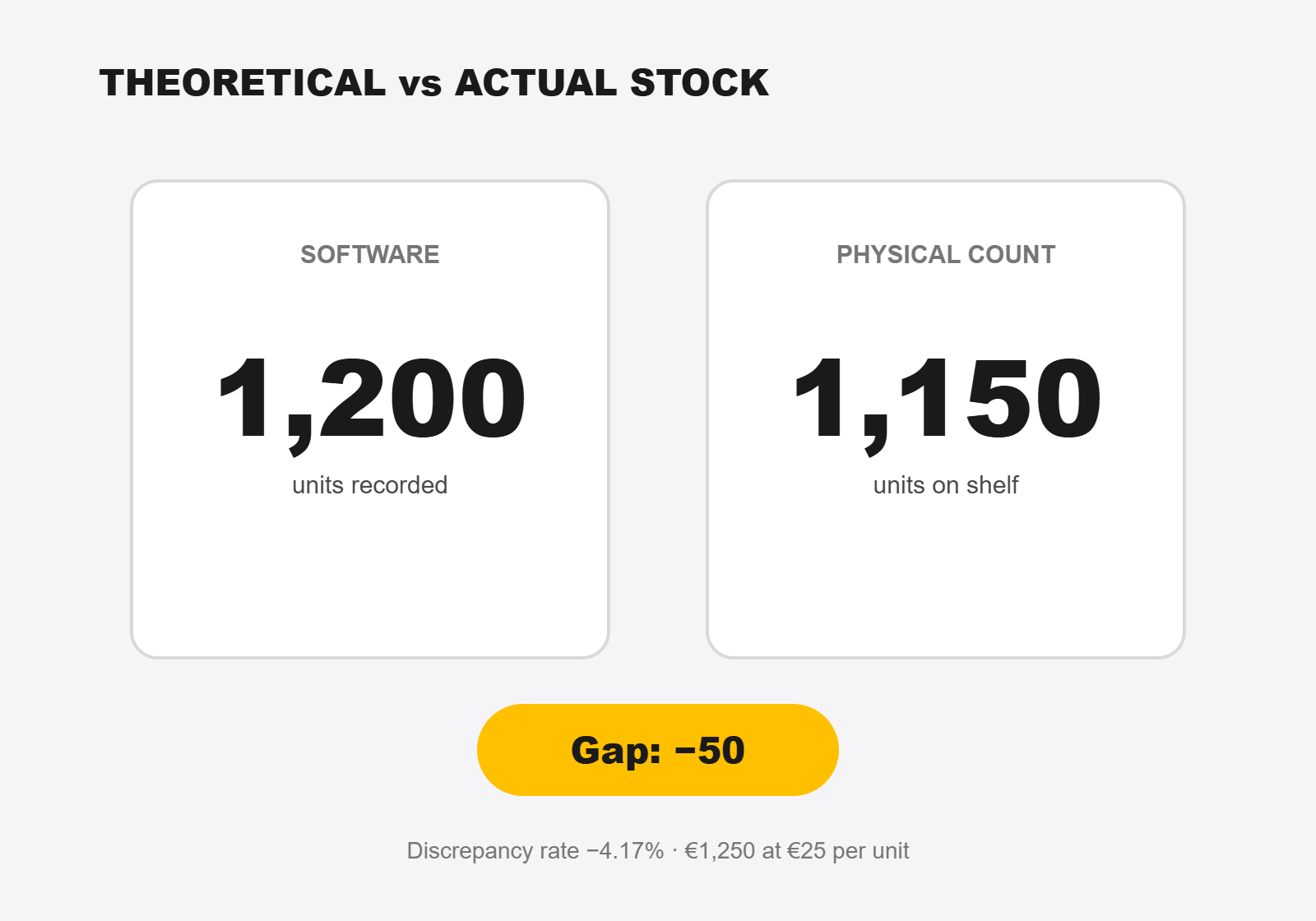
Example used in the table: the system reports 1,200 units, the count finds 1,150, at a unit cost of €25. Across the whole count, 60 of the 500 items counted show a discrepancy.

IndicatorFormulaExampleWhat it measures
Discrepancy in quantityActual stock - theoretical stock1,150 - 1,200 = -50 unitsA shortage (negative result) or a surplus (positive result)
Discrepancy in valueDiscrepancy in quantity × unit cost-50 × €25 = -€1,250The real financial impact of the discrepancy on the item
Discrepancy rate(Discrepancy in quantity / theoretical stock) × 100(-50 / 1,200) × 100 = -4.17%The discrepancy on a comparable basis across items
Stock accuracy rate(Items counted with no discrepancy / total items counted) × 100(440 / 500) × 100 = 88%The share of accurate records, the key indicator for managing stock

A discrepancy rate of -4.17% is well beyond the tolerance threshold and calls for action. Stock accuracy is the clearest indicator for managing stock performance, and the one most often forgotten: it measures not the volume lost but the share of accurate records. According to the landmark study by DeHoratius and Raman (University of Chicago, 2004), covering 370,000 records, 65% of the stock records analysed contained a discrepancy: the real accuracy of an untooled stock is often far lower than teams assume.

What Inventory Discrepancy Rate Is Acceptable?

A discrepancy rate below 1% in value is considered excellent. Between 1 and 2%, it remains acceptable but should be monitored. Above 2%, it becomes problematic and calls for a root-cause audit. These thresholds vary with the sector and the unit value of the items.

Discrepancy rate (in value)InterpretationRecommended action
Under 1%Excellent, reliable stockMaintain current procedures
1 to 2%AcceptableCycle counts, closer monitoring
Above 2%ProblematicRoot-cause audit, more reliable identification

These benchmarks must be weighed against sector reality. In retail, shrinkage alone accounts for 1 to 3% of turnover. A rate judged acceptable on low-value consumables can be unacceptable on costly equipment, where every missing unit counts. The goal is not absolute zero, rarely realistic, but a stable, controlled and explainable rate.

What Are the Causes of an Inventory Discrepancy?

The causes of an inventory discrepancy fall into four families: human entry and counting errors, theft and shrinkage, logistics errors in receiving or dispatch, and unrecorded damage or expiry. Poor labelling amplifies each of them.

Cause of the discrepancyTypical share (sector order of magnitude)How to tackle it
Entry and counting errors0.5 to 1%Automate reading, remove manual entry
Theft and shrinkage1 to 3%Secure zones, trace movements
Unreported damage0.3 to 0.8%Breakage declaration procedure
Receiving / dispatch errors0.2 to 0.5%Goods-in checks, systematic scanning
Unmanaged expiry0.1 to 0.4%FEFO management, date alerts

Behind most of these causes lies a common denominator: an identification inventory error. An unreadable, peeled or misread label, and the movement is not logged in the right place. That is exactly where reliability is won or lost, well before the software.

How to Reduce Inventory Discrepancies

To reduce inventory discrepancies, act on three levers: control frequency (cycle counts), identification reliability (durable labels, barcode, RFID) and data-capture automation through a handheld and a centralised software. Each lever removes a source of error.

1

Introduce Cycle Counts

Rather than one massive, error-prone annual stocktake, cycle counts check part of the stock continuously, prioritising high-rotation or high-value items. Discrepancies are caught early, their cause is still traceable, and correction costs less.

2

Make Asset Identification Reliable

A count is only as good as its labels. Readable, hard-wearing, correctly applied barcode labels remove reading errors at source. For exposed assets (abrasion, cold, outdoors), reinforced materials keep the identifier legible for the whole life of the asset.

3

Automate Capture in the Field

Manual entry is the leading source of inventory error. A barcode terminal or a mobile app for inventory management records every movement in real time, with no re-keying. The gap between the physical action and the system data disappears.

4

Move to RFID for High Volumes

Beyond a certain volume, the barcode reaches its limits. RFID reads hundreds of tags per second, with no line of sight. A stocktake that took a full day is done in a few minutes, with far higher accuracy. See our page on RFID inventory and traceability.

5

Centralise in a Management Software

Without a single source of truth, discrepancies rebuild themselves. An asset management software such as SAM (SBE Asset Manager) centralises movements, logs discrepancies over time and lets you generate barcodes and QR codes tied to each asset. On RFID-tracked estates, deployments supported by SBE Direct show around a 90% drop in counting errors and stock accuracy above 99%.

Barcode or RFID Inventory: Which Technology Makes Stock Reliable?

Barcode inventory reads one label at a time, with line of sight, at a very low unit cost. RFID inventory reads hundreds of tags at a distance, with no line of sight, for accuracy close to 99%. Barcode suits moderate volumes and tight budgets; RFID suits frequent stocktakes and large estates.

CriterionBarcode inventoryRFID inventory (UHF)
Reading modeOne label at a time, line of sight requiredMulti-tag reading, no line of sight
SpeedA few units per minuteSeveral hundred tags per second
RangeContact to a few centimetresSeveral metres (up to 10 m in UHF)
Label costVery lowHigher, offset by time saved
Best forModerate volumes, tight budgetHigh volumes, frequent stocktakes
Impact on discrepancyRemoves manual entry errorAccuracy near 99%, near-instant count. See the 65 x 35 mm UHF RFID tag

Both technologies meet the same requirement for readable data, but over different scopes. UHF RFID relies on international standards: ISO/IEC 18000-63 for the communication protocol and ETSI EN 302 208 for the 865-868 MHz band used in Europe. This framework guarantees interoperability of RFID tags and readers across suppliers. The joint study by the Auburn University RFID Lab and GS1 US (2018) measured inventory accuracy raised to nearly 99% after RFID deployment, against a far lower average with manual counting.

SBE note: the choice is not binary. Many companies keep barcode on low-value consumables and switch to RFID on critical assets. A mixed approach often delivers the fastest return.

Which One Is Right for You?

If your priority is…Choose…
A minimal label cost on large volumes of consumablesBarcode inventory
A full stocktake in minutes, repeated oftenUHF RFID inventory
Tracking high-value assets (IT estate, fixed assets)RFID paired with asset management software
A gradual transition without changing everythingA mixed barcode + RFID approach

Controlling an inventory discrepancy is not about counting more often, but about a reliable end-to-end chain: legible identification, automated capture and a single source of truth. Start by measuring your real discrepancy rate and stock accuracy, pinpoint the dominant cause, then fix it at the root with the tool suited to your volume. Making asset identification reliable is what durably reduces the inventory discrepancy, not recounting a stock that lies.

FAQ

What Is the Difference Between an Inventory Discrepancy and Shrinkage?▾

An inventory discrepancy is the measured gap between theoretical and actual stock. Shrinkage is the share of that gap that cannot be justified after administrative errors are corrected. In other words, not every discrepancy is shrinkage: an entry error is reconciled, whereas shrinkage is a real loss (theft, disappearance). In retail, shrinkage accounts for 1 to 3% of turnover. Reducing one always starts by making the measurement of the other reliable.

What Inventory Discrepancy Rate Is Considered Acceptable?▾

In value, a rate below 1% is excellent, 1 to 2% remains acceptable, and above 2% the discrepancy becomes problematic. These thresholds are benchmarks: on high-unit-value equipment, tolerance is lower, because every missing unit weighs heavily. The realistic goal is not zero discrepancy, but a stable, explainable rate tracked over time through the stock accuracy rate.

How Do You Justify an Inventory Discrepancy in Accounting?▾

A discrepancy must be documented, then reconciled. You match the movements, trace the origin (entry error, breakage, theft, unprocessed return), keep the supporting records, then post the adjustment that aligns book stock with physical stock. An unexplained positive discrepancy is as sensitive as a negative one, because it overvalues the balance-sheet assets. Fine-grained movement traceability, delivered by automated capture, is the best supporting evidence.

How Often Should You Run a Stocktake to Limit Discrepancies?▾

The legal annual stocktake is not enough to control discrepancies, as it detects anomalies too late. Cycle counts, which check a fraction of stock continuously, catch discrepancies while the cause is still traceable. Frequency scales with value and rotation: weekly on critical items, monthly or quarterly on the rest. RFID allows this frequency to rise sharply without adding to the workload.

Does RFID Really Eliminate Inventory Discrepancies?▾

RFID does not remove every discrepancy, but it eliminates the main cause: human entry and counting error. The Auburn University RFID Lab and GS1 US study (2018) measured inventory accuracy raised to nearly 99%. It does not, however, detect a damaged or physically misplaced item. Combined with cycle counts and a centralised software, it makes stock durably reliable. For a concrete case, see our article on RFID inventory.

See the author's articles
Melissa Oumaouche

With over 5 years of experience in creating content optimized for search engines, Mélissa is currently Marketing & Product Manager at SBE Direct, where she leads the product catalogue positioning across the e-commerce website and marketplaces, as well as the SEO content strategy in coordination with the marketing team she oversees.

We use cookies to improve your experience.