A hazard warning sign is a triangular yellow safety sign with a black border that warns of a hazard without forbidding or prescribing any specific behavior. Its installation has been mandatory in workplaces since 1 January 2014 (Order of 2 August 2013, standard NF EN ISO 7010). This article explains what it means, outlines its five main risk categories (physical, mechanical, electrical, chemical, and environmental), and details the applicable standards, the penalties for failing to display it (up to €3,750 per offense), and the key criteria for choosing the right sign for your site. It should not be confused with road hazard warning signs, which fall under traffic signage. You will also find a comparison with prohibition, mandatory, and information signs.

What is a hazard warning sign?

A hazard warning sign, also called a hazard warning safety sign or warning sign, is a safety sign designed to alert anyone present to a potential risk in a given environment. It does not prescribe a specific behavior (as a mandatory sign would) and does not prohibit anything; it simply informs people that a hazard is nearby.

Visual characteristics

A hazard warning sign is instantly recognisable by the following features:

  • Triangular shape with the point facing upwards
  • Yellow background (yellow must cover at least 50% of the surface)
  • Black pictogram in the centre representing the type of hazard
  • Black border

These characteristics are defined by standard ISO 3864‑1, which sets out the safety colors and shapes used on safety signs.

Difference from other safety signs


A hazard warning sign is part of a wider family of workplace safety signs that also includes prohibition, mandatory, and information or safe condition signs. Unlike prohibition signs, which indicate what is not allowed, or mandatory signs, which state what must be done, a hazard warning sign simply alerts people to a potential risk without prescribing a specific action. It uses a yellow triangle with a black pictogram, whereas prohibition signs are round with a red band and diagonal bar, and mandatory signs are blue circles. Information and evacuation signs, on the other hand, are generally green rectangles or squares and indicate escape routes, first aid equipment, or safety locations rather than hazards.

The two categories of hazard warning signs

Permanent hazard warning sign

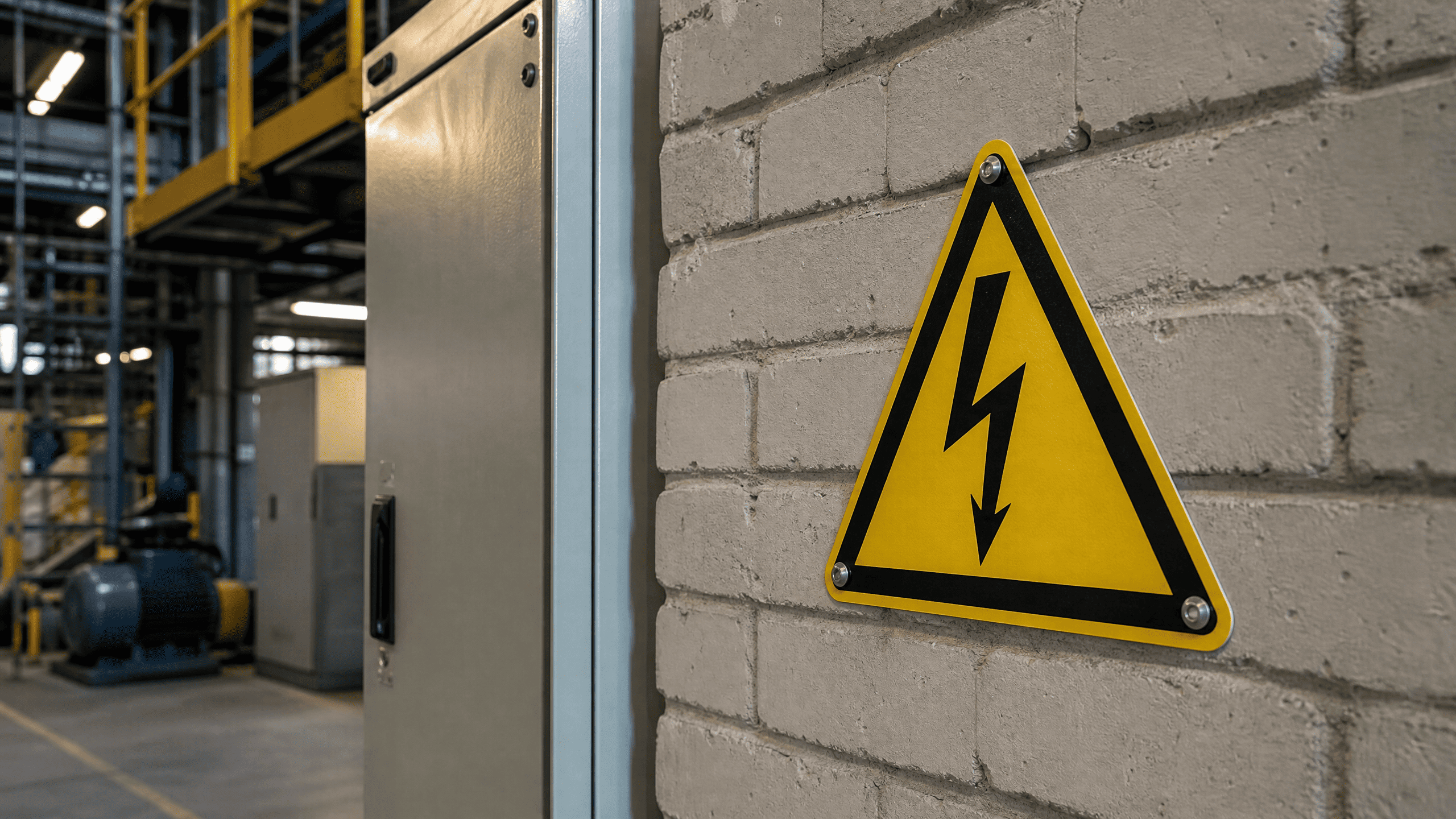
A permanent hazard warning sign is installed in a fixed position to indicate a constant risk, such as an electrical cabinet, stored chemicals or an area where loads are regularly moved overhead. It remains in place for as long as the hazard exists and is usually made from durable materials suitable for long-term use indoors or outdoors.

Permanent hazard warning sign fixed near an electrical cabinet to indicate a constant high‑risk area

Temporary hazard warning sign

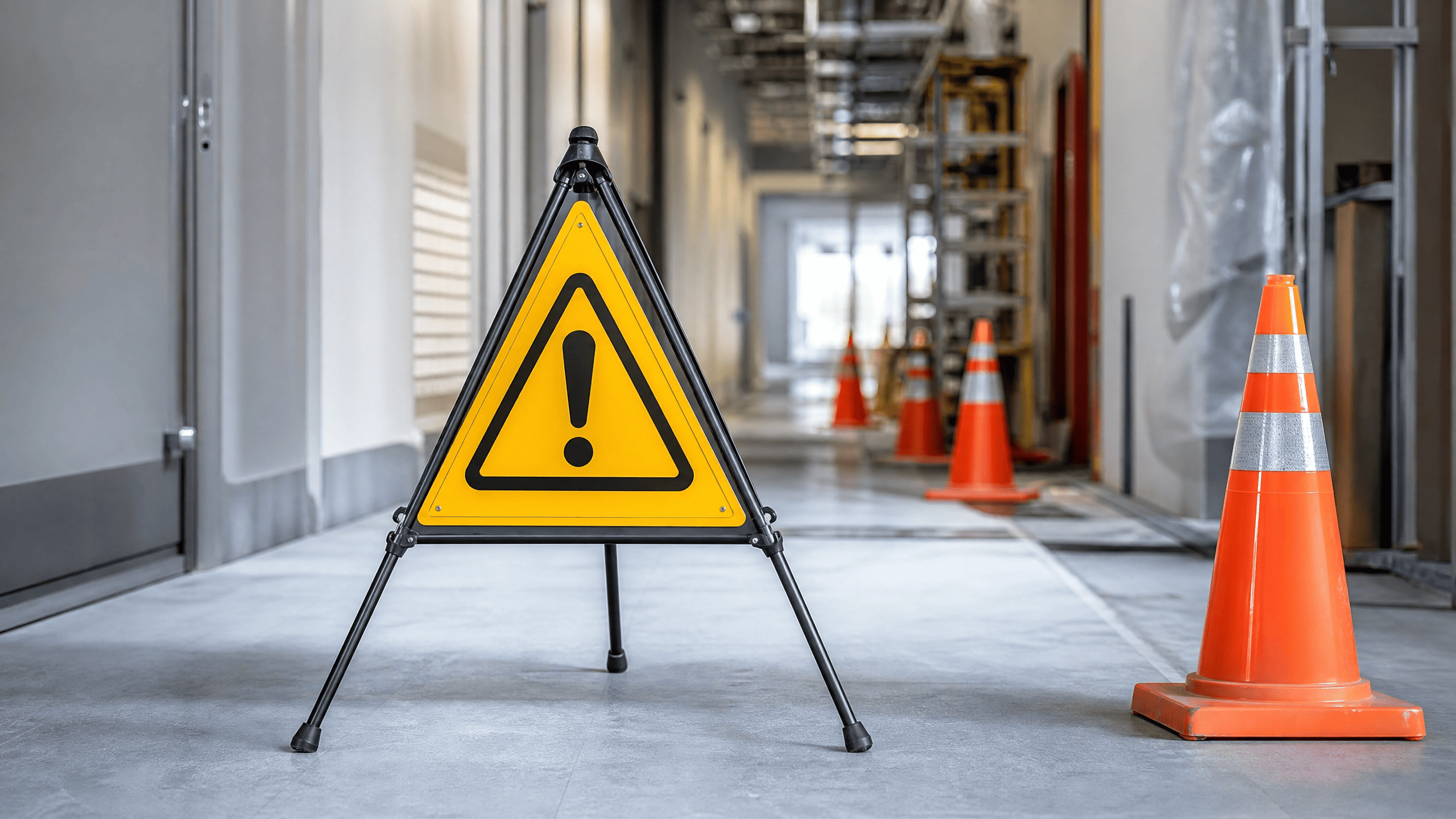
Temporary hazard warning sign placed on a construction site to warn of short‑term maintenance and work hazards

A temporary hazard warning sign is used to indicate a short-term or changing risk, such as ongoing works, a construction area or maintenance operations. It is put in place for the duration of the work and removed as soon as the hazard disappears, often using portable, lightweight supports that can be moved as conditions on site evolve.

What is the role of a hazard warning sign?

A hazard warning sign fulfills three essential functions:

  • Alert: It draws attention to a risk before it is too late.
  • Prevent accidents: it reduces unintentional unsafe behaviors.
  • Frame behavior: it guides people towards the appropriate course of action.

A well‑positioned and clearly visible sign can prevent serious accidents, especially for visitors, temporary workers or new employees who are not yet familiar with the site’s hazards.

Types of hazard warning signs

1. Physical hazard warning signs

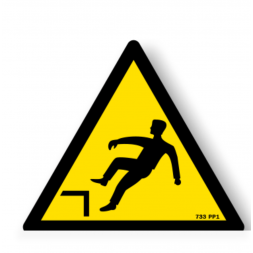
These hazard warning signs indicate risks of direct bodily injury, such as falls, level changes, slippery floors, or hidden obstacles. They are essential in circulation areas, stairwells, loading docks, or any zone where a loss of balance could result in serious injury.

Example: Danger sign with picture of risk of falling on an uneven surface

2. Mechanical hazard warning signs

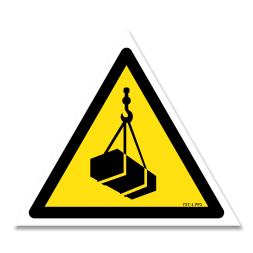
Mechanical hazard warning signs warn of moving equipment such as construction machinery, suspended loads, or material‑handling vehicles in operation. They help prevent collisions, crushing, and impact injuries by alerting pedestrians and operators before they enter the danger zone.

Example: 

Suspended loads sign with picture, which indicates a risk linked to overhead or suspended loads in lifting areas

3. Electrical hazard warning signs

An electrical hazard warning sign is essential in any technical room, electrical cabinet, or high-voltage area. It warns of the risk of electric shock or arc flash and corresponds to the standardized W012 pictogram defined in ISO 7010.

Example: 

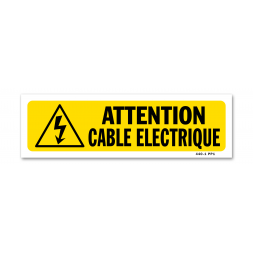
Indication sign “Attention: electrical cable”, used to mark the presence of dangerous electrical cables and prevent accidental contact.

4. Chemical hazard warning signs

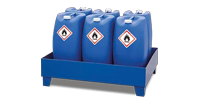
A chemical hazard warning sign covers harmful, corrosive, flammable, and explosive substances, as well as biological risks. It is mandatory wherever dangerous products are handled or stored, such as in laboratories, workshops, or REACH/CLP storage areas.

Example: 

Corrosive materials sign with picture, used to warn of corrosive substances that can cause severe burns and material damage.

5. Environmental and biological hazard warning signs


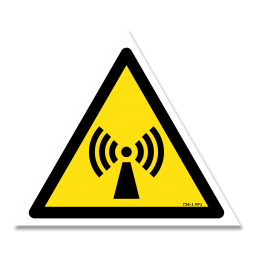
These hazard warning signs indicate risks linked to the physical environment, such as non‑ionizing radiation, explosive atmospheres (ATEX zones), or biological hazards. They are essential in high-risk industrial areas, laboratories, or technical rooms where invisible dangers can have serious consequences for health and safety.

Examples:

Regulation and standards for hazard warning signs

NF EN ISO 7010 standard

This is the main reference for safety signs. It defines the safety pictograms used in all places where people’s safety is at stake and aims to harmonise symbols, colours and formats across Europe. In France, since 1 January 2014, any new sign installed must comply with the NF EN ISO 7010 standard, following the ministerial decree of 2 August 2013. Signs installed before this date and compliant with the former NF X 08‑003 standard may be kept, but it is recommended not to mix both generations of pictograms on the same site to avoid confusion.

ISO 3864‑1 standard

ISO 3864‑1 defines the safety colours and shapes used for safety signs. It is the standard that imposes the yellow triangle with a black border as the reference design for warning and hazard signs. It also specifies how colours such as red, blue and green are used for prohibition, mandatory and safe condition signs, ensuring consistent visual language across all safety signage.

French Labour Code

Article R4224‑24 of the French Labour Code requires that health and safety signage in workplaces comply with the characteristics defined by ministerial order. In practice, this means that employers must use safety signs that conform to NF EN ISO 7010 and to the design principles set out in ISO 3864‑1. Articles R4224‑20 to R4224‑24 cover all obligations relating to health and safety signalling in workplaces, including the duty to install and maintain appropriate signs wherever risks cannot be avoided or sufficiently reduced by technical measures alone.

To learn more about the applicable standards, see the article 

“ISO 7010 standard: unified safety signs across Europe”

Employers’ obligation for signage and risk prevention

Hazard warning signage in the workplace is the direct responsibility of the employer. Their main obligations are as follows:

  • Install appropriate signage: whenever a risk cannot be eliminated by technical or organisational measures, a suitable sign must be installed (Article R4224‑20 of the French Labour Code).

  • Inform and train employees: workers must be told what the signs used on their workplace mean, particularly when new staff members are inducted.

  • Maintain signage: a faded, cracked or partially obstructed sign is not compliant. The employer must ensure that all safety signs remain visible and legible at all times.

  • Check compliance: the labour inspectorate can review safety signage at any time, and non‑compliance may lead to enforcement measures and sanctions.

Penalties for lack of safety signage

Failure to install or maintain adequate safety signage exposes the employer to several consequences:

  • Formal notice from the labour inspectorate, with an obligation to remedy the situation within a specified deadline.

  • Fines of up to €3,750 per breach (5th‑class offense), depending on the applicable provisions and the seriousness or recurrence of the non‑compliance.

  • Criminal liability in the event of a work accident linked to missing signage: the company director may be prosecuted for endangering life or causing unintentional injury, and the employer’s inexcusable fault may be recognized.

  • Insurance and cost impacts: recognition of inexcusable fault can significantly increase the company’s occupational accident and disease contributions and lead to higher compensation for the victim.

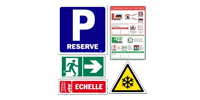
To remain compliant, each specific situation must be covered by suitable signage. Some environments require custom safety signs with activity‑specific instructions, while fire risks call for dedicated fire instruction signs similar to fire safety instruction panels.

How to choose the right hazard warning sign

1. Identify the exact risk: before buying any sign, clearly define the nature of the hazard (physical, electrical, chemical, mechanical, etc.), as this will determine which pictogram you need.

2. Select the correct pictogram: only use pictograms that comply with ISO 7010; each hazard has a standardized code (for example, W012 for electrical hazard).

3. Choose the right material: adapt the material (rigid PVC, aluminum, self‑adhesive vinyl, photoluminescent, etc.) to the environment so that the sign remains durable, legible, and compliant indoors, outdoors, or in harsh industrial conditions.
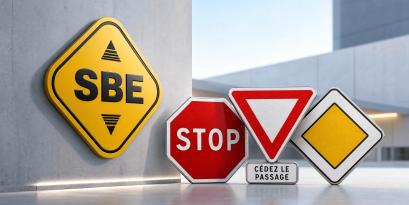
4. Check the size: the size of the sign must match the reading distance – the further away it needs to be seen, the larger it must be, in line with the ratios defined by ISO 7010.

5. Check compliance: make sure the sign carries the ISO 7010 reference and complies with the requirements of the French decree of 2 August 2013 for newly installed safety signage.

Why choose SBE Direct hazard warning signs?

SBE Direct is a specialist in safety signage for professional environments. Here is what sets its hazard warning signs apart:

  • Guaranteed compliance: panels designed in line with NF X 08‑003, ISO 6790, and ISO 7010 so your site stays compliant with current regulations.

  • High print quality: professional screen printing for maximum durability, excellent legibility, and long‑term resistance in demanding industrial environments.

  • Volume discounts: attractive, decreasing prices with discounts of up to 70% depending on the quantities ordered.

  • Custom‑made solutions: customized safety signs tailored to your specific risks, layouts, and internal procedures.

  • Indoor and outdoor use: a wide choice of materials and formats so you can equip both indoor areas and outdoor or exposed zones with the right level of durability.

Continue reading...
These articles too might interest you.

Priority sign: meaning and rules to know

A priority sign is a road sign coded "AB" that sets the order of passage at an intersection or on a given lane. France uses nine priority signs, the most common being the priority road (AB6), priority to the right (AB1), one-off priority (AB2), give way (AB3a), stop (AB4) and end of priority (AB7). Their installation is governed by the IISR, the decree of 24 November 1967 and the NF EN 12899 standard (retro-reflection). Local authorities and managers of private sites open to traffic are responsible for installing and maintaining them a missing or defective sign can trigger their civil and criminal liability in the event of an accident.

Product News
Melissa Oumaouche
970 views

Unknown Shrinkage: How to Reduce It?

Unknown shrinkage (inventory discrepancy) is the difference between theoretical and actual stock in a retail business, representing over 7 billion euros in annual losses in France (1.4% of turnover on average). It stems mainly from shoplifting (39%), internal fraud (28%), administrative errors (21%), and supplier fraud (12%). To reduce these losses, the article recommends combined solutions: anti-theft labels (AM, RF, EM), RFID inventory tags, video surveillance, and staff training. A comprehensive system can reduce shrinkage by 40-60% with an ROI of 6-18 months.

Product News
Melissa Oumaouche
1344 views

How to open a combination safe?

Opening a combination safe requires method, not force. Dial rotation, disc alignment, direction of manipulation: this guide details every step to unlock your safe without stress or mistakes. You'll also discover the common pitfalls that jam the lock and how to avoid them. Forgotten code, lost emergency key, disc lock maintenance or switching to an electronic model: this article covers every scenario to support you in your daily use. Browse our selection of digital safes on SBE Direct.

Product News
Melissa Oumaouche
1579 views

Frequently asked questions

What is the difference between a warning and a prohibition sign?

A hazard warning sign (yellow triangle) indicates the presence of a risk. A prohibition sign (red and white circle) bans a specific behaviour. The first informs about a danger, the second imposes a rule.

Is a hazard warning sign mandatory?

Yes. A hazard warning sign is mandatory whenever a risk cannot be eliminated by other technical or organisational measures. Article R4224‑20 of the French Labour Code requires employers to install appropriate safety signage in such cases, and since 1 January 2014 new signs must comply with the NF EN ISO 7010 standard.

What size should you choose?

Sign size depends on the distance at which the sign needs to be read. ISO 7010 defines minimum dimensions based on viewing distance. As a rule of thumb: 100 × 100 mm for viewing distances up to 2 m, 200 × 200 mm up to around 4 m, and larger formats are required beyond that to ensure good legibility.

Can you create your own pictograms?

No. You cannot create your own safety pictograms if you want your signage to be compliant. The pictograms must follow the NF EN ISO 7010 standard, which defines the shapes, colours and symbols to use.

What is the difference between a workplace hazard sign and a road danger sign?

A workplace hazard sign is governed by ISO 7010 and is used inside companies and public buildings to warn of risks such as electricity, chemicals or machinery; it is not intended to regulate road traffic. A road danger sign is part of the highway code and follows specific road‑traffic conventions (such as the Vienna Convention), with its own shapes, symbols and rules to warn drivers of hazards on the road network

See the author's articles
Melissa Oumaouche

With over 5 years of experience in creating content optimized for search engines, Mélissa is currently Marketing & Product Manager at SBE Direct, where she leads the product catalogue positioning across the e-commerce website and marketplaces, as well as the SEO content strategy in coordination with the marketing team she oversees.

We use cookies to improve your experience.