RFID in store is first and foremost a way of knowing what you have on the shop floor, and where. An RFID tag fitted to an item is read at a distance, with no line of sight, by a handheld reader or by a reader mounted on a gate. Counting is then done aisle by aisle, without taking products off the rails. This guide sets out the uses that hold up in store, those that do not, and the cost items to budget for before launching a project.
Key points
→RFID can support several stages of the customer journey, from finding a product through to its return.
→The benefits depend on the compatibility between the tags, the readers and the store software.
→On its own, an RFID tag is neither an anti-theft system nor a checkout solution.
→Equipment should be chosen from a precise need and validated by trials on your own products.
How does RFID work in a store?
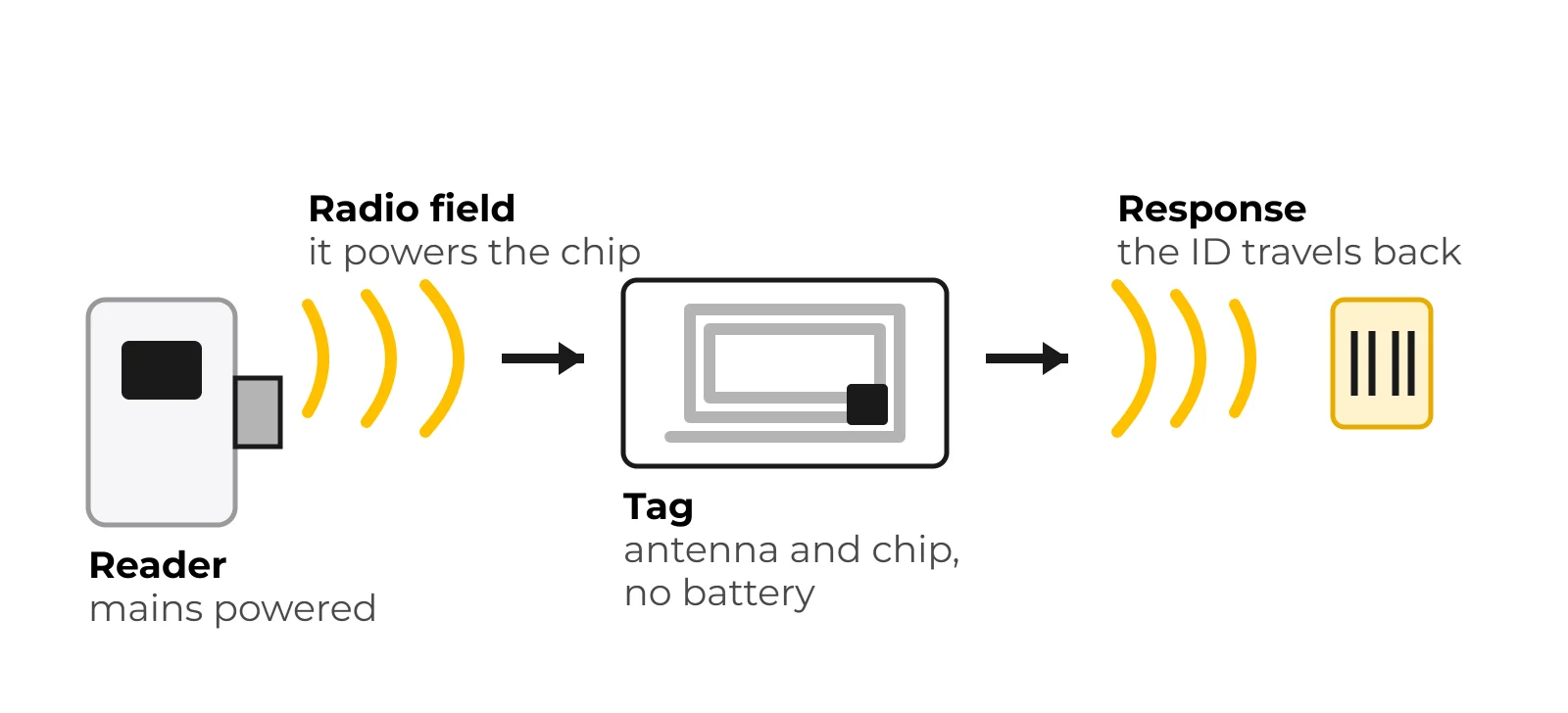
RFID, or radio frequency identification, relies on an exchange of data between an electronic tag and a reader. The tag contains a chip and an antenna. Its identifier allows the software to retrieve the information linked to the item: reference, size, colour or status, depending on the data recorded.
In an equipped store, the same item can be identified at several stages: goods-in, searching the stockroom, checkout or return. The uses available depend on the read points installed and on the connections with the retailer's software.
The tag identifies the product; the IT system gives meaning to the reads. On its own, the tag knows neither its exact location nor its payment status.
What are the benefits of RFID in store?
1. Speeding up the checkout
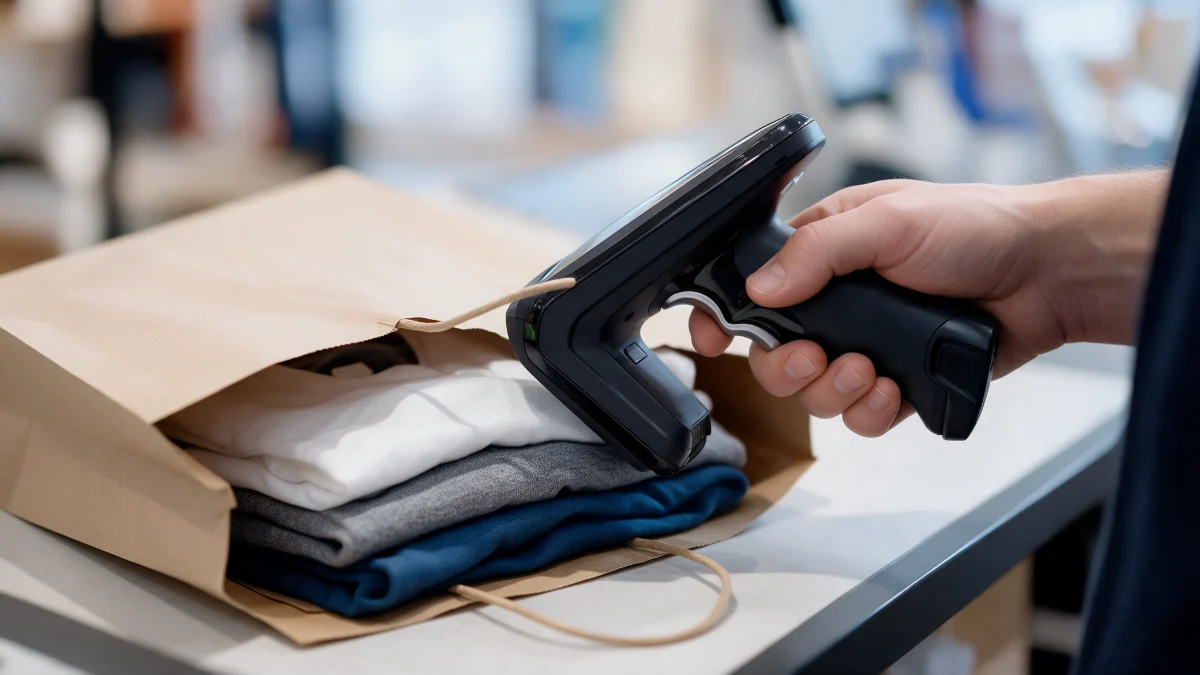
A checkout fitted with RFID can recognise several items placed in a read zone, without scanning each barcode separately. The system then passes the references to the till software to build the basket.
In a clothing store, for example, the customer can drop several pieces into a dedicated tray. Staff check the items recognised before continuing with payment.
This use requires a compatible, correctly tuned installation, so that nearby products are not read by mistake. Recognising the items and taking payment remain two separate operations.
2. Finding an item for a customer more easily
A product can be recorded as available and still be hard to find. It may be in the stockroom, on a neighbouring display or among the items waiting to be put back.
With a reader and an application that offers a search mode, a sales assistant can look for a specific tag. Depending on the equipment, a signal helps them get closer to the product.
The benefit is concrete: when a customer asks for a jacket in another size, the assistant has a search aid. This function should not be confused with permanent tracking of every item's position.
3. Improving product availability on the shop floor
An item sitting in the stockroom cannot be sold as easily if it is missing from the shop floor. RFID can help teams spot the references to put back out, where the setup can distinguish between zones.
In a shoe shop, the aim may be to keep a consistent display of the models available. In fashion, it is mainly about completing the sizes and colours on show.
The commercial benefit comes from the replenishment carried out on the strength of the information gathered. RFID reading supports the decision, but how the team is organised remains essential in making products accessible to customers.
4. Making click and collect preparation easier
Click and collect commits the store to a promise: handing the customer the right items at the time announced. A wrong reference or a poorly recorded availability can lead to a cancellation or to extra waiting.
Linked to order management tools, RFID can help locate products and check the items picked. The team can confirm more easily that it has selected the right variant before handing the parcel over.
To obtain this benefit, store data and website data must be synchronised. RFID helps make the service more reliable; it does not replace the management of reservations and orders.
5. Simplifying returns and exchanges
Where each item carries a unique identifier linked to its sales history, RFID can make checks easier when it is returned.
The member of staff can retrieve the information available in the system: the item concerned, the associated transaction or the purchase channel. This identification is useful when a retailer accepts in-store returns of orders placed online.
It complements the usual checks, in particular on the condition of the product and the return conditions. Its effectiveness assumes that the tag is still readable and that the sales data is accessible.
6. Strengthening control over goods leaving the store
RFID can contribute to loss prevention when it is built into a suitable surveillance setup. Readers placed at the exits can identify the items detected and check their status in the system.
If a product is not recorded as sold, an alert can be triggered according to the rules defined. This approach provides information about the item concerned, beyond a simple detection signal.
A standard RFID tag does not, however, automatically replace an anti-theft system. Control rests on the setup as a whole: tags, readers, software and up-to-date transactions.
7. Giving sales staff more time to advise customers
Looking for a product, checking an order or identifying a return are necessary tasks, but they can take sales staff away from the shop floor.
By making these operations easier, suitable RFID equipment can free up time to welcome customers, explain the differences between two products or suggest an alternative.
For your store, the objective deserves to be measured concretely: how many minutes go into one search? How many orders need a second check? Time saved becomes useful when it genuinely improves how the team is organised and how available they are.
Tags read by an operator walking the aisles with a handheld reader.
The result depends on the quality of tag encoding and on how well the product database is maintained.
Daily replenishment
A record of the references present on the shop floor, then compared with theoretical stock.
The frequency of the count must match the replenishment rhythm, otherwise the data is already out of date.
Goods-in
Checking cartons on arrival, before they reach the shop floor.
The supplier must apply the RFID tag at source, otherwise goods-in stays on barcodes.
Finding an item in the stockroom
Reading at a distance to locate a reference in compact storage.
Location accuracy depends on the number of antennas and on where they are installed.
Tracking items in fitting rooms
Textile tag read on return to the checkout or to the stockroom.
Best kept for high-value or slow-moving items.
Shrinkage control
EAS or RFID tag paired with a detection gate.
RFID alone does not stop a theft: see the section « What RFID does not do ».
Checkout
Tag read to identify the item.
Checkout remains a manual or assisted operation, not automatic payment.
What RFID does not do
RFID is often presented as an answer to everything. In store, three misunderstandings keep coming up.
It does not replace an anti-theft system
An RFID tag identifies an item. It does not stop that item leaving the store. To deter theft, you need a detection setup: an EAS anti-theft label, a gate, an alarm. An RFID tag can be combined with an anti-theft function, but it is the gate and the alarm that trigger the alert, not the chip on its own.
It does not geolocate an item
RFID does not give a GPS position. A reader indicates that a tag is within its read field, at a distance that depends on the frequency, the antenna and the environment. In store, we talk about a read zone, not about coordinates. To track a parcel on the road, you use a GPS tracker, not an RFID tag.
It does not take payment automatically
A basket that pays for itself remains a demonstration scenario. At the checkout, RFID can identify items and speed up entry, but payment, checking and validation remain separate human or software steps. No store can do without a properly framed checkout.
What it does do, on the other hand
It counts fast, it counts without line of sight, and it produces data that can be used for replenishment and stocktaking. That is already a great deal. It is not the same thing as securing, locating or taking payment.
How much does an RFID project cost in store?
An RFID project is costed store by store, aisle by aisle. The amounts vary too much from one outlet to another for a single price to mean anything. Here are the items to have your suppliers quote, in this order.
1. The tags
The first item is the most visible: one tag per article, renewed at every replenishment. The cost depends on the format, the material, the quantity ordered and the level of personalisation (printing, encoding, numbering).
Ask for a unit price and a price per thousand, on the real volume of your assortment.
2. The readers
A handheld reader for stocktakes, a fixed reader or a gate for goods-in or for exits. The quote must state the number of devices, the accessories (antennas, pistol grips, batteries, chargers) and the length of the warranty.
3. Infrastructure and installation
Cabling, mounts, power supply, antenna positioning, coverage testing. This item is often underestimated: a badly placed antenna produces missed reads or stray reads.
4. Software and integration
The software has to talk to your till system and your stock management. Ask for the cost of the licence, of the integration and of future developments. Make clear who carries the maintenance.
5. Encoding and application
Encoding the tags, printing them, applying them to the items or having the supplier apply them. This item includes labour and set-up time.
6. Training and support
Sales and stockroom teams need to learn how to read, how to count and how to handle discrepancies. Allow for training time and for the period of dual running, during which the old and the new system work side by side.
7. Post-launch follow-up
Consumables, replacement of damaged tags, updates, support. An RFID project is judged over time, not on its first week.
How to compare two quotes
Ask every supplier for the same scope: number of items tagged, number of readers, number of stores, length of the service. A quote that is cheaper on tags can cost more on integration. Compare item by item, not on the total.
Is RFID right for your store?
Whether a project makes sense depends more on the difficulties you face than on the size of the business alone. Before choosing your equipment, identify the situations that cost time or lose sales.
A small shop can start with one targeted use. Conversely, a retailer with few references and procedures that already work well may have less to gain from a wide rollout.
To assess the economic case, take the whole project into account: consumables, readers, any antennas, software, integration, training and maintenance. Compare that cost with the gains observed during a trial, without assuming an automatic rise in turnover.
What to check before choosing your RFID equipment
Compatibility between tags, readers and software
Not all RFID tags answer the same uses. Check the frequency, the protocol supported and how far your system can actually exploit the data.
Also ask your supplier how the reads will be linked to store operations. A reader able to identify a tag is not enough to trigger a payment or to update an order.
Matching the tags to your products
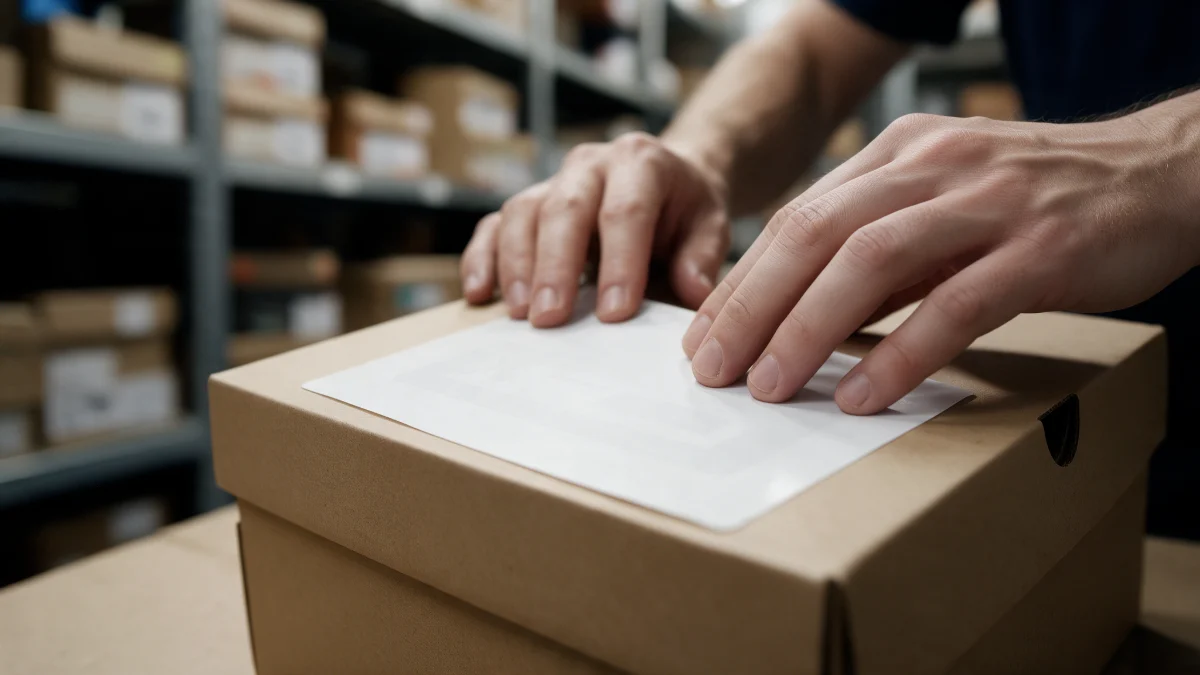
Format, fixing method and application surface are among the criteria to examine. A tag designed for cardboard packaging does not necessarily meet the constraints of a metal product or a textile.
Browse our range of RFID tags to compare the formats and specifications available. The choice must be validated with the reading equipment planned and under real store conditions.
Results of a trial on a limited scope
Start with one product family or one precise use. Prepare a few representative scenarios: finding an item that has been moved, identifying several products grouped together or checking an order.
To compare the situation before and after the trial, track simple indicators:
→The average time needed to find an item
→The number of errors when picking orders
→The time spent identifying products at the checkout
→The frequency of missed or unwanted reads
→How easy the equipment is for the teams to use
These observations will help you choose the right equipment and adjust the way you work before a wider rollout.
FAQ
Is RFID useful in a small shop?▾
It can be, if it answers a recurring difficulty: searching for references, picking orders or handling items at the checkout. A targeted trial makes it possible to assess whether the gains justify the cost of the equipment.
Does an RFID tag replace an anti-theft system?▾
Not on its own. To take part in monitoring exits, it has to be built into a compatible system able to detect the item and check its status.
Can barcodes be kept alongside RFID?▾
Yes. The two means of identification can coexist. Their use must be organised in the software so that references are matched correctly and double entries avoided.
Do I need to change my till software?▾
Not necessarily. You need to check with the publisher whether the software can receive and process data from an RFID reader. Depending on the installation, an additional connection, a module or a change of solution may be needed.
Does an RFID tag act as an anti-theft device?▾
No, not on its own. An RFID tag identifies an item. To deter theft, you need a detection setup: an EAS anti-theft label, a gate, an alarm. An RFID tag can include an anti-theft function, but it is the gate that triggers the alert. The choice is therefore made according to the risk in each aisle, not according to the technology alone.
Which RFID tag should be used on a garment?▾
A textile tag, designed to be sewn or heat-sealed onto the garment and to withstand washing. It is chosen according to the fabric, the space available on the care label and the method of application, in the workshop or at the supplier. A standard paper label is not suitable for an item that is worn and washed.
How do you carry out an RFID stocktake in store?▾
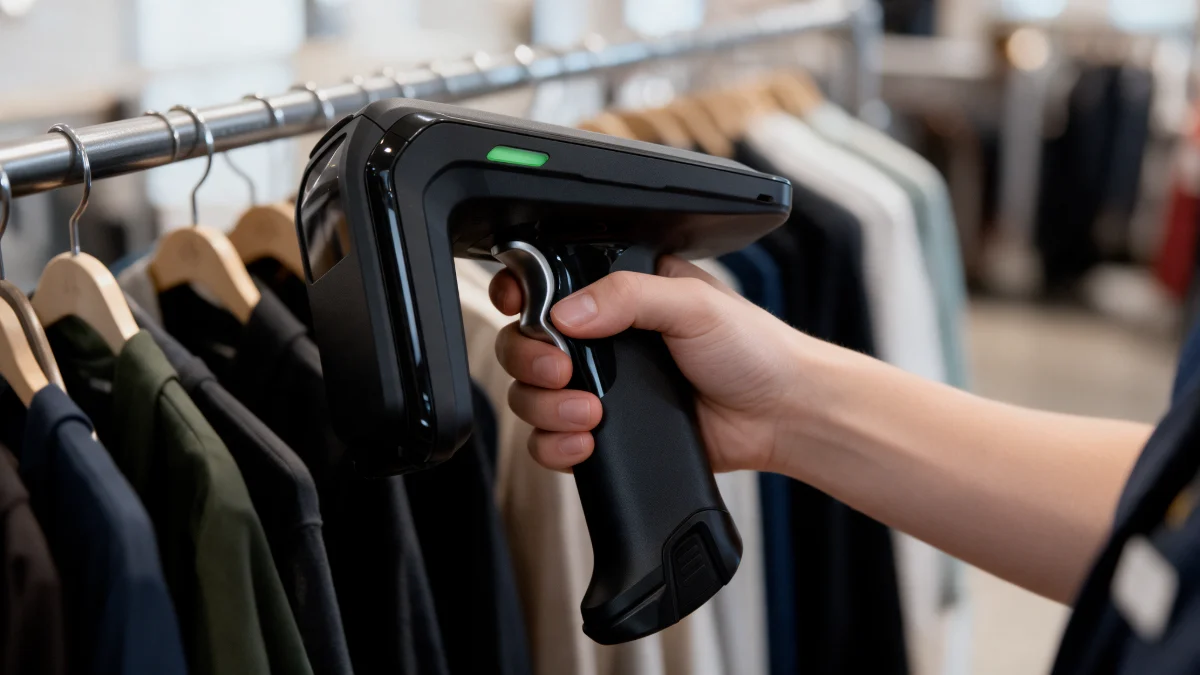
An operator is equipped with a handheld reader, walks the aisles, and each tag read is compared with the product database. The operation is repeated aisle by aisle. The quality of the result depends on three things: correctly encoded tags, an up-to-date product database and a reading protocol that stays the same from one stocktake to the next.
Looking to fit your items with RFID?
Tell us about your surfaces, your fixing constraints and your reading equipment so we can guide you towards the right references.
With over 5 years of experience in creating content optimized for search engines, Mélissa is currently Marketing & Product Manager at SBE Direct, where she leads the product catalogue positioning across the e-commerce website and marketplaces, as well as the SEO content strategy in coordination with the marketing team she oversees.