Aluminium labels: choosing the substrate, the marking and the adhesive

Aluminium labels: choosing the substrate, the marking and the adhesive

An aluminium label is not chosen from a catalogue. It is chosen on three figures: the temperature the adhesive genuinely withstands, the thickness that suits the application geometry, and the marking process that will keep the code legible in five years. Everything else - colour, format, packaging - is settled afterwards.

The metal itself is almost never the weak point. An aluminium plate withstands 660 °C without melting. It is the adhesive that lets go, or the marking that wears away. This guide gives the figures, the standards and the order of decisions, so that the specification holds up in front of a purchasing department as well as an auditor.

In brief: the three decisions that set the service life

  1. The service temperature is the adhesive's, not the metal's. A label on a housing that reaches 120 °C does not hold because aluminium resists: it holds because the adhesive has a higher continuous rating. The gap between a standard reference and a high-performance one is decided there, and nowhere else.
  2. The thickness follows from the application. On a 20 mm cable or a curved drum, 0.07 mm of ultra-flexible aluminium bends to shape; 1 mm lifts at the edges. On a riveted plate, the opposite: below 1 mm thickness for a 3 to 4 mm hole, the rivet head deforms the sheet and the metal splits around the hole.
  3. The process decides permanence. Anodising and laser engraving mark into the material: there is nothing to erase. Screen printing and thermal transfer lay a layer on the surface: faster, less durable. Fixed data or unit-level numbering often decides for you.

A label that ticks all three stays put. A label that misses one comes off, fades, or becomes unreadable without warning.

Label, plate or metallised label: three different products

These three objects have neither the same use nor the same price, and confusing them loses tenders.

The metal label - in the broad sense, the term covers any adhesive metal carrier. An aluminium label is a finished product: a thin metal substrate, an industrial adhesive, a permanent marking. It is what you stick on an IT estate, on tooling, on a drum.

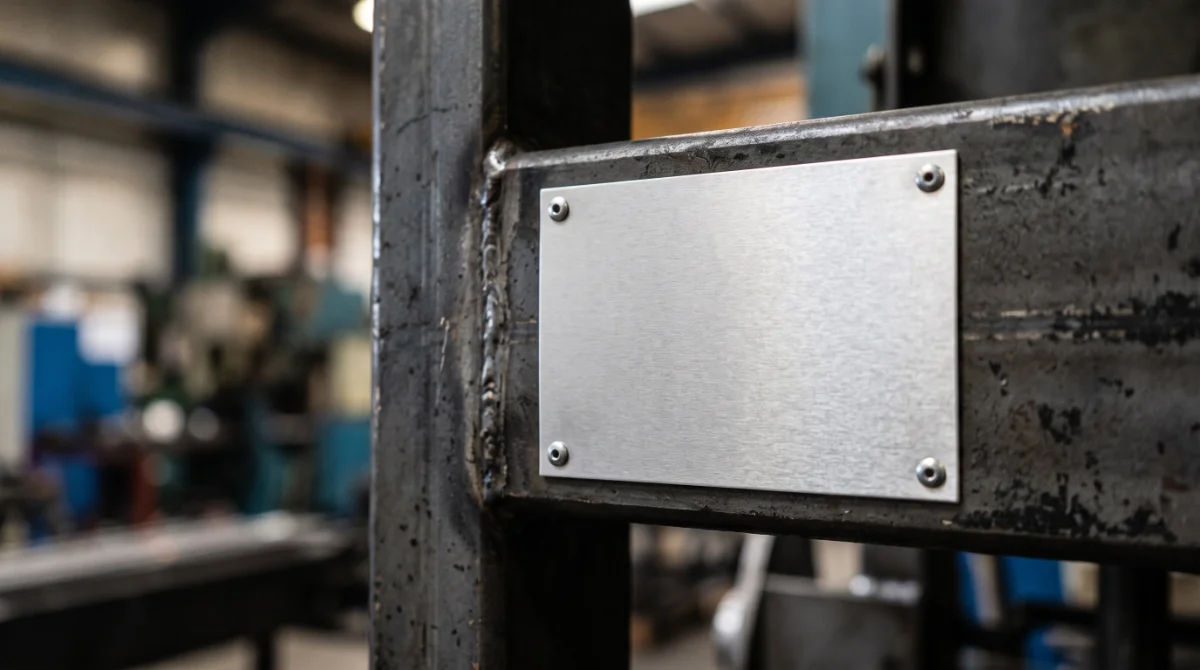
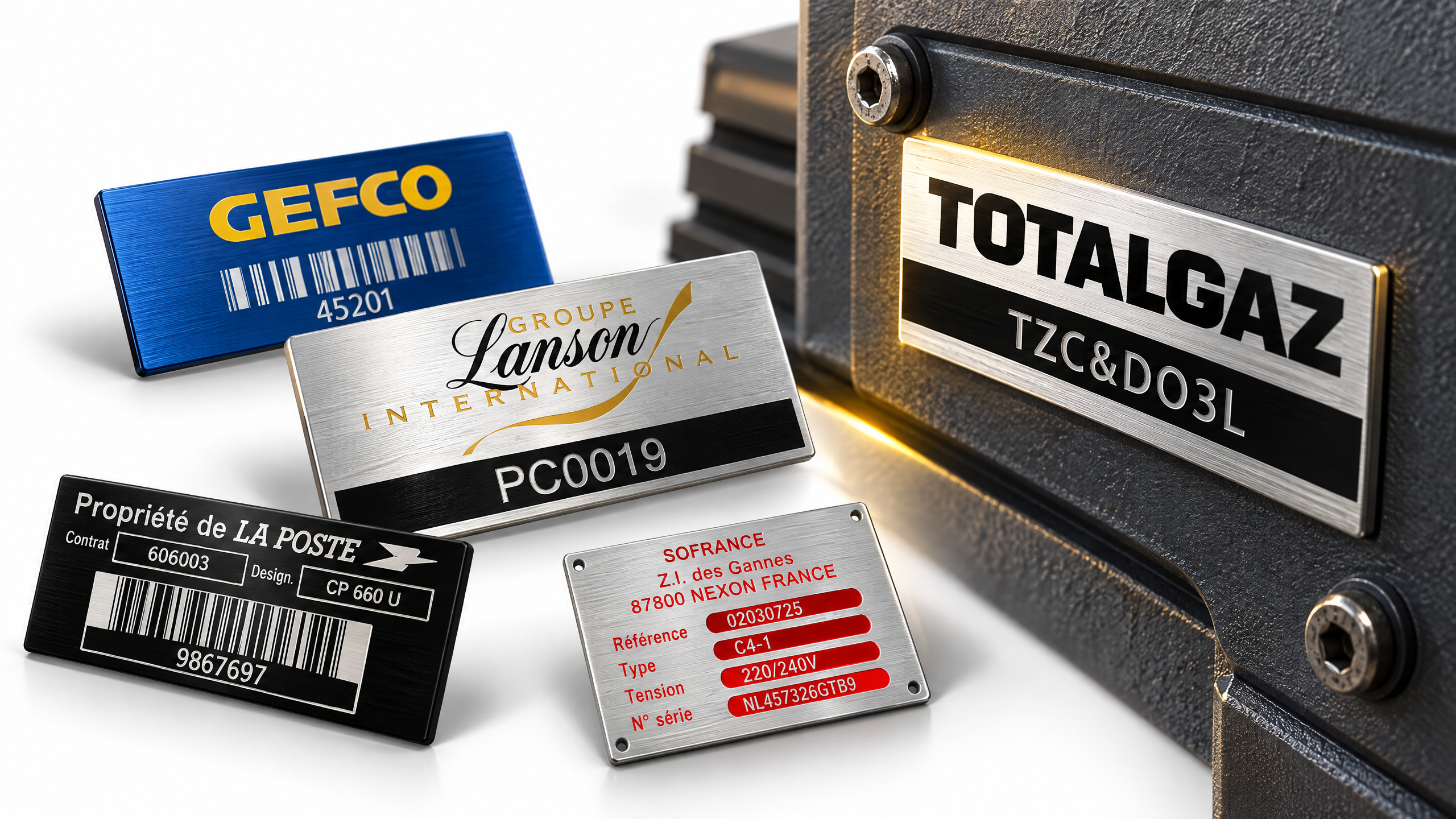
The engraved aluminium plate is thicker and more rigid. It can be drilled, riveted, screwed. It is the format for machines, electrical cabinets and equipment that has to carry an identification for the life of the asset - and sometimes beyond. It is ordered through a different channel from the adhesive label, with its own drilling tolerances.

The metallised label is a plastic film with a silver finish. It imitates aluminium to the eye, not in service: it withstands neither fire, nor solvent, nor pressure washing. If the specification says "metal", it does not qualify.

A riveted plate calls for 1 mm minimum thickness with a 3 to 4 mm hole: below that, the rivet head splits the sheet.

For rigid machine nameplates, drillable and anodised through the material, the dedicated range is on the 3M adhesive aluminium plates page, with the formats and drilling options.

Why aluminium rather than a plastic film

Four properties, all verifiable, explain why you pay three to ten times the price of a polypropylene.

It does not melt at process temperature. Melting point around 660 °C. A polyester deforms from 150 °C, a polypropylene well before. On a part near a furnace, an exhaust or a weld, the debate is closed.

It protects itself. In air, aluminium covers itself within minutes with a native oxide layer that blocks further oxidation. Anodising industrialises that phenomenon: the layer is thickened, coloured and sealed. The result is a surface that does not rust and does not peel.

It is light. 2.7 g/cm³, roughly a third of steel. A 1 mm plate weighs nothing and puts no strain on a thin support or a cable.

It is recyclable. Recycling aluminium takes around 5 % of the energy of primary production, and the recycled metal keeps properties close to primary. An argument that counts more and more in public tenders.

The downside: it conducts electricity and heat, it is opaque to radio signals (barring a specific on-metal design), and it costs more per piece. You do not choose it by default.

The five families of aluminium label

Five families cover most needs. Naming them correctly saves rounds of quotations.

  1. The thin-film self-adhesive aluminium label. 0.07 mm ultra-flexible or 0.15 mm flexible. It bends onto a cable, a pipe, a handle, a cover. It is the flexible aluminium label of IT estates and tooling: 100 % metal, very hard to tear off by hand, laser engraved. On a tight radius of curvature, it is the only option that does not lift at the edges.
  2. The rigid anodised label. 0.8 mm or 1 mm. It does not bend, it is applied flat. It is the best seller, and the best durability-to-price ratio for fixed assets, machines and nameplates.
  3. Lacquered aluminium. The difference between anodised and lacquered aluminium lies in the manufacturing method, not in the colour. Anodising transforms the metal at the surface: the oxide layer is part of the piece, coloured through the material. Lacquering applies a paint onto the metal. The direct consequence: on lacquered stock, a laser removes the paint and reveals the metal - the contrast is sharp, but the marked area is no longer protected. On anodised stock, the laser engraves into the oxide and leaves a marking that does not move.
  4. Surface finishes. Brushed, mirror, colour, four-colour. They serve brand image on a nameplate and have no effect on durability. Only pay for them if somebody looks at them.
  5. The on-metal RFID label. An antenna tuned to work when applied to metal, where a standard RFID label reads nothing. It adds contactless identification to the visual one, without replacing the engraved marking.

The full range of anodised aluminium labels runs from 0.07 mm to 1 mm, with 3M 300LSE adhesive on every reference.

Marking techniques on aluminium, compared

Laser engraving on aluminium is the most requested technique, for a simple reason: it is the only one that produces a unit-level, permanent marking with no consumable. But it is not the only one, and five processes share the field.

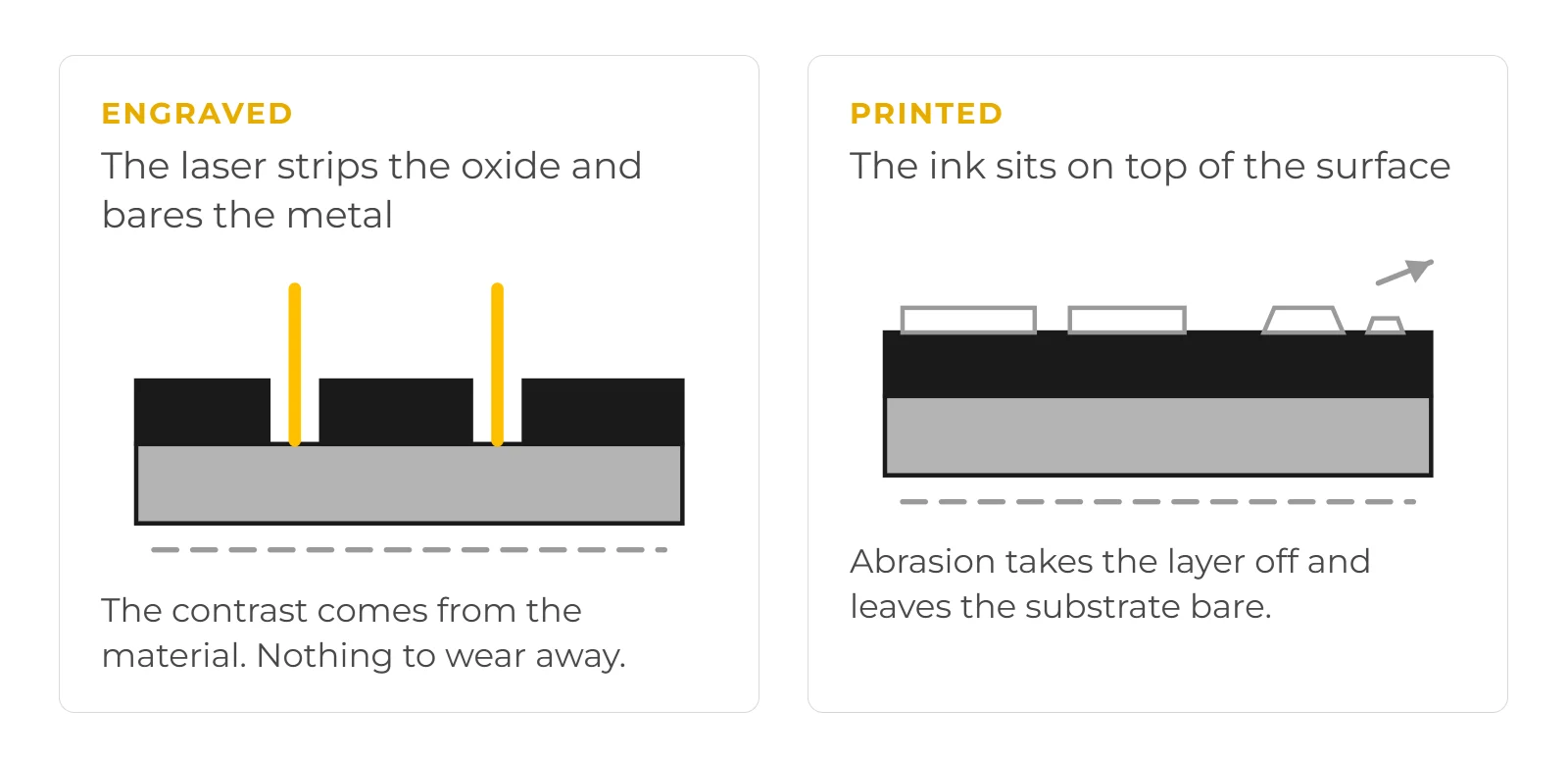
Engraving strips the oxide and bares the metal: the contrast comes from the material. Ink, by contrast, sits on top and goes with abrasion.
Process What it does Permanence Variable data Typical run
Dyed anodisingThe dye penetrates the pores of the oxide before sealingVery high, through the materialNo, fixed contentMedium to large
Laser engravingThe beam removes the anodised layer, the bare metal provides the contrastIndelible, no inkYes, unit number, barcode, DataMatrixFrom 100 pieces
Screen printingInk laid on the surface, dried or UV curedGood, wears under abrasionNo, or per sheetLarge
Thermal transferResin ribbon on a coated or lacquered carrierMedium, depends on the carrier and ribbon pairingYes, per unitSmall to medium
Cold stampingMechanical punching into the surfaceVery high, the metal is deformedYes, manual or with a numbering headSmall, maintenance

Three concrete trade-offs behind this table:

  • →Fixed content and high volume → anodising or screen printing. The unit cost collapses, unit-level personalisation disappears.
  • →Sequential numbering, barcode, DataMatrix → laser engraving. No ribbon, no ink, no possible rework.
  • →A plate already in place, to be completed on site → cold stamping, with a manual numbering head or a marking case.

Watch out for thermal transfer on aluminium: the ink does not adhere the same way on bare anodised stock and on lacquered stock. That pairing is never validated without a trial on the exact reference. Laser marking on anodised aluminium remains the only one that depends on neither a ribbon nor a print head temperature.

The six criteria for choosing your aluminium label

Six questions, in this order. They eliminate most references before price even comes up.

  1. The real service temperature. Not the metal's: the surface temperature at the bonding point, in operation, including start-up peaks and cleaning cycles. A label on a hot cover does not go through the same thing as a label on the cold frame 30 cm away.
  2. Chemistry. Solvents, cutting oils, degreasers, plant protection products, pressure washing, steam. Aluminium copes; the adhesive and the marking do not.
  3. The expected service life. Three years, ten years, the life of the machine. That figure is what justifies - or does not - moving from plastic film to aluminium.
  4. The thickness, derived from the geometry. On a flat and rigid surface, 0.8 mm is a good compromise. On a curved surface, 0.07 mm or 0.15 mm. On a drilled and riveted plate, 1 mm minimum for a 3 to 4 mm hole: below that, rivet pressure deforms the plate and weakens the metal around the hole.
  5. The fixing. Adhesive or mechanical. Adhesive is enough in 90 % of cases, and very hard to tear off by hand. Drilling, rivets or screws become necessary when the part is subject to mechanical stress, to repeated washing, or when traceability requires a tamper-proof fixing.
  6. Volume and lead time. This is where the order settles: 500 pieces minimum on the standard references in the range, small runs from 100 pieces on the engraved 1 mm reference, with a short lead time. A maintenance team that needs 40 plates is not on the same channel as an estate-wide rollout.

And a seventh criterion, often forgotten: the verification grade required. It belongs to the specification, not to the supplier.

Which adhesive for an aluminium label?

This is the real weak link in the stack. You bond a metal onto a metal, a painted plastic, a composite or a powder coating - and it is that interface that decides everything.

An acrylic only reaches its final strength in 24 to 72 hours: a label pulled within the hour after application has not yet reached its definitive hold.

Two families dominate the professional market: high-performance acrylics and rubbers. Acrylics hold over time, resist UV and moderate heat, and adhere to metal, glass and hard plastics. Their final strength builds over 24 to 72 hours. Rubbers offer immediate tack on recycled board and wood, cost less, and age badly.

On SBE aluminium labels, the adhesive is 3M 300LSE, a high-performance acrylic designed for rough and low surface energy substrates. Its typical values, as 3M publishes them:

Adhesive Prolonged rating Peak rating Target
3M 300LSE93 °C continuous149 °C peakRough surfaces, low surface energy, painted metal
3M 200MP familydepends on reference204 °C peakHot parts, metal and glass, short cycles

Two cautions when reading this. First, 3M describes these figures as typical values, measured for exposures of a few minutes to a few hours depending on the line: they are not contractual guarantees, and the hold depends on the surface, the application pressure and the bond design. Second, the answer to "up to what temperature does an aluminium label withstand" is never a single number: it is a pairing of duration and temperature, plus a surface.

The surfaces behind one failed bond in two, in practice: cold and condensation, a greasy film or release agent residue, dusty board, polyethylene, powder coating, strongly curved surfaces. On those, a standard adhesive lifts within 48 hours even when perfectly applied.

The application test, in three minutes

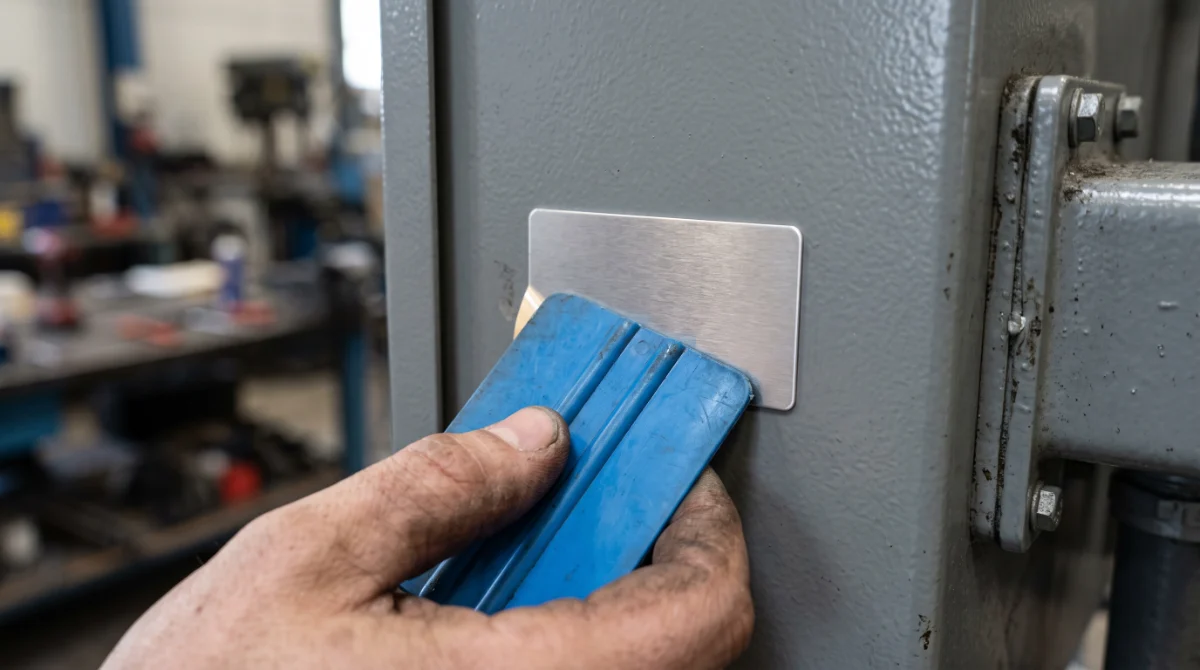
Degrease, apply, press firmly across the whole surface with a squeegee, wait 24 hours, pull. If the label comes away without resistance or leaves a film behind, the problem is the interface, not the label.

Barcodes and QR codes on aluminium: guaranteeing readability

An engraved code does not wear away. It can still never read. Three parameters decide.

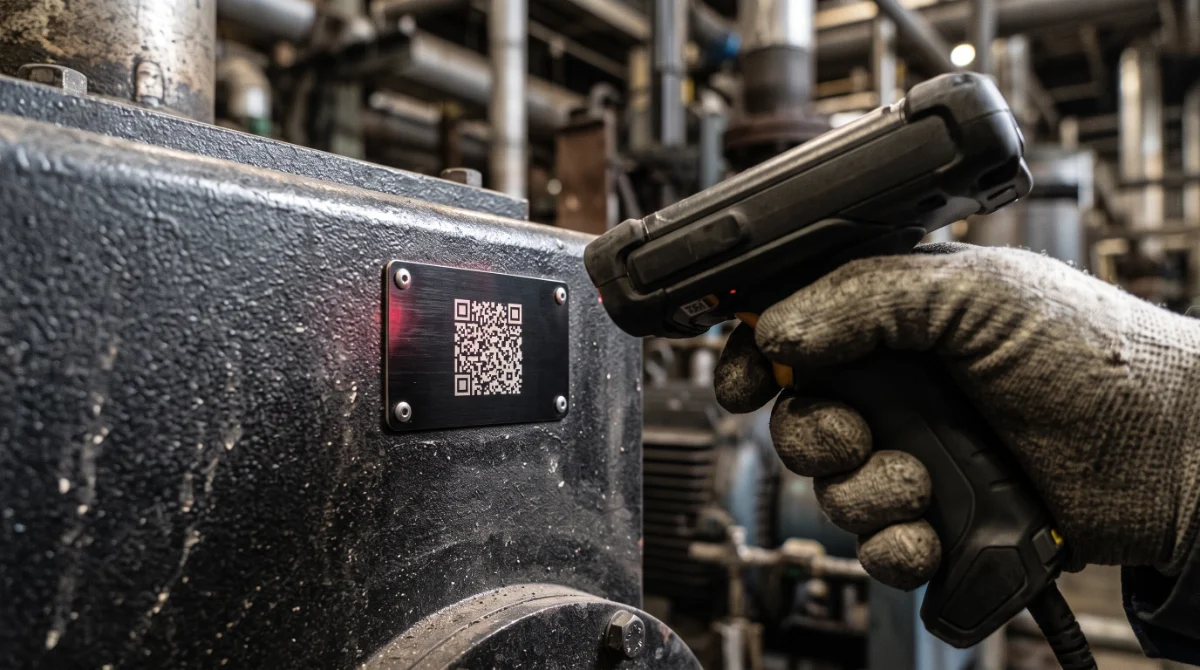
The symbology and the content. For industrial and defence use, Data Matrix ECC200 is the reference: it is the minimum symbol required by MIL-STD-130, and the format adopted by the GS1 DataMatrix standard. It holds large quantities of data in a compact square, which counts on a 40 × 15 mm plate. The QR code suits cases where the reader is a smartphone or a recent terminal.

Module size and contrast. On engraved black anodised aluminium, the contrast comes from the bare metal: it is excellent, but the engraving edges have to be clean. A module that is too fine forgives less than a code printed on paper, because there is no ink margin to make up for it.

Measurement, not eyesight. A code is validated with a verifier, to ISO/IEC 15415 for 2D symbols. The grade is written on a 0 to 4 scale (A = 4, B = 3, C = 2, D = 1, F = 0) and is recorded with the measurement conditions: aperture, wavelength, angle.

A Data Matrix ECC200 verified at grade B is a good production result - 3.0 on the scale - but it has to be quoted in full, for example 3.0/10/660/45°, and compared with the minimum the specification requires. Grade B is not a pass for every use.

A reader says "it scans". Only a verifier gives a grade, and it is that grade an auditor asks for.

A smartphone, even with a good application, does not measure a grade: it says "it scans". That is not the same information, and an auditor will not settle for it.

The full method for setting an X-dimension, choosing the ribbon and validating a code before rollout is set out in the guide how to choose a barcode label in five steps.

Aluminium, stainless steel or polyester: when to change material

Aluminium is not always the right answer, and stainless steel even less so. The table below is there to decide, not to rank.

Criterion Anodised aluminium Stainless steel Polyester
Usable thickness0.07 to 1 mm0.5 to 1.5 mm50 to 250 µm
Temperature ratingVery high (melts at 660 °C)Very highMedium, deforms from 150 °C
Chemistry and solventsExcellentExcellent, including acidsGood, except strong solvents
Abrasion and UVExcellent, marking through the materialExcellentGood, may yellow
WeightLow (2.7 g/cm³)High (7.9 g/cm³)Very low
MarkingLaser engraving, anodisingLaser engraving, stampingResin thermal transfer
Relative costHighVery highModerate
When to choose itFixed assets, machines, durable outdoor use, hot partsMarine environments, aggressive food processing, explicit customer requirementMixed use, workshop, medium service life
When to avoid itStrongly curved surface with no flexible version, tight budgetNeedless weight and cost, thin surfaceHot part, solvents, more than three years outdoors

Two field rules. Polyester is enough for a clean workshop and three years of use; moving to aluminium is justified by duration, heat or a requirement for permanent marking - not on principle. And if an engraved aluminium plate is already imposed by a customer specification, the only remaining trade-off is thickness and drilling.

Applications and standards by sector

Four regulatory frameworks come up constantly in specifications. Knowing them avoids discovering the requirement after the order.

Machinery - Regulation (EU) 2023/1230. It replaces Directive 2006/42/EC from 20 January 2027. The CE marking must be visible, legible and indelible on the machine; beyond CE, Annex III requires identification information that varies by machine category - name and address of the manufacturer, designation, type or model, serial number, year of construction, and in some cases rated power and mass. In practice, that translates into an engraved aluminium nameplate, whose content is checked machine by machine.

Defence and military property - MIL-STD-130. For an item identified under IUID, the standard requires a machine-readable mark containing the UII data set, with Data Matrix ECC 200 as the minimum symbol, accompanied by human-readable information except where space is lacking. The mark must remain durable and legible for the life of the item. That is the framework that pushes towards metallic aluminium rather than a film.

Cabinets and terminal blocks - IEC 60445. The identification of terminals and conductors by colour, symbol or alphanumeric code follows this standard, with reserved colours: green-and-yellow for the protective conductor, blue for neutral, black, brown or grey for phases. Identification labels inside cabinets are frequently engraved aluminium, precisely because they do not come off during interventions.

Safety signage - ISO 7010. Evacuation and emergency pictograms fall under this standard, including photoluminescent versions. It is not the same product as an asset label, but the two coexist on one site, and consistency across the range often makes the difference in a tender.

One last, very concrete case: metrology labels for agricultural sprayers must meet the requirements of the French Ministry of Agriculture and resist plant protection products. Anodised aluminium is chosen there for its chemical resistance, not for its looks.
Checklist before requesting a quotation

Eight pieces of information. A quotation request that contains all of them is handled in a day; an incomplete one takes three rounds.

  • →The exact surface: painted metal, bare metal, plastic, composite, powder coating, and how clean it is.
  • →The service temperature at the bonding point, peaks included.
  • →The aggressions: solvents, oils, washing, UV, abrasion, immersion.
  • →The expected service life, in years, not in adjectives.
  • →The thickness and the geometry: flat or curved, radius, and whether the plate is drilled - with the hole diameter.
  • →The content and the process: fixed or variable data, presence of a barcode or a Data Matrix, grade required.
  • →Volume and lead time: 500 pieces minimum as standard, small runs from 100 pieces on the 1 mm reference.
  • →The proof of conformity expected: customer standard, MIL-STD-130, machinery regulation requirements, or simply a code verification report.

Three points of caution, learned the hard way. Never approve a quotation without a 24-hour application trial on the real surface - not a catalogue sample stuck on a desk. Never order the full run without having checked a code on a verifier, not on a smartphone. And never assume that a marking legible today will be legible in three years: that is exactly what engraving through the material guarantees, and what an ink does not.

Unsure about the surface or the temperature?

Tell us the bonding surface, the temperature at the application point and the volume: we will settle the thickness, the adhesive and the marking process.

See the aluminium labels →

Frequently asked questions

Up to what temperature does an aluminium label withstand?▾

Two answers not to be mixed up. The metal holds: aluminium melts around 660 °C. The assembly holds less, and it is the adhesive that sets the limit. On the aluminium labels in our range, the 3M 300LSE adhesive is rated 93 °C continuous and 149 °C peak. A reference based on the 3M 200MP family goes up to 204 °C peak. These values are typical, published by 3M, and depend on the surface and the exposure duration: beyond a few hours at high temperature, you need a data sheet and a trial, not an extrapolation.

What is the difference between anodised and lacquered aluminium?▾

Anodising transforms the metal at the surface: an oxide layer forms and becomes an integral part of the piece, coloured through the material and sealed. Lacquering applies a paint onto the metal. On a label, that changes everything about the marking: a laser on anodised stock engraves into the oxide, with no consumable and no loss of protection; a laser on lacquered stock removes the paint and reveals the metal, with sharp contrast but an unprotected marked area. For outdoor or workshop use, anodised ages better.

What thickness for a riveted plate?▾

1 mm minimum for a 3 to 4 mm hole. Below that, the rivet head compresses the sheet, deforms it around the hole and the metal splits on application or a few months later. On an undrilled plate, applied flat, 0.8 mm is enough in most cases. On a curved surface, you have to go the other way, down to 0.07 mm or 0.15 mm - and give up drilling.

Does marking on anodised aluminium wear away?▾

No, provided the marking is made within the oxide layer. Laser engraving locally removes the anodising and reveals the metal: the contrast comes from the material, not from an ink. It does not come off with solvent, UV or rubbing. By contrast, a marking by thermal transfer or screen printing lays a layer on the surface, which wears under abrasion. The question to ask the supplier is therefore not "does it hold?" but "where is the marking: in the material or on it?".

Can a laser-engraved barcode on aluminium be read?▾

Yes, provided the code is validated on a verifier. The bare metal against black anodised contrast is excellent, but a module that is too fine passes on a bench and fails on a fixed reader a metre away, at a different angle. For a Data Matrix, aim for at least grade B to ISO/IEC 15415, recorded with its measurement conditions. An engraved code does not degrade over time, which is its main advantage over a printed one.

What is the minimum order quantity?▾

500 pieces on the standard references in the anodised aluminium range - that is the production launch threshold. For a smaller need, the engraved 1 mm reference is available in small runs from 100 pieces, with a short lead time, which covers estate extensions, replacements and pilots before rollout.

Melissa Oumaouche
See the author's articles
Melissa Oumaouche

With over 5 years of experience in creating content optimized for search engines, Mélissa is currently Marketing & Product Manager at SBE Direct, where she leads the product catalogue positioning across the e-commerce website and marketplaces, as well as the SEO content strategy in coordination with the marketing team she oversees.

We use cookies to improve your experience.