A hospital wristband makes sure the right care reaches the right patient at every step of a hospital stay. This guide explains what the wristband is for, what the different colours mean and how to choose the right model for your wards. You will find a clear colour-code table, a materials comparison and the key safety principles behind patient identification.

A hospitalised patient moves through several departments and meets dozens of professionals within hours. How do you guarantee, at every point of care, that you are treating the right person? What do coloured wristbands actually signal?

What information should they carry? This complete guide answers all of these questions and helps you equip your wards with the right hospital wristbands.

What is a hospital identification wristband for?

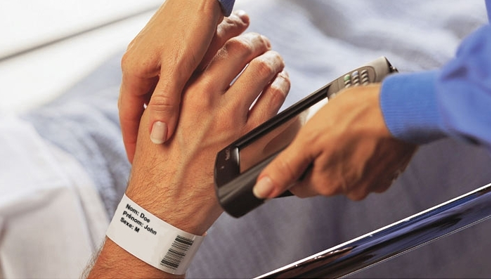
A hospital identification wristband is a band worn on the wrist that reliably links a patient to their medical record throughout their stay. It reduces the risk of identity errors - wrong patient, wrong procedure, wrong treatment - by keeping identification verifiable at all times, including when the patient cannot answer for themselves.

This requirement has a name: patient identification safety, known in France as identitovigilance. Health authorities require unique, reliable patient identification at every stage of care, and wearing a wristband is a recommended safety barrier from the moment of admission. 

In France, the National Health Identifier (INS) has been mandatory since 2021 for referencing health data, reinforcing the wristband's role as a physical identification support consistent with the digital record.

In practice, the wristband delivers three measurable benefits for care teams:

  • Reliability: it is tamper-proof, tear-proof and water-resistant, so it stays readable from the operating theatre to the ward;
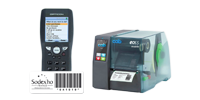
  • Speed: fitted with a barcode, it lets staff read and update the electronic medical record in a single scan, for example with a compact barcode data collector;
  • Traceability: every examination feeds one shared record, accessible to all professionals.

All inpatients are covered - including emergency and outpatient care - with the notable exception of residents in long-term care facilities and psychiatric units, where other identification methods apply.

What information goes on a patient wristband?

There is no single mandatory list of fields: each facility sets its own protocol. In practice, hospitals favour a support that is readable both by eye and by machine, combining printed text with a 1D or 2D barcode to make information flow reliable.

The data most often carried on a patient identification wristband includes:

  • the patient's first and last name;
  • the permanent patient identifier (or National Health Identifier);
  • sex;
  • date of birth;
  • date of admission;
  • blood group, where relevant.

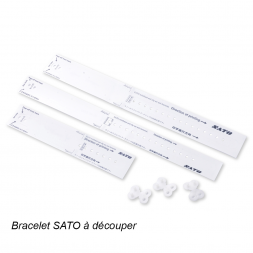
Once fitted with a tamper-evident snap closure, the wristband cannot be removed or swapped without being destroyed: this property is what turns it into a safety barrier rather than a simple accessory. For wards that print on demand, the SATO printable patient wristband prints the barcode straight from the hospital information system.

What do the colours of hospital wristbands mean?

The colour of a hospital wristband communicates a critical piece of information at a glance: an allergy, a fall risk or a resuscitation instruction. In the United States, a standardised colour code became widespread so that "all staff speak the same language"; in France, there is no single national standard on the subject.

The most widely used colour code, promoted by US patient-safety organisations, reads as follows:

ColourMeaningTypical use
RedKnown allergyAlert before any treatment or examination
YellowFall riskReinforce monitoring and support
PurpleDo not resuscitate (DNR)Respect advance directives
PinkLimb restrictionAvoid IV / blood pressure on that arm
GreenLatex allergyAdapt gloves and equipment

This code is far from trivial: in the US, the FDA issued a warning that purple should be reserved for "do not resuscitate" status, following incidents involving similarly coloured wristbands used for other purposes. The lesson is universal: a colour code only holds value if it is unified and unambiguous across the whole facility.

The case of France: no national consensus

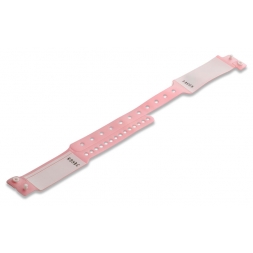
In France, health centres have no shared consensus on wristband colour, and no study has proven one colour code superior to another. Typically, a patient receives a white or blue wristband on arrival, while paediatrics often uses pink. Each facility is therefore free to set its own convention - provided, precisely, that every team knows it. For paediatric wards, SBE Direct offers a pink children's hospital wristband sized for small wrists.

Materials and technologies: which wristband for which use?

Not all identification wristbands are equal. The material determines comfort, wear time and resistance to friction, fluids and disinfectants. Three main families coexist in hospital settings.

CriterionSoft vinylTyvek / paperThermal printable
Wear timeLong stay (several days)Short stay, transitVariable
ComfortHigh, flexibleLightGood
PersonalisationHandwriting or labelPrint / writeBarcode printed on demand
Water resistanceExcellentFairGood
Typical useInpatient, surgeryEmergency, outpatientDigitised wards

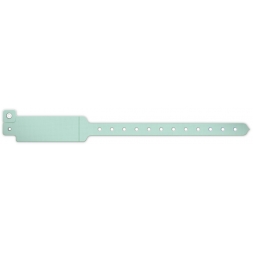
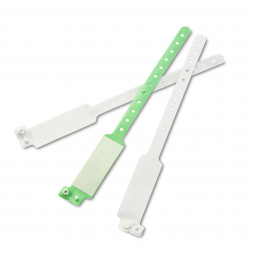
Soft vinyl remains the benchmark for inpatient care: robust, comfortable and water-resistant, it suits extended stays - see the adult hospital wristband and its children's hospital wristband counterpart. The printable wristband becomes essential as soon as a ward generates identifiers from software, printing name and barcode on demand. Finally, specific contexts call for dedicated supports, such as mortuary identification wristbands for traceability in the mortuary. For budget-conscious wards, a discounted green soft vinyl hospital wristband is also available.

How to choose the right hospital wristband

The right wristband depends on the ward, the length of stay and the level of digitisation. The table below sums up the main scenarios.

SituationRecommended solutionDetail
Adult inpatient, long stayAdult soft vinylComfort and durability over time
Paediatrics / neonatalChildren's soft vinylReduced size, secure closure
Digitised ward (HIS)Printable wristband + barcodeScannable identifier on demand
Emergency / outpatientLight support, fast fittingHigh volume, short stay
MortuaryDedicated mortuary wristbandTraceability and durable marking

Three habits complete the choice: check the compatibility of the wristband with your printers and scanners, standardise a single colour code known to every team, and favour a tamper-evident closure to guarantee the safety barrier. Need help sizing a specific volume? SBE Direct's teams issue an express quote and provide free samples to test comfort before deployment.

A hospital wristband is neither a detail nor a mere accessory: it is a safety barrier, a traceability support and a core link in patient identification. Colours, where used, communicate vital information in a second - as long as they are unified across the facility. Material, size, barcode and colour code: every parameter matters so that the hospital wristband fully plays its role.

Updated August 2026.

FAQ

What do the colours of hospital wristbands mean?

Colours flag critical information at a glance. The most common code links red to an allergy, yellow to a fall risk, purple to "do not resuscitate" status, pink to a limb restriction and green to a latex allergy. In France, this code is not standardised at national level: each facility sets its own convention, which must be known to every team to be effective.

Is a hospital identification wristband mandatory?

Health authorities require unique, reliable patient identification throughout the stay, and the wristband is the recommended safety barrier to achieve it from admission onwards. It covers all inpatients, including emergency and outpatient care, except residents of long-term care facilities and psychiatric units. Since 2021, France's National Health Identifier has reinforced this reliability requirement.

What information is on a patient wristband?

It usually carries the name, date of birth, sex and patient identifier, often completed with a 1D or 2D barcode for instant access to the digital record. Blood group and date of admission may be added depending on the facility's protocol. The exact list is not centrally imposed.

Which material should you choose for a hospital wristband?

For a long stay, soft vinyl offers the best comfort-durability balance. For a digitised ward, the printable wristband generates name and barcode on demand. Emergency departments prefer a light support that is quick to fit. In all cases, a tamper-evident closure and good water resistance are essential: explore SBE Direct's full range of hospital wristbands.

Can a patient identification wristband be personalised?

Yes. Printable wristbands accept name, identifier and barcode generated from the hospital information system, while blank models are completed with an indelible marker. Personalisation must stay legible over time and remain compatible with your printers and scanners.

Equip your wards with identification wristbands

Adult and children soft vinyl, printable wristbands, mortuary models. Express quote and free samples.

View the wristband range →

Related products

Continue reading...
These articles too might interest you.

How to make your company badges successful?

As seen in previous articles, company badges are used to identify people, control access and promote your company. In order for your badges to fulfil these 3 purposes, it is essential to respect some pre-requisites. Here are a few tips on how to make good looking and effective access badges.

SBE advise you
7989 views

Safety signs: what you need to know

It is very common to see signs in public spaces as well as in businesses. Safety signs are essential in gathering and public environments. But who decides on business signage in France? And more importantly, how do you know which sign to put up and where? 

SBE advise you
12485 views
See the author's articles
Melissa Oumaouche

With over 5 years of experience in creating content optimized for search engines, Mélissa is currently Marketing & Product Manager at SBE Direct, where she leads the product catalogue positioning across the e-commerce website and marketplaces, as well as the SEO content strategy in coordination with the marketing team she oversees.

We use cookies to improve your experience.