A pair of safety boots carries between six and ten codes on its label. The safety footwear standard EN ISO 20345 defines every one of them, yet no manufacturer translates them into shop-floor language. Buyers end up ordering S3 where S1P would have done, or the other way round, and the gap is paid for in accidents or in budget. What really separates S1 from S3? What are the S6 and S7 classes introduced in 2022 worth? Are your SRC-marked boots still compliant? This guide answers code by code, and closes with a trade-by-trade table, alongside the SBE Direct safety shoe range covering classes S1P to S5.

Key takeaways

  • EN ISO 20345 requires a toe cap that withstands 200 joules and 15 kilonewtons. Without both results, the footwear is not safety footwear.
  • Eight classes exist: SB, S1, S2, S3, S4, S5, S6 and S7. S3 remains the site reference, S5 its polymer boot equivalent for saturated environments.
  • S6 and S7 arrived in 2022. They are the former S2 WR and S3 WR combinations, now standalone and genuinely waterproof classes.
  • The SRA, SRB and SRC markings are gone. Slip resistance becomes a basic requirement, and SR identifies an additional test on glycerol-lubricated ceramic.
  • Penetration resistance now reads as three codes: P for a metal insert, PL and PS for non-metallic inserts tested with a 4.5 mm and a 3 mm nail.
  • The choice comes down to three questions: penetration hazard, water exposure, ground regularity.
  • The employer supplies the footwear free of charge and covers replacement, under articles R4321-4 and R4323-95 of the French Labour Code.

What is the EN ISO 20345 standard?

EN ISO 20345 is the European standard setting the requirements for safety footwear. Its founding criterion comes down to two figures: the protective toe cap must withstand a 200 joule impact and a 15 kilonewton compression. Without both results, footwear is not safety footwear.

In plain terms, 200 joules is a 20 kilogram mass dropped from one metre onto your toes, and 15 kilonewtons is roughly 1.5 tonnes of pressure. That threshold is what separates safety footwear from ordinary work footwear.

Technically, EN ISO 20345 sets the requirements while EN ISO 20344 sets the test methods used to verify them. The two work as a pair. The CE mark on the boot comes from Regulation (EU) 2016/425 on personal protective equipment, which places safety footwear in category II. The version now in force is EN ISO 20345:2022, gradually replacing EN ISO 20345:2011.

SBE note: a CE mark on its own says nothing about the protection level. The class code (S1, S3, S7) and the additional markings carry the useful information. CE footwear without an S code is not safety footwear.

EN ISO 20345, 20346 or 20347: what is the difference?

Three standards cover professional footwear, and only one covers safety. EN ISO 20345 requires a 200 joule toe cap, EN ISO 20346 a 100 joule toe cap, EN ISO 20347 no toe cap at all. Each uses its own class prefix: S for safety, P for protective, O for occupational.

StandardFamilyToe capClass prefixTypical use
EN ISO 20345Safety footwear200 J and 15 kNSB, S1 to S7Construction, industry, logistics, food processing
EN ISO 20346Protective footwear100 JPB, P1 to P5Marginal in Europe, rarely stocked
EN ISO 20347Occupational footwearNoneOB, O1 to O7Catering, service, healthcare without crushing risk

In practice EN ISO 20346 stays marginal. The real decision sits between EN ISO 20345 and EN ISO 20347. If the workstation exposes the foot to a falling object, even a light one, the answer is EN ISO 20345. The logic matches every other item of personal protective equipment: the level follows the risk assessment, never comfort alone.

Safety shoe classification: from SB to S7

The safety shoe classification stacks eight levels. SB is the base, S1 and S2 add comfort and upper water resistance, S3 adds penetration resistance, S4 and S5 cover moulded polymer boots, S6 and S7 cover the fully waterproof models introduced in 2022.

SB: the common base

SB stands for Safety Basic. The boot carries a 200 joule toe cap, a slip-resistant outsole and nothing else as a requirement. The heel may be open, the upper is not water tested, the outsole has no penetration-resistant insert. SB on its own appears mostly on safety clogs and sandals. Every other class is an enriched SB.

S1 and S2: antistatic properties, energy absorption and a water-resistant upper

S1 adds three requirements to SB: a closed seat region, antistatic properties (marking A) and energy absorption in the seat region (marking E). This is the class for dry workshops and covered warehouses.

S2 repeats S1 and adds water penetration and absorption resistance of the upper (marking WPA). Beware of a common misreading: S2 protects against a splash or a puddle crossed quickly, not against immersion. The boot is not waterproof.

The most requested add-on to S1 is penetration resistance, giving S1P. That configuration dominates the SBE Direct range, as on these low safety shoes with anti-perforation soles, whose textile insert is certified to EN 12568 and withstands 1,100 newtons.

Image slot 1

File to insert: SAFETY-FOOTWEAR-classes-SB-S7-EN.png

ALT: Safety shoe classification from SB to S7 under EN ISO 20345:2022, showing the protection added by each class.

S3: the reference class on site

The S3 safety boots standard combines S2, outsole penetration resistance and a cleated outsole. Three protections in a single code, which explains its de facto standard status on construction sites and in heavy industry.

The code now splits by insert type: S3 with a metal insert, S3L with a non-metallic insert tested with a 4.5 mm nail, S3S with a non-metallic insert tested with a 3 mm nail. The finer the test nail, the wider the coverage: an S3S stops objects an S3L lets through. A catalogue example: this basketball-style S3 safety shoe in nubuck settles the question of acceptance by the teams.

S4 and S5: polymer boots for wet environments

S4 and S5 are not a step above S3. They describe a different construction: a one-piece moulded boot in PVC, rubber or polyurethane, therefore waterproof by design.

  • S4: polymer boot with a 200 J toe cap, antistatic properties and energy absorption in the seat region.
  • S5: everything in S4, plus penetration resistance and a cleated outsole.

S5 is the wet-environment equivalent of S3: road works, sanitation, wet food processing, concrete pouring. These PVC knee boots illustrate the S4 configuration in its simplest form.

S6 and S7: the waterproof classes introduced in 2022

This is the headline change of the 2022 revision. Before it, waterproof leather footwear was labelled S2 WR or S3 WR. Those combinations are now classes in their own right.

  • S6: equivalent to S2 with whole-footwear water resistance (WR), without penetration resistance.
  • S7: equivalent to S3 with whole-footwear water resistance (WR), penetration resistance included.

The difference with S2 and S3 is clear. WPA tests the upper alone and tolerates measured penetration. WR tests the assembled boot under walking conditions and allows no water inside. S7 also splits into S7L and S7S depending on the insert type.

Summary table: SB, S1, S2, S3, S4, S5, S6 and S7

Class200 J toe capAntistatic (A)Energy absorption (E)Water-resistant upper (WPA)Penetration resistanceWaterproof (WR)Construction
SBYesNoNoNoNoNoOpen
S1YesYesYesNoNoNoClosed seat region
S1P / S1PL / S1PSYesYesYesNoYesNoClosed seat region
S2YesYesYesYesNoNoClosed seat region
S3 / S3L / S3SYesYesYesYesYesNoCleated outsole
S4YesYesYesWaterproof by designNoWaterproof by designMoulded polymer boot
S5 / S5L / S5SYesYesYesWaterproof by designYesWaterproof by designPolymer boot, cleated
S6YesYesYesYesNoYesClosed seat region
S7 / S7L / S7SYesYesYesYesYesYesCleated outsole

Difference between S1 and S3: how to decide

The difference between S1 and S3 comes down to two protections: S3 adds a water-resistant upper (WPA) and a penetration-resistant outsole, plus a cleated tread. S1 protects toes and heel in a dry, clean environment. S3 also protects the sole of the foot against sharp objects and tolerates moisture.

Image slot 2

File to insert: SAFETY-FOOTWEAR-S1-or-S3-EN.png

ALT: Three questions for choosing between S1 and S3 safety footwear: sharp objects, water exposure, ground regularity.

One case comes up constantly: the mechanical workshop, dry but littered with swarf and fasteners. S1P answers it better than S3, because a water-resistant upper is useless there and costs breathability. That is the trade-off behind these high safety shoes with a steel toe cap, or their composite toe cap version when staff must pass through detection gates.

Three questions settle it, in this order.

  1. Does the floor carry sharp objects? Nails, screws, offcuts, rubble, broken glass. If so, you need a penetration-resistant insert: S1P at minimum, S3 if the floor is also wet.
  2. Is the foot exposed to water or liquids? Occasional splashes or puddles: S2 or S3. Standing in water or jet washing: S5, S6 or S7.
  3. Is the ground uneven? Soil, mud, fill, gravel: the cleated outsole of S3 gives grip that S1 does not have.

Additional markings: decoding the label

Additional markings complete the class code. They describe optional protections the manufacturer has had tested: heat resistance, insulation, penetration resistance, metatarsal protection, enhanced grip. Each maps to a specific test described in EN ISO 20344.

Full table of additional requirements

CodeMeaningWhat it guarantees
AAntistaticElectrical resistance between 0.1 and 1,000 megohms. Drains static charge without removing protection against electrical contact.
CConductiveResistance below 0.1 megohm. Reserved for explosive atmospheres. Never use where live voltage is present.
EEnergy absorption of the seat region20 joules absorbed in the heel area. Reduces impact from prolonged walking.
WPAWater-resistant upperFormerly WRU. Limited water penetration and absorption, upper only.
WRWhole-footwear water resistanceNo water ingress inside the assembled boot. Basis of classes S6 and S7.
PPenetration resistance, metal insertSteel insert. Partial outsole coverage, triggers detection gates.
PLNon-metallic insert, 4.5 mm nailTextile or composite insert. Lighter and more flexible, wider coverage.
PSNon-metallic insert, 3 mm nailSame principle, tested with a finer nail. Highest coverage level.
HIHeat insulation of the sole complexLimits heat transfer through the outsole. Foundries, asphalt, bitumen.
CICold insulation of the sole complexLimits cold transfer through the outsole. Cold rooms, outdoor winter work.
HROHeat-resistant outsoleContact at 300 °C for 60 seconds without degradation. Roofing, welding, kitchens.
FOFuel oil resistant outsoleThe outsole does not swell or break down on contact with oils and fuels.
MMetatarsal protectionGuard covering the instep. Heavy handling, foundry work.
ANAnkle protectionPadded ankle collar. Loading bays, scaffolding, cluttered floors.
CRCut resistance of the upperUpper resistant to sharp objects. Glassworks, sheet metal, forestry.
SRAdditional slip resistanceTested on ceramic tile with glycerol. Replaces SRA, SRB and SRC.
SCScuff cap abrasion resistance8,000 Martindale cycles without holing. Kneeling, crouching, crawling work.
LGLadder gripTransverse profile of at least 1.5 mm in the waist area. Work at height.

How to read a full marking string

A label reads left to right: the standard, then the class, then the additional markings in the order the laboratory validated them. Here is a worked example.

EN ISO 20345:2022 S3L SR HRO FO CI

SegmentWhat the standard saysWhat it means on site
EN ISO 20345:2022Safety footwear, 200 J toe cap, 2022 versionGenuine PPE, certified to the version now in force.
S3Closed seat region, A, E, WPA, penetration resistance, cleated outsoleIt handles nails, moisture and soft ground.
LNon-metallic insert, 4.5 mm test nailNo metal in the outsole: lighter, clears detection gates.
SRSlip resistance on glycerol-lubricated ceramicIt grips greasy floors, not just soapy ones.
HROOutsole tested at 300 °C for 60 secondsYou can walk on hot bitumen or near a welding bay.
FOFuel oil resistant outsoleOils do not eat into the outsole.
CICold insulation of the sole complexProlonged standing on cold concrete or in a cold room.

In one sentence: this boot suits an industrial maintenance technician moving between cold floors, greasy floors and hot zones, with no metal parts in the outsole.

What changed with EN ISO 20345:2022

Six changes separate EN ISO 20345:2022 from the 2011 version: creation of classes S6 and S7, split of penetration-resistant inserts into P, PL and PS, rebuilt slip resistance testing, FO moved to optional, new SC marking and new LG marking.

  1. Classes S6 and S7. The S2 WR and S3 WR combinations become standalone classes.
  2. Penetration resistance detailed. P now means a metal insert only. PL and PS cover non-metallic inserts, tested with a 4.5 mm and a 3 mm nail respectively.
  3. Slip resistance rebuilt. According to the technical guide published by uvex safety, SRA, SRB and SRC disappear. Slip resistance becomes a basic requirement of all safety footwear, and the SR marking identifies an additional test on glycerol-lubricated ceramic. Test zones are now the heel at strike and the forefoot at push-off.
  4. FO becomes optional. Fuel oil resistance is no longer required by default on S1, S2 and S3. It must be checked marking by marking.
  5. SC marking. A new scuff cap abrasion test over 8,000 Martindale cycles.
  6. LG marking. A new ladder grip test, previously limited to firefighter footwear.

SBE note: of the 9 catalogue models we checked in September 2026, all still carry a 2011-version marking, namely S1P SRC, S3 SRC, S3 HRO SRC or S5 SRA. This is not a compliance failure. Stock certified under the 2011 version remains usable, and certificates issued before November 2024 remain valid, so both versions coexist on the market until the end of the decade. The real risk sits elsewhere: a tender that specifies « SRC » mechanically excludes every 2022-certified model, which carries « SR ». Those clauses need rewriting.

Which safety footwear standard for your trade?

The right marking follows the hazards of the workstation, not the sector. An electrician working in a cabinet and an electrician on a building site do not need the same boot. The table below gives the most common starting point per trade, to be checked against your own risk assessment.

TradeDominant hazardsRecommended markingUseful options
Construction and civil worksNails, rubble, mud, soft groundS3, or S7 where mud is permanentLG for ladders, AN on scaffolding
Mechanics and maintenanceOils, fuels, falling toolsS1P, S3 outdoorsFO essential, M for heavy parts
ElectriciansElectrical contact, static electricityS1P or S3 with no metal partsA mandatory, ESD in electronics, never C
Food processingWater, grease, jet washing, hygieneS2 or S3, S5 in wet zonesSR, washable materials, light outsole
Catering and kitchensGreasy wet floors, hot falling objectsS2 or S3 depending on the postSR essential, HRO near fryers
Logistics and warehousingFalling loads, wheeled traffic, long walkingS1P, S3 on outdoor docksEnhanced E, AN, SR

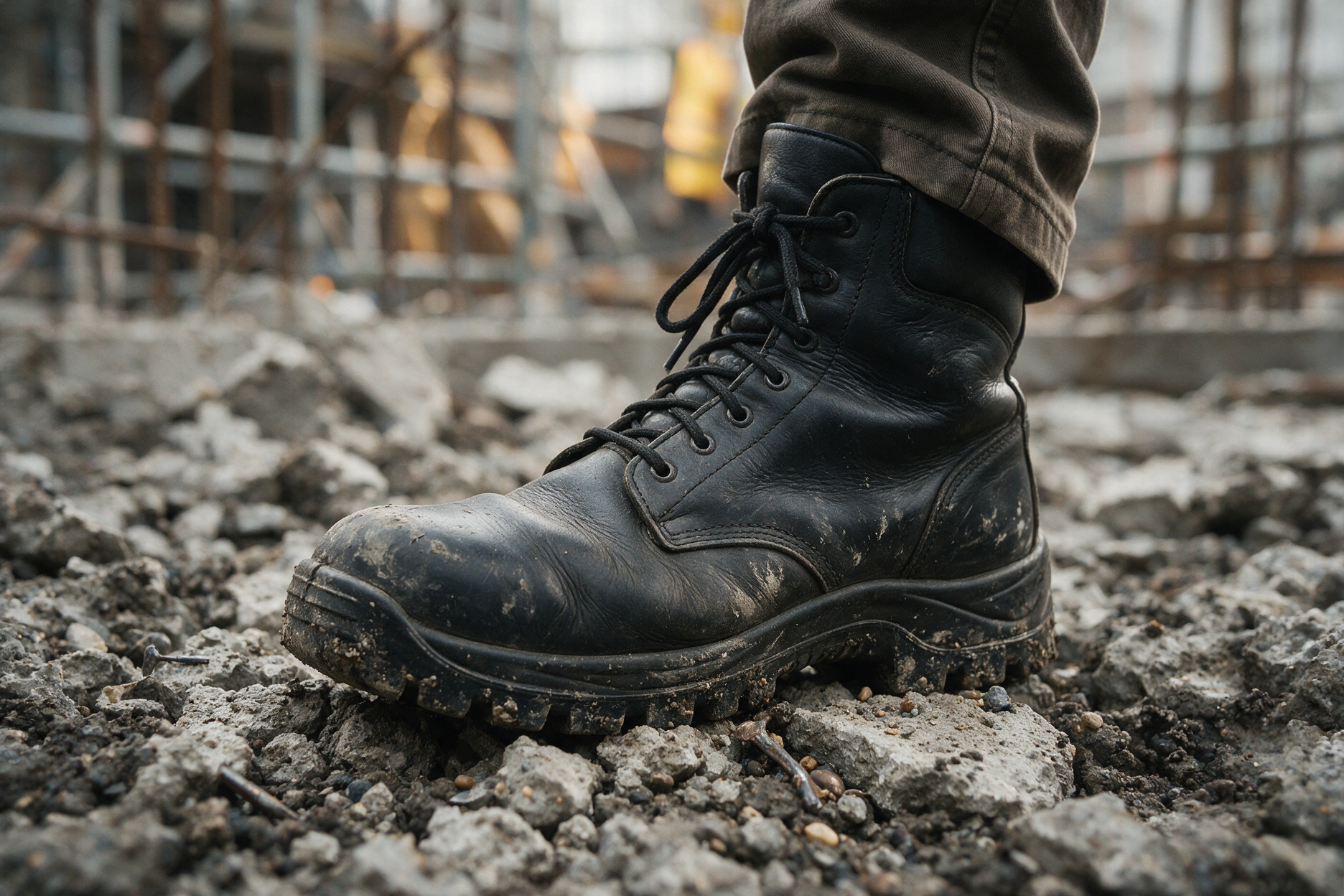
Construction: cleated S3 with penetration resistance

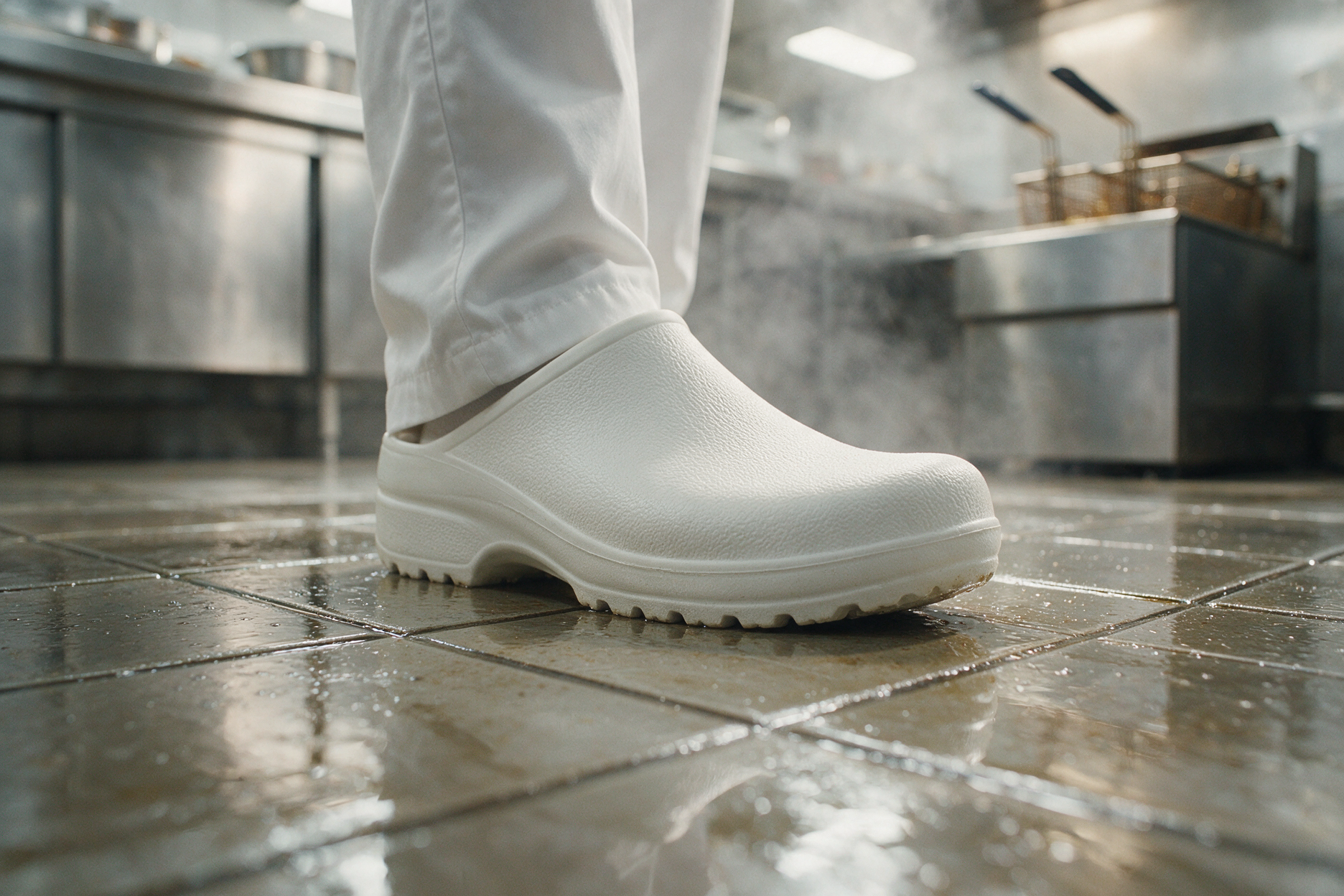
Kitchens and food processing: SR clog on greasy floors

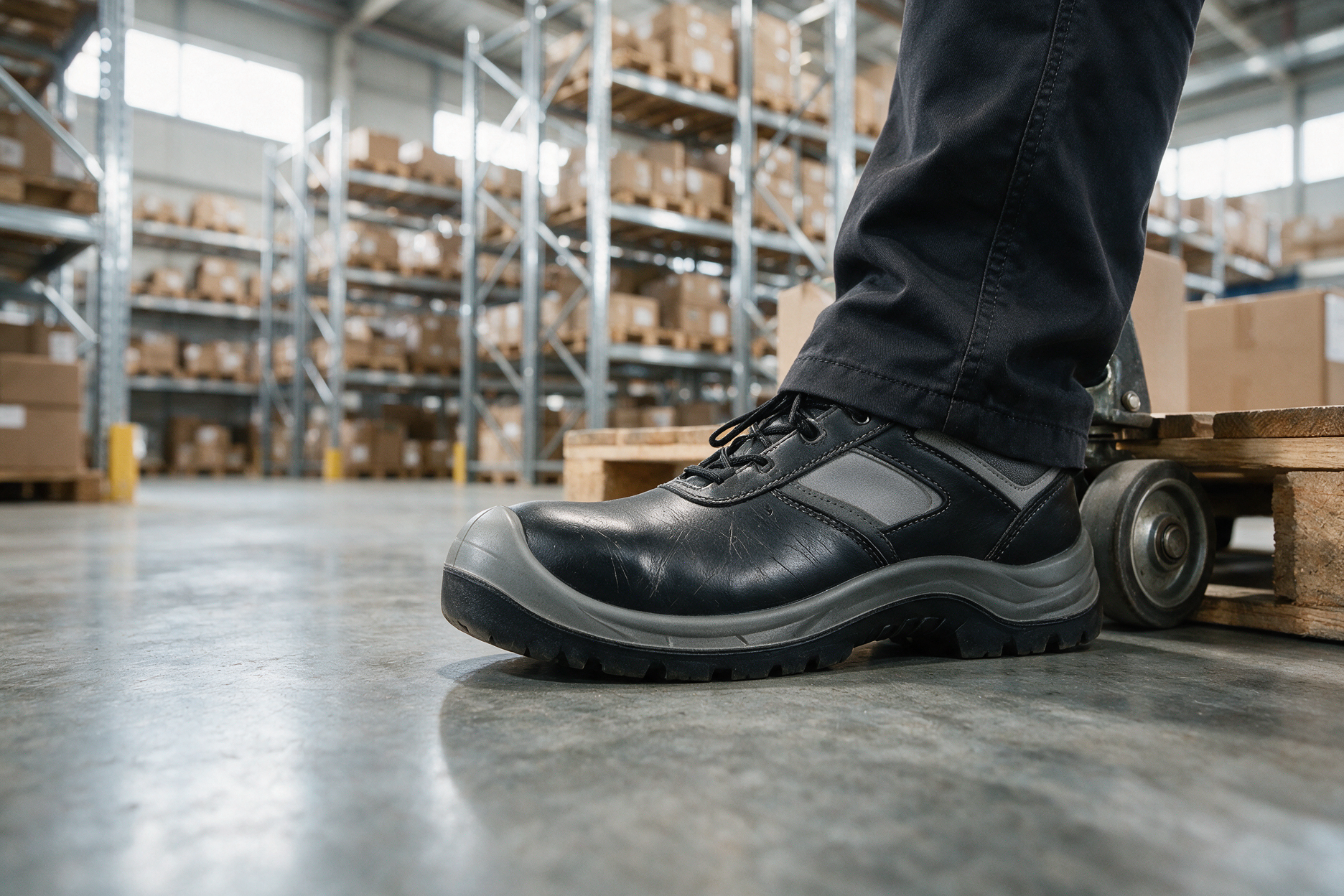
Logistics: S1P in a covered warehouse

Construction and civil works

S3 is the minimum standard here, for one reason: a nail through the sole is the number one hazard in structural work, and the penetration-resistant insert is the only barrier. Construction sites increasingly add a ladder grip requirement, hence the LG marking introduced in 2022.

Mechanics and industrial maintenance

For mechanics everything turns on FO. An outsole not tested against hydrocarbons swells, hardens and then delaminates under repeated oil contact. These hydrocarbon-resistant safety shoes combine a 200 J steel toe cap, a steel penetration-resistant insert and a dual-density polyurethane outsole.

Electricians

Two reflexes apply. First, specify marking A and never marking C, which makes the boot conductive. Second, remove metal parts from the outsole and toe cap, so choose a composite cap and a textile insert. In electronics and cleanrooms, add the ESD marking, as on these antistatic ESD safety shoes with a steel toe cap and knitted upper.

Food processing

Food processing adds a constraint the standard does not cover: cleanability. A washable microfibre S2 or S3 works in preparation areas. In jet-washing zones, move to an S5 boot, or to S7 if the operator also walks outside the wet zone during the same shift. These white safety clogs with a steel cap and microfibre upper cover dairy and pharmaceutical plants.

Catering and kitchens

Kitchens are decided on grip. A kitchen floor combines water, grease and flour, which is exactly the case the SR marking tests on glycerol-lubricated ceramic. Add HRO for frying and oven stations. S2 is enough where nothing heavy falls, otherwise specify S3.

Logistics and warehousing

Warehousing answers two distinct hazards: a load falling from racking, and the fatigue of ten kilometres walked per shift. S1P covers the dry covered warehouse. S3 becomes necessary as soon as outdoor docks enter the scope. On mixed sites, a high S3 HRO safety shoe also covers adjacent maintenance and welding bays.

Employer duties under European and national law

Two layers of law apply. Regulation (EU) 2016/425 governs how safety footwear is placed on the market and requires CE marking. National labour law governs its use at work: in France, article R4321-4 of the Labour Code requires the employer to provide appropriate PPE, and article R4323-95 requires that it be provided free of charge and properly maintained.

Supply and free provision

Under article R4321-4 of the French Labour Code, the employer must make appropriate personal protective equipment available to workers as needed, and must ensure it is actually used. Article R4323-95 adds the rule that settles disputes: PPE is provided free of charge by the employer, who maintains it in good working order and in a satisfactory hygienic condition through the necessary servicing, repairs and replacements.

Three practical consequences follow. No payroll deduction may fund a pair of safety boots. No deposit may be required. And replacing a worn pair is the employer's responsibility, not the worker's.

Service life and replacement

No text sets a legal service life for safety footwear. Replacement is decided on actual condition, against four observable criteria.

  • Cleats worn smooth or torn off: the certified grip no longer exists.
  • Upper pierced, split or deformed: foot support and water resistance are lost.
  • Toe cap visible, dented or displaced: withdraw the boot from service immediately.
  • A severe impact taken: the toe cap is single use, even with no visible deformation.

Under heavy site use, annual replacement is the most common practice. In offices and warehouses, two years is usual. Issue records deserve the same documentation as glove issues, and our guide to the European standards for safety gloves follows the same marking logic.

Conclusion

Three reflexes are enough to specify correctly. First, start from the penetration hazard, because it decides between S1 and S3. Second, qualify water exposure, because it decides between S2, S5 and S7. Third, read the additional markings, because they are what separates compliant footwear from footwear suited to the job.

SBE Direct has supported safety and procurement teams since 1992, with more than 16,000 customers, free samples, an express quotation within 4 hours and volume pricing. Before you place a bulk order, request a sample and test it on the workstation: the safety footwear standard is only ever chosen well once the boot has been worn on site.

Updated in September 2026.

FAQ

What do S1, S2 and S3 mean in safety footwear?

S1, S2 and S3 are three increasing levels of EN ISO 20345. S1 adds a closed seat region, antistatic properties and energy absorption in the seat region to the SB base. S2 repeats S1 and adds water penetration and absorption resistance of the upper, marked WPA. S3 repeats S2 and adds a penetration-resistant outsole plus a cleated tread. In short, S1 protects toes and heel, S2 adds moisture resistance, S3 adds penetration resistance and grip on soft ground. On a construction site S3 is the starting point; in a dry workshop S1P is usually enough.

What is the S4 safety footwear class?

S4 describes a one-piece moulded safety boot in polymer, PVC, rubber or polyurethane, waterproof by construction. It carries a 200 joule toe cap, antistatic properties and energy absorption in the seat region, without a penetration-resistant insert. S4 is not a step above S3: it is a different family, intended for saturated environments. As soon as a penetration hazard exists, move to S5, which adds the insert and a cleated outsole.

What legislation applies to safety footwear?

Two texts apply. Regulation (EU) 2016/425 governs placing on the market and requires CE marking. National labour law governs use at work: in France article R4321-4 obliges the employer to provide appropriate personal protective equipment and ensure it is actually used, while article R4323-95 states that it is provided free of charge, with the employer covering servicing, repairs and replacements. No financial contribution may be requested from the worker. Wearing is made mandatory by internal instruction, based on the documented risk assessment.

Are my SRC-marked boots still compliant?

Yes. Footwear certified to EN ISO 20345:2011, carrying SRA, SRB or SRC markings, remains compliant and usable while in good condition. The 2022 version does not make existing stock illegal: it applies to new certifications. The point to fix sits in your purchasing documents. A specification demanding « SRC » unintentionally rules out every 2022-certified model, which carries « SR ». Replace the clause with neutral wording such as « slip resistance compliant with the applicable version of EN ISO 20345 ».

The right code, tested on your workstation

Free sample and express quotation within 4 hours.

View the safety shoe range →

We use cookies to improve your experience.