The Digital Product Passport (DPP) is becoming a requirement for any manufacturer placing a product on the European market, and it raises a question nobody was asking yesterday: how do you attach a digital identity card to every single item, accessible throughout its whole life? Composition, material origin, repairability, recycling streams: information that today sits scattered across technical data sheets, ERP systems and supplier documents will tomorrow have to fit into a single, interoperable record. Which products are covered? From when? And above all, which physical carrier should you choose to make that passport readable in the field? This guide answers those questions.

What exactly is the Digital Product Passport (DPP)?

The Digital Product Passport is a structured digital record, linked to a physical product through a unique identifier, that brings together reliable information on its composition, environmental performance, durability and circularity. You access it by scanning a data carrier (QR code, RFID or NFC) applied to the product or its packaging.

The DPP was introduced by Regulation (EU) 2024/1781, known as the ESPR (Ecodesign for Sustainable Products Regulation), which entered into force on 13 June 2024. Its articles 9 to 15 set out the general framework for the passport. The principle is twofold: the information must be readable by a human, but also usable by information systems, thanks to standardised, interoperable formats.

One architectural point is worth clarifying straight away. The passport is not stored in a central European database. An EU central registry opens in mid-2026 (target date 19 July 2026), but it works as an index: it holds a time-stamped proof of registration, not the content of the passport. The data stays hosted by the economic operator or its service provider. You therefore retain control of your product data.

The purpose of the DPP

The purpose of the DPP is to make a product's data traceable, reliable and accessible throughout its life cycle, in the service of the circular economy. In plain terms: to make it possible to repair, reuse, recycle or verify a product from a single, up-to-date source of information.

The passport is part of the European Green Deal. According to AFNOR, which published the first French standards for the scheme, the DPP is a tool serving the circular economy before it is a commercial tool, even though many business uses will follow from it. In practice, it aims to reduce the information asymmetry between a manufacturer, a repairer, a recycler and a buyer.

For a company, the stakes go beyond compliance. A product becomes an informational entity that can be read, compared and recommended by automated systems. The quality of your product data therefore determines your compliance as much as your visibility on channels increasingly driven by algorithms.

Who is affected, and from when? The official timeline

The DPP does not apply all at once. It rolls out category by category, each one activated by a sector-specific delegated act that sets the mandatory data, the formats and the deadlines. The obligation falls on the economic operator placing the product on the European market, generally the manufacturer or the importer. Unlike the CSRD, companies of every size are affected, including SMEs.

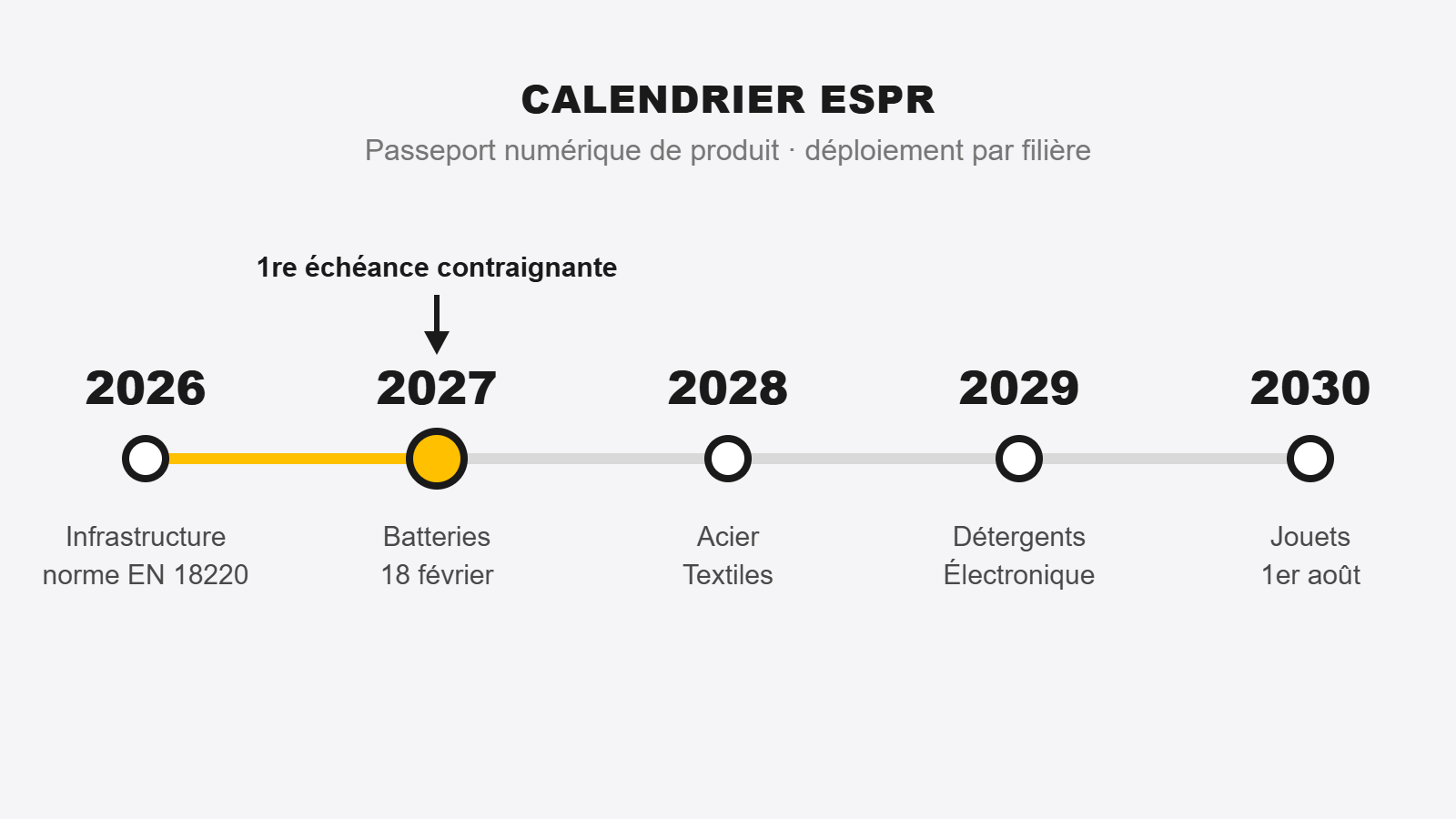
The ESPR 2025-2030 working plan, adopted on 16 April 2025, sets the order of priority. Sectors with a high environmental impact come first.

Product categoryDelegated act / frameworkDPP applicationStatus
Batteries (industrial > 2 kWh, electric vehicles, light transport)Regulation (EU) 2023/154218 February 2027First binding deadline
Iron and steelDelegated act expected around 20262028 at the earliest (~18 months after the act)Pioneer category
Textiles and clothingDelegated act expected ~Q2 2027~end 2028 / 2029In preparation
Aluminium, tyres, consumer electronicsScope targeted ~20272028-2029 depending on the actIn preparation
Electronics and ICT (smartphones, computers)Sector delegated acts2028-2029In preparation
Detergents and surfactantsRegulation (EU) 2026/40523 September 2029Framework published
ToysToy Safety Regulation1 August 2030Deadline set

Note: these dates depend on the publication of delegated acts, which the Commission revises regularly. Batteries are the only milestone that is fully binding today, on 18 February 2027. To follow developments, refer to EUR-Lex and the European Commission ESPR page.

2026 is the year of infrastructure. The technical standards and the central registry are being put in place, before the first product obligations take effect in 2027.

What the DPP changes for SMEs and mid-caps

For an SME or a mid-cap, the DPP turns product data into a regulated asset: it must become reliable, traceable, auditable and durable over time. The main task is not technical, it is organisational: collecting and validating the information scattered across your suppliers.

  • The burden of proof moves up the chain: if you import a product and sell it under your own brand, the passport is your responsibility, not your Asian supplier’s.
  • Collecting supplier data takes time, often 6 to 18 months depending on the complexity of the supply chain.
  • The persistence requirement means rethinking the physical marking of your products, a subject we cover further down.

Many companies still treat the DPP as a 2030 subject. That is a scheduling error. If you are in a sector targeted for 2027, the audit of your supply chain should already have begun. There is time to adapt, but it is being used up fast.

What is the risk without a compliant DPP?

An absent or non-compliant DPP creates a market access risk: without a valid passport, a product covered by a delegated act can no longer be marketed in the European Union. Administrative penalties and reputational risk come on top of that.

The exact level of penalties has not yet been settled at European level. The ESPR leaves it to each Member State, including France, to set proportionate and deterrent penalties. A legal framework is nevertheless emerging: information omitted or inaccurate in a passport may be classed as a misleading commercial practice, which exposes the company to penalties and, in serious cases, to product withdrawal from the market.

The real cost of non-compliance is therefore measured on two levels. The regulatory level, with the inability to sell and possible national fines. And the commercial level: in a catalogue where your competitors display a complete passport, a product without reliable data loses visibility with buyers and with recommendation systems alike.

QR code, RFID or NFC: which data carrier for your digital passport?

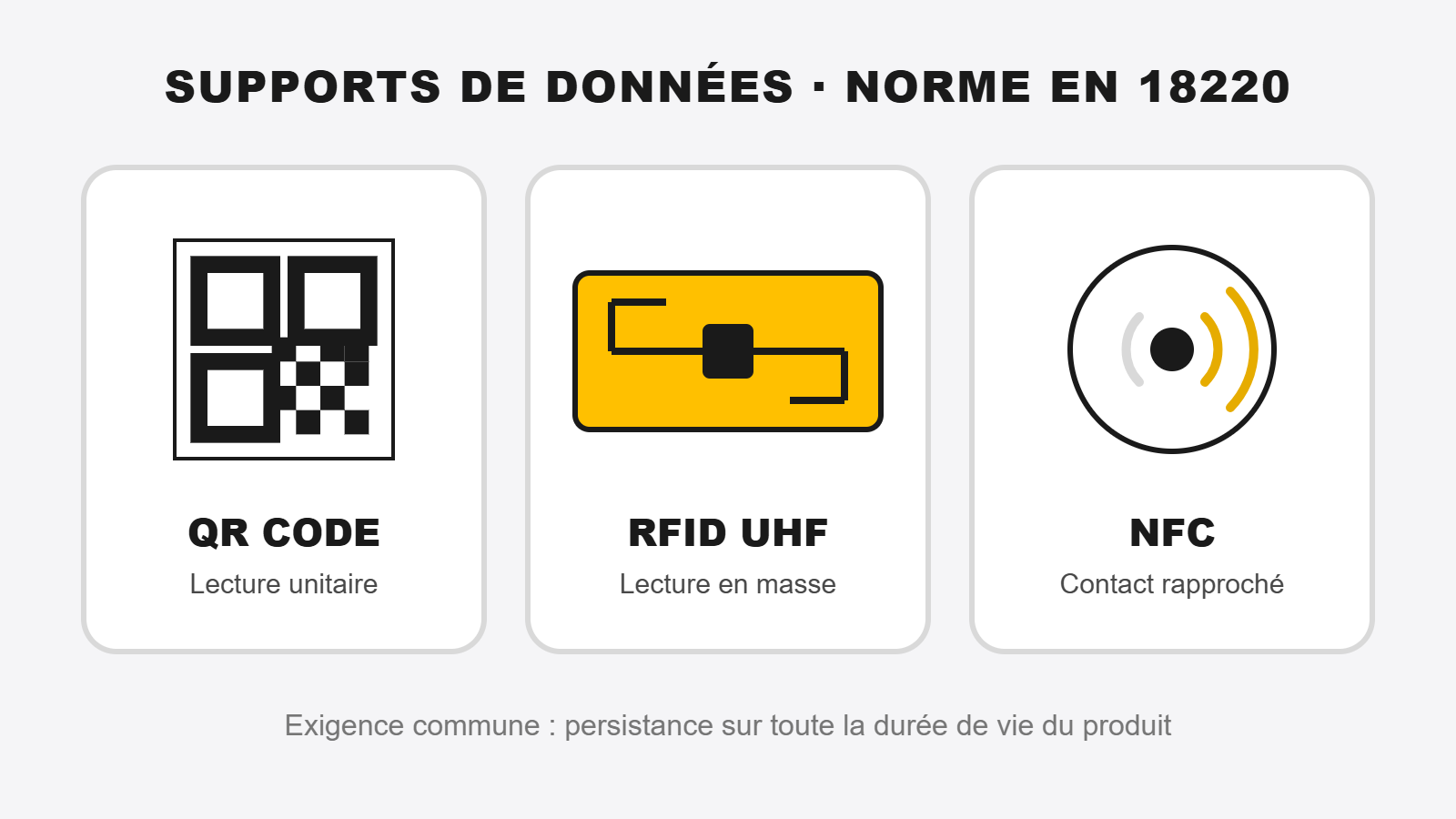
The data carrier is the physical bridge between your product and its digital passport. The choice comes down to three main families: the QR code (or DataMatrix), UHF RFID and NFC. None is universally superior: the right carrier depends on your product, your environment and your volumes.

That choice is no longer left to chance. Standard EN 18220:2026 "Digital Product Passport - Data carriers", published by CEN/CENELEC (technical committee JTC 24) at the end of May 2026, defines the authorised carriers and how they must be encoded.

It forms part of a set of eight JTC 24 standards, including EN 18219 on unique identifiers. In France, EN 18220 is adopted under the reference NF EN 18220.

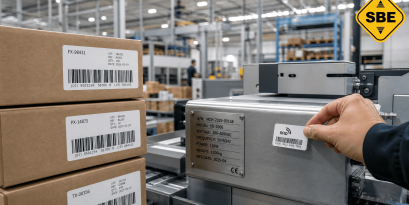
The most structuring requirement in this standard is persistence: the carrier must stay readable throughout the life of the product. A label that peels off, fades or becomes illegible after a few months in an industrial environment does not fulfil its regulatory role. This is where the choice of marking becomes a compliance matter, not just a logistics one.

Data carrier comparison

CriterionQR code / DataMatrixUHF RFIDNFC
Unit costVery low (printing)Low to mediumMedium
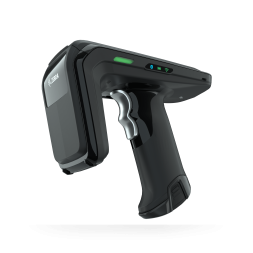
ReadingOne at a time, line of sight requiredBulk reading, no line of sight (up to several metres)One at a time, close contact
Durability / persistenceDepends on the print substrateHigh (protected chip)High
Surface neededSmall, but a minimum readable size is requiredSmall, invisible encodingSmall
Typical use casePublic access, high-volume productsBulk inventory, logistics, industrial assetsConsumer interaction on contact, authentication

Physical constraints often settle the choice. On a very small product, the available surface limits the size of a readable QR code. In harsh environments (heat, solvents, abrasion, outdoors), only a carrier designed to last guarantees the readability the regulation requires for the whole product life. For an inventory of several thousand references, bulk reading with UHF RFID saves time on a scale no unit-by-unit QR scan can match.

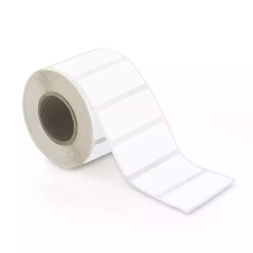
This is precisely the ground of durable identification. For demanding environments, our ultra-resistant 3M double-adhesive labels, also available in a pre-cut pre-printed version, are designed to withstand abrasion, solvents and temperature swings. The full ultra-resistant labels range answers this persistence requirement. For bulk reading and automated traceability, RFID technology and traceability takes over. With more than 30 years of experience in B2B identification and traceability, these carrier-by-carrier trade-offs are what we equip our customers with every day.

Preparing for the DPP in 5 steps

Preparing for the DPP is not about adding a QR code at the last minute. It is a data project to run well ahead of your sector deadline. Here is a five-step method to make progress now.

  1. Identify your category and its deadline. Check whether your products fall under a published or expected delegated act, and note the application date. That milestone sets the pace for everything else.
  2. Map your product data. List the information required (composition, origin, durability, recyclability), its sources and how reliable it is. Identify the data missing at your suppliers.
  3. Start the supplier data collection. This is the longest stage. Secure access to your partners’ data now, because a supplier unable to provide it becomes a blocking point.
  4. Choose your data carrier. Decide between QR code, UHF RFID and NFC according to your product, your environment and your volumes, respecting the persistence requirement of EN 18220.
  5. Integrate the unique identifier and the marking. Link each product to its identifier (GTIN, serial number) and industrialise the application of a durable carrier, tested for your real environment.

The order matters. A data carrier badly chosen at step 4 can undo all the data validation work done beforehand. Test how your barcode labels and RFID carriers hold up on your own products before any mass rollout. Free samples let you validate persistence in real conditions.

Limitations of the DPP

The DPP has limitations you need to know in order to approach it without illusions. It is neither a security tool, nor a guarantee of quality in itself, nor a universal scheme applicable today.

  • The timeline: dates shift with the delegated acts and retain an element of uncertainty, which complicates planning.
  • The data: a passport is only worth the reliability of the information it contains, and responsibility for its accuracy rests entirely with the operator.
  • Authenticity: a QR code on its own can be copied, which limits its reach against counterfeiting unless it is combined with secure carriers and the authentication mechanisms provided for in the scheme’s standards.

These limitations do not cancel out the value of the DPP. They are a reminder that the passport is an information foundation, not a turnkey solution. Its value depends directly on the quality of your data and the reliability of your marking.

The Digital Product Passport is no longer a distant prospect: batteries open the ball on 18 February 2027, and the textile, metals and electronics sectors follow close behind. The standards infrastructure has been in place since 2026, with EN 18220 governing the choice of your data carriers.

For an SME or a mid-cap, the message is simple: the data project starts before the deadline, and choosing a persistent marking determines compliance as much as operational performance. Anticipating the mapping of your data, securing supplier collection and validating how your carriers hold up in real conditions: that is the path to start now in order to approach the Digital Product Passport without a last-minute rush.

Which data carrier for your product passport?

Ultra-resistant labels, barcodes, UHF RFID and NFC. Free samples to validate persistence.

View ultra-resistant labels →

Continue reading...
These articles too might interest you.

Product labelling: how to optimise traceability and compliance?

Product labelling identifies, informs, protects and traces any product placed on the European market. This guide details the six regulatory frameworks every B2B operator must master in 2026. You will learn which mandatory information applies to your sector, how to choose the right substrate (polyester, vinyl, anodised aluminium, destructible) and which DGCCRF penalties apply in the event of non-compliance up to a €750,000 fine and 2 years' imprisonment for misleading commercial practices. SBE Direct's labelling solutions, deployed across more than 900,000 tamper-evident plates at 16,000 B2B customers with up to -96% theft observed on marked assets, secure both regulatory compliance and traceability of your asset base.

Product News
Melissa Oumaouche
2171 views

Industrial traceability: identify, track, secure

Industrial traceability has become a strategic foundation in 2026: 14,484 product recalls recorded across Europe in 2024, an average cost of €10.5 million per major recall, and mounting regulatory pressure (ISO 9001, MDR, FSMA, GS1 standards). This comprehensive guide explains how to identify, track and secure your products and assets across the three levels of traceability (upstream, internal, downstream), how to choose between barcodes, Datamatrix, UHF RFID, aluminium plates and tamper-evident labels, and how to deploy a reliable system in five steps. A proven method, built on 30 years of SBE Direct expertise and more than 16,000 customers supported.

Product News
Melissa Oumaouche
1224 views

UHF RFID Explained: Frequency, Technology & Industrial Applications

UHF RFID technology (860–960 MHz) enables the simultaneous reading of hundreds of tags at distances of up to 15 meters, with no line-of-sight requirement, where barcodes still demand manual, one-at-a-time scanning. It has established itself as the global standard for automated traceability across industries as diverse as logistics, retail, healthcare, and industrial asset management. Its key advantages include data accuracy exceeding 99%, an 80–90% reduction in cycle count time, and an ROI typically achieved within 12 to 18 months. Its only notable limitations involve sensitivity to metal surfaces and liquids, which require the use of On-Metal tags (also referred to as metal-mount RFID tags) in demanding industrial environments.

Product News
Melissa Oumaouche
3609 views

Frequently asked questions

What products are exempt from the DPP?

The DPP only applies once a delegated act makes it mandatory for a given category. Certain categories are explicitly excluded from the scope of the ESPR: food, animal feed, medicines, motor vehicles, and national defense products. For all other categories, the absence of an obligation so far simply means that the corresponding delegated act has not yet been published. In other words, a temporary exemption is not a permanent one: you need to track the publication of delegated acts sector by sector on EUR-Lex.

What is the difference between a DPP and a barcode?

A classic barcode, associated with a GTIN, identifies a type of product and is mainly used for checkout and inventory management. The Digital Product Passport goes much further: it is a rich, structured record, often serialized at the unit level, that brings together a product's composition, origin, durability, and recyclability. The data carrier (QR code, RFID, or NFC) is only the access point; the DPP is the data behind that access point. In practice, many companies will evolve their barcode labels into QR codes carrying the DPP identifier.

Does the DPP protect against counterfeiting?

The DPP was not designed as an anti-counterfeiting device, but it can contribute to it. A printed QR code is easily copied and, on its own, offers no guarantee of authenticity. However, the passport's unique identifier, combined with secure carriers (RFID or NFC with authentication) and the data authentication standards built into the system, strengthens the verification of a product's origin and integrity. Protection against counterfeiting therefore depends on the carrier and security mechanisms you pair with the passport, not on the DPP itself.

Does the DPP replace CE marking?

No. CE marking and the Digital Product Passport serve two distinct, complementary purposes. CE marking certifies that a product complies with applicable European safety, health, and environmental requirements, through a declaration of conformity. The DPP, on the other hand, is a record of information about the product's composition, durability, and circularity. One certifies compliance, the other organizes access to information. A product subject to both obligations...

See the author's articles
Melissa Oumaouche

With over 5 years of experience in creating content optimized for search engines, Mélissa is currently Marketing & Product Manager at SBE Direct, where she leads the product catalogue positioning across the e-commerce website and marketplaces, as well as the SEO content strategy in coordination with the marketing team she oversees.

We use cookies to improve your experience.