A priority sign is a road sign coded "AB" that sets the order of passage at an intersection or on a given lane; it complements or replaces the general priority-to-the-right rule defined by the French Highway Code. This article details the nine priority signs in force in France (priority road AB6, priority to the right AB1, one-off priority AB2, give way AB3a, stop AB4, end of priority AB7…), the applicable regulations (IISR, decree of 24 November 1967 as amended, NF EN 12899 standard), best installation practices, and the responsibilities of the road manager. You will also find concrete criteria (material, format, height) to choose the right sign according to your environment: public roads, private car parks, and industrial sites.

In France, the priority-to-the-right rule applies as a default, unless a priority sign indicates another rule. These markers are essential to organize intersections, protect road users, and improve traffic flow. On a private road, in a car park or on a professional site, priority signage prevents hesitation. It makes clear who goes first and reduces the risk of accidents.

Priority sign: what is it?

A priority sign is a road sign that sets the order of passage at an intersection, at a crossing point, or on a given lane. It complements the general rule or replaces it depending on the context. Several cases exist. Some signs grant priority. Others require giving way. Others mark the end of a priority regime.

Types of priority signs


There are nine priority signs in France, all coded "AB." Here are the main ones.

Priority road sign

The priority road sign indicates that a road keeps a priority status across several intersections. The driver retains priority until the end of this lane.

This device is useful on a main route. It improves the readability of the direction to follow and protects vehicles traveling on this road. 

Priority road sign AB6 yellow and white diamond mounted on a post by the roadside

At complex intersections, the priority road sign is often paired with an M7 schematic sub-panel. This small complementary panel represents the intersection seen from above: the bold line indicates the priority lane, the thin lines the secondary lanes. It allows the driver to grasp the layout of the intersection at a glance and anticipate the priority direction.

Priority-to-the-right sign

Priority-to-the-right sign AB1 black cross on white background

The priority-to-the-right sign recalls the basic rule of the Highway Code. In the absence of a sign indicating otherwise, road users must give way to vehicles coming from the right. This rule mainly applies to unsignposted intersections. It remains simple, but it must be understood by all to avoid traffic conflicts.

One-off priority sign

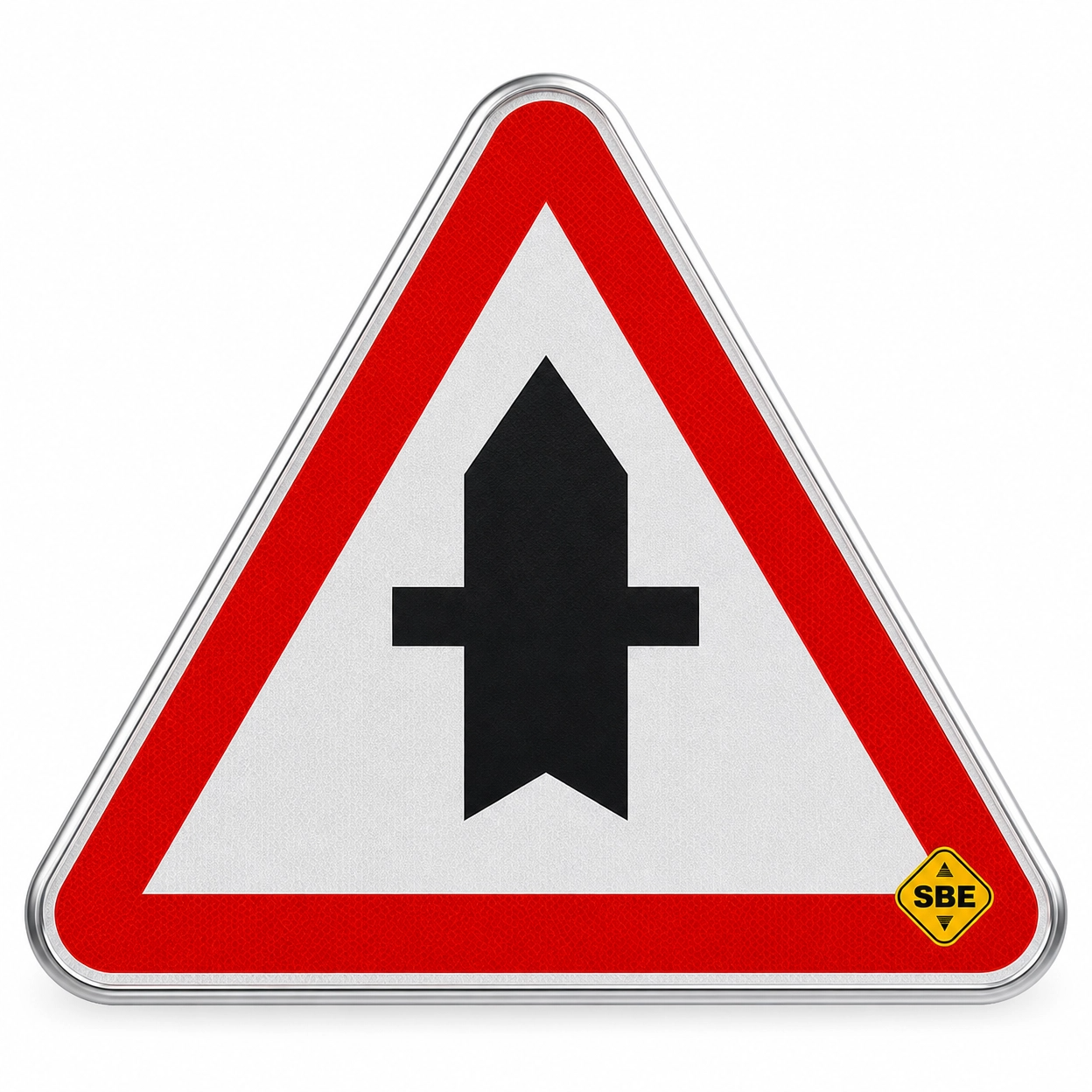
The one-off priority sign applies at a precise point. It grants the right of passage at a single intersection, without making the entire road a priority road.

It is often found at secondary access points, technical zones, or internal lanes. It serves to manage a crossing in a clear and rapid way.

One-off priority sign AB2 black arrow on red triangle

Priority over oncoming traffic sign

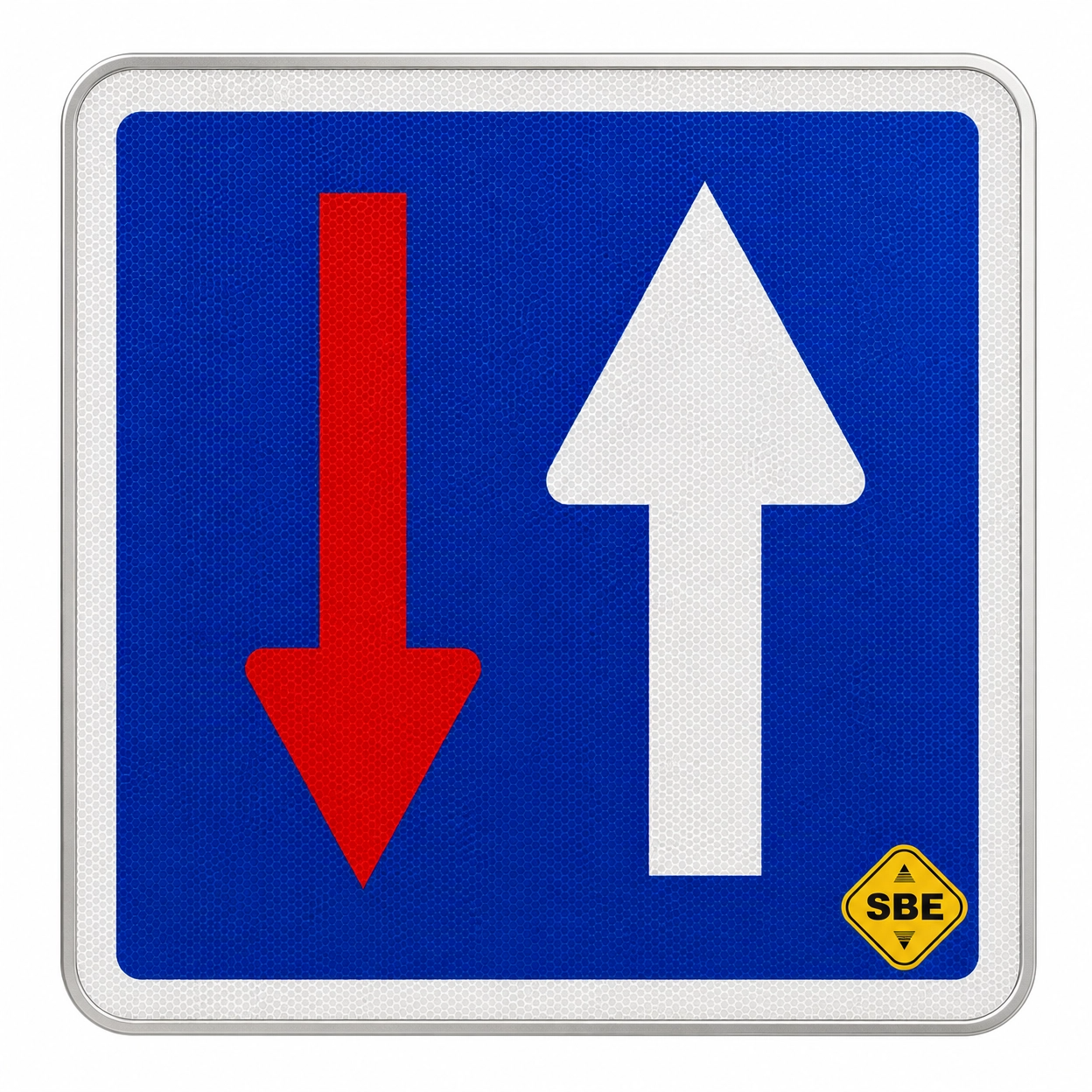
Priority over oncoming traffic sign C18 blue with white arrows


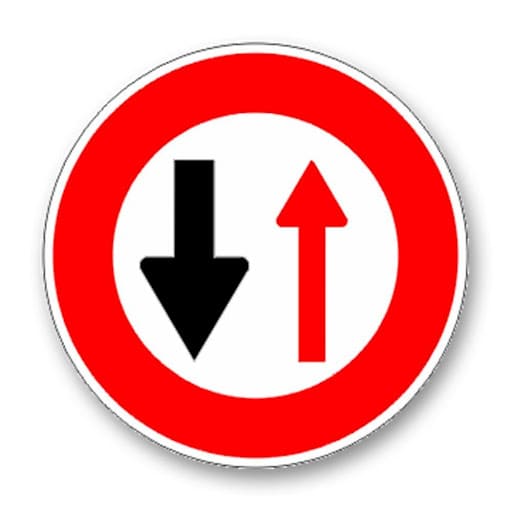
This sign indicates which direction of traffic has priority when two vehicles struggle to cross. It is common on narrow lanes, construction sites, or some private accesses. Not to be confused with its opposite (give way to oncoming traffic).

It prevents blockages and eases driving in areas where the crossing distance is limited. It is a simple element but very useful in the field.

"Give way" and "stop" signs

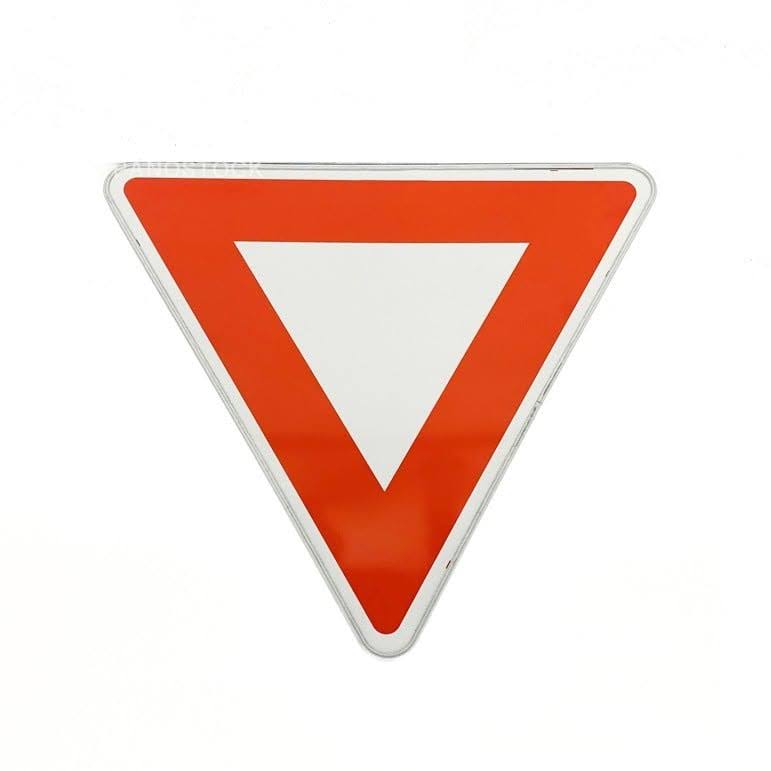
Give way sign AB3a inverted red and white triangle
Stop sign AB4 red octagon with white STOP lettering road signage

The give way sign requires the driver to slow down and let priority vehicles pass. It does not always require a full stop, but it does require immediate vigilance. The stop sign is stricter. It requires a complete stop at the stop line, even if no vehicle is approaching. These two signs play a central role in road signage. They clearly establish the direction of passage and reduce interpretation errors.

End of priority sign

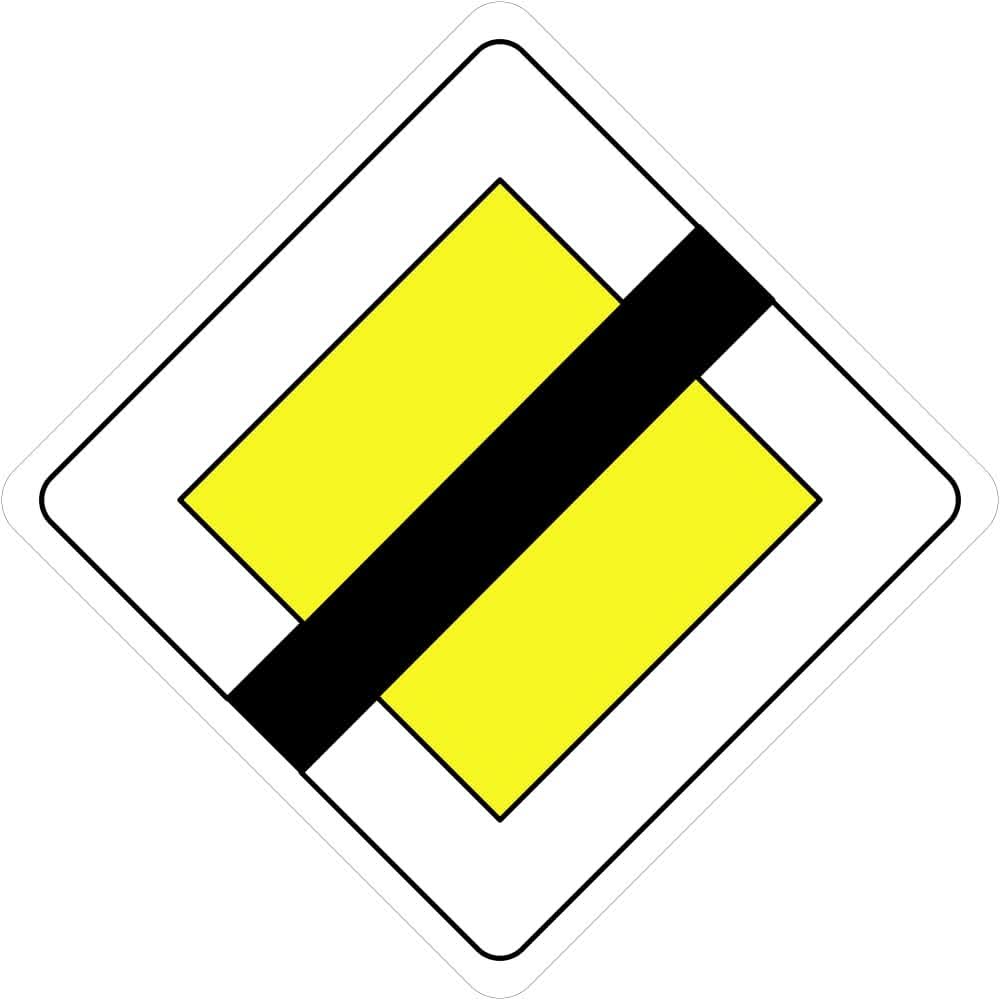
The end of priority sign indicates that the lane no longer benefits from a priority regime. After this point, the standard rule resumes, or new signage applies.

This marker is important to avoid any ambiguity. It marks the end of the road's main status on this section.

A standard roundabout grants priority to entering vehicles. A gyratory junction works the other way around: vehicles already in the ring have priority, signaled by a give way sign (AB3a) at each entrance. On a private site, installing this sign is recommended to remove any ambiguity.

End of priority sign AB7 yellow diamond crossed with black bar

The importance of road markings

Road markings complement priority signs. They reinforce the reading of the signage and guide the vehicle to the effect line or the stop line. Examples include triangles, stop lines or give way markings painted on the ground. These markings remain very useful when visibility is reduced. On a private site, they improve immediate understanding of traffic rules. They help every user adopt the right behavior.

How does priority work with public transport?


Public transport sometimes benefits from specific rules. The tram always has priority, whether at an intersection, a pedestrian crossing, or when leaving a dedicated lane. For buses, priority only applies when they leave a stop and signal their intention to merge back into traffic. In this case, drivers must give way to them. Special lights (diamond-shaped or bar-shaped) also frame these situations in urban areas.

How to choose the right priority sign?

  • Environment: an indoor car park does not require the same materials as an outdoor road exposed to the weather. Choose Dibond aluminum or PVC depending on the use.

  • Standards and compliance: make sure the sign complies with ISO 6790/7010 standards and the NF/CE compliance required for road signage.

  • Readability: the format must be adapted to traffic speed. In open country, sizes of 800 mm or more are recommended; in urban areas, 600 mm is generally sufficient.

What regulations apply to priority signs?

Standards in force

In France, priority signage is governed by the Interministerial Instruction on Road Signage (IISR) and the order of 24 November 1967 as amended. Signs must be retro-reflective and comply with the performance classes defined by the NF EN 12899 standards.

Obligations for companies and local authorities

Local authorities are required to install and maintain signage on public roads. Companies and managers of private sites open to traffic also have a signage obligation to prevent accidents.

Liability in case of missing or defective signage

The absence or poor condition of a priority sign may engage the liability of the road manager in the event of an accident. A failure to maintain constitutes a fault likely to engage civil, or even criminal, liability.

Best installation practices

In France, priority signage follows precise rules of shape, dimensions, and positioning. It must remain consistent with the Highway Code and the prescriptions on road signage.

  • Height: between 1 m and 2.30 m from the ground in built-up areas, with a minimum of 1.50 m in open country.

  • Location: in open country, the advance sign (AB3b or AB5) must be installed approximately 150 m before the intersection. In built-up areas, the sign is placed between 0 and 50 m from the intersection. These distances allow the driver to adapt their speed and react safely.

  • Readability: avoid any obstruction from vegetation or street furniture. Regular maintenance is essential.

  • Overall consistency: every element must be consistent with road markings and other surrounding devices.


Companies and local authorities must ensure that the signs installed match the actual needs of the site. In case of absence or poor condition, the manager's liability may be engaged.

Why order your priority signs from SBE Direct?

SBE Direct offers a comprehensive range adapted to professionals and local authorities:

  • Proven print quality: high-resolution screen printing, compliant with ISO 6790/7010 standards.

  • Wide choice of materials: Dibond aluminium (gold, brushed), 2 mm PVC, 4 mm plexiglass, photoluminescent or magnetic vinyl.

  • Volume discounts: competitive prices from €36 excl. VAT, with quantity-based reductions.

  • Custom personalisation: format, design and material adaptable to your specific needs.

  • Fast delivery throughout France.

Discover the stop sign, the priority road sign, and the entire road signage range.


Continue reading...
These articles too might interest you.

Unknown Shrinkage: How to Reduce It?

Unknown shrinkage (inventory discrepancy) is the difference between theoretical and actual stock in a retail business, representing over 7 billion euros in annual losses in France (1.4% of turnover on average). It stems mainly from shoplifting (39%), internal fraud (28%), administrative errors (21%), and supplier fraud (12%). To reduce these losses, the article recommends combined solutions: anti-theft labels (AM, RF, EM), RFID inventory tags, video surveillance, and staff training. A comprehensive system can reduce shrinkage by 40-60% with an ROI of 6-18 months.
Product News
Melissa Oumaouche
1347 views

RFID inventory: how to save time and reduce errors

RFID inventory replaces manual counting with fast, contactless reads, scanning hundreds of items in seconds using RFID tags and mobile terminals. You cut inventory errors by up to 90%, save 80–90% of time, and gain real-time visibility over your stock in logistics, retail, and industry. This guide explains how RFID inventory works, its concrete benefits (over 99% accuracy, real-time traceability, cost reduction), and the key steps to deploy it in your business with the right equipment: RFID tags, RFID readers, and RFID software.

Product News
Melissa Oumaouche
1083 views

How Does a Thermal Printer Work: Printing Process Explained

Thermal printing is a technology that uses heat to produce an image on a medium; no ink or cartridges are required. There are two main types: direct thermal, which is fast and cost-effective for short-lived applications, and thermal transfer, which offers greater durability for demanding environments. Choosing the right printer depends on the desired print lifespan, print volume, and operating conditions. Explore our complete guide to compare both technologies and find the model that fits your needs.

Product News
Melissa Oumaouche
1069 views

Frequently asked questions

What is the difference between the stop sign and the give way sign?

The stop sign (AB4) requires the vehicle to come to a complete halt, even if the road is clear. The give way sign (AB3a) requires the driver to slow down and let priority users pass, but does not require a full stop if no one is approaching.

Is the stop sign mandatory in a private car park?

It is not legally mandatory under the Highway Code on a private car park that is not open to public traffic. However, it is strongly recommended for safety reasons and to limit the civil liability of the site manager.

Who is responsible for signage on a professional site?

The site operator or manager is responsible for installing, ensuring compliance with and maintaining the devices. In the event of an accident linked to defective signage, their liability may be engaged.

Can a priority sign be installed on a private road?

Yes, it is entirely possible and even advisable for private roads open to traffic. The devices must comply with the same visual standards as those used on public roads in order to be understood by all users.

See the author's articles
Melissa Oumaouche

With over 5 years of experience in creating content optimized for search engines, Mélissa is currently Marketing & Product Manager at SBE Direct, where she leads the product catalogue positioning across the e-commerce website and marketplaces, as well as the SEO content strategy in coordination with the marketing team she oversees.

We use cookies to improve your experience.