Who does EN ISO 7010 apply to?
It applies to any premises hosting workers or the public. Manufacturing, logistics, healthcare, schools, public bodies, retail and offices: as soon as a risk remains after collective prevention measures, it must be signposted. Machine builders use it too, notably code 7010 M002, which points the operator to the instruction manual.
Is the ISO 7010 standard compulsory in France?
No. ISO 7010 is voluntary. What is compulsory is the regulatory outcome: article R.4224-24 of the French Labour Code requires health and safety signage to meet characteristics set by ministerial order. That order, dated 4 November 1993, transposes Directive 92/58/EEC and fixes shapes, colours and proportions.
The link between the two lies in Annex II to that order, as amended by the order of 2 August 2013:
"signs installed up to 1 January 2014 in accordance with standard NF X 08-003 [...] and those installed after 1 January 2014 in accordance with standard NF EN ISO 7010, April 2013 version, are presumed to comply with the regulations"
Annex II to the order of 4 November 1993, as amended by the order of 2 August 2013, reproduced by INRS in booklet ED 6293, 2017.
In other words, the standard grants a presumption of conformity. You are not obliged to follow it, but following it puts you on the right side during an inspection. It is the safest route, and by far the simplest.
SBE note: many sites state that ISO 7010 has been "compulsory since 2013". That is inaccurate. The obligation applies to signalling the risk, not to the standard itself. The distinction matters: it decides whether you have to replace your existing estate or not.
ISO 7010 or ISO 3864: what is the difference?
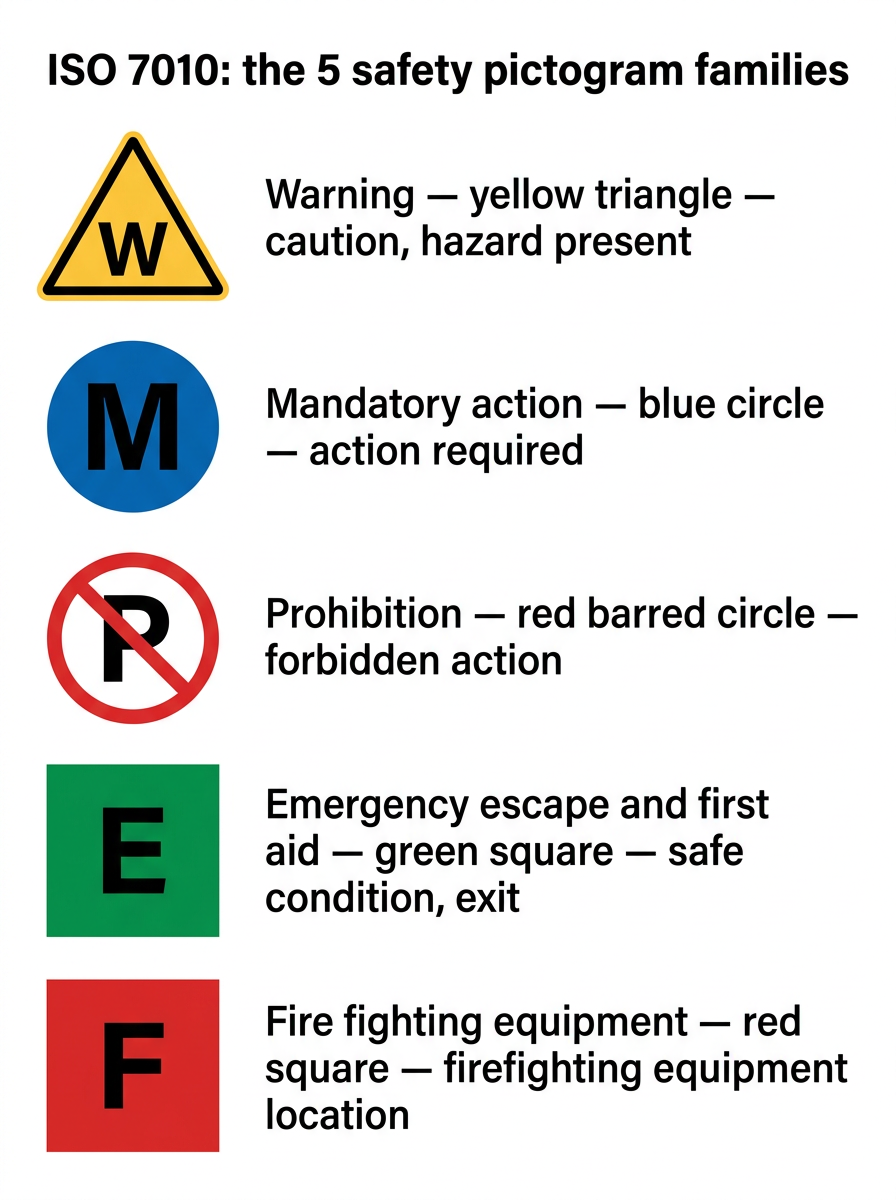
ISO 3864 sets the rules, ISO 7010 sets the drawings. The ISO 3864 series defines safety colours, geometric shapes, proportions and sizing rules. ISO 7010 applies those rules and registers each pictogram with its code. The two are read together: you cannot size an ISO 7010 sign without Annex A of ISO 3864-1.