Security seal for a ballot box: protecting election equipment and safeguarding a transparent count

Security seal for a ballot box: protecting election equipment and safeguarding a transparent count

Securing voting equipment rests on a simple principle: make any tampering visible. The ballot box security seal plays this witness role, alongside the locks required by law. Is sealing a ballot box mandatory? Which type of seal should you choose for your box? How do you apply and check these devices without getting in the way of the vote? This complete guide answers these questions, drawing on the French regulatory framework and on the range of security seals from SBE Direct.

Key takeaways

  • →A seal is a tamper witness: it reveals an opening, it does not block it the way a lock does.
  • →Article L63 of the French Electoral Code requires a transparent box, a single opening, two dissimilar locks and a strict split of the keys. It does not require a seal.
  • →The seal is a complementary control, useful for traceability and transparency, compatible with the organising authority's instructions.
  • →The choice depends on the fixing point: eyelets, adhesive joint, padlock point or sealing wire.
  • →A seal is only useful if it is numbered, recorded and then checked. A number that is never logged provides no guarantee.

What Is a Security Seal For on a Ballot Box?

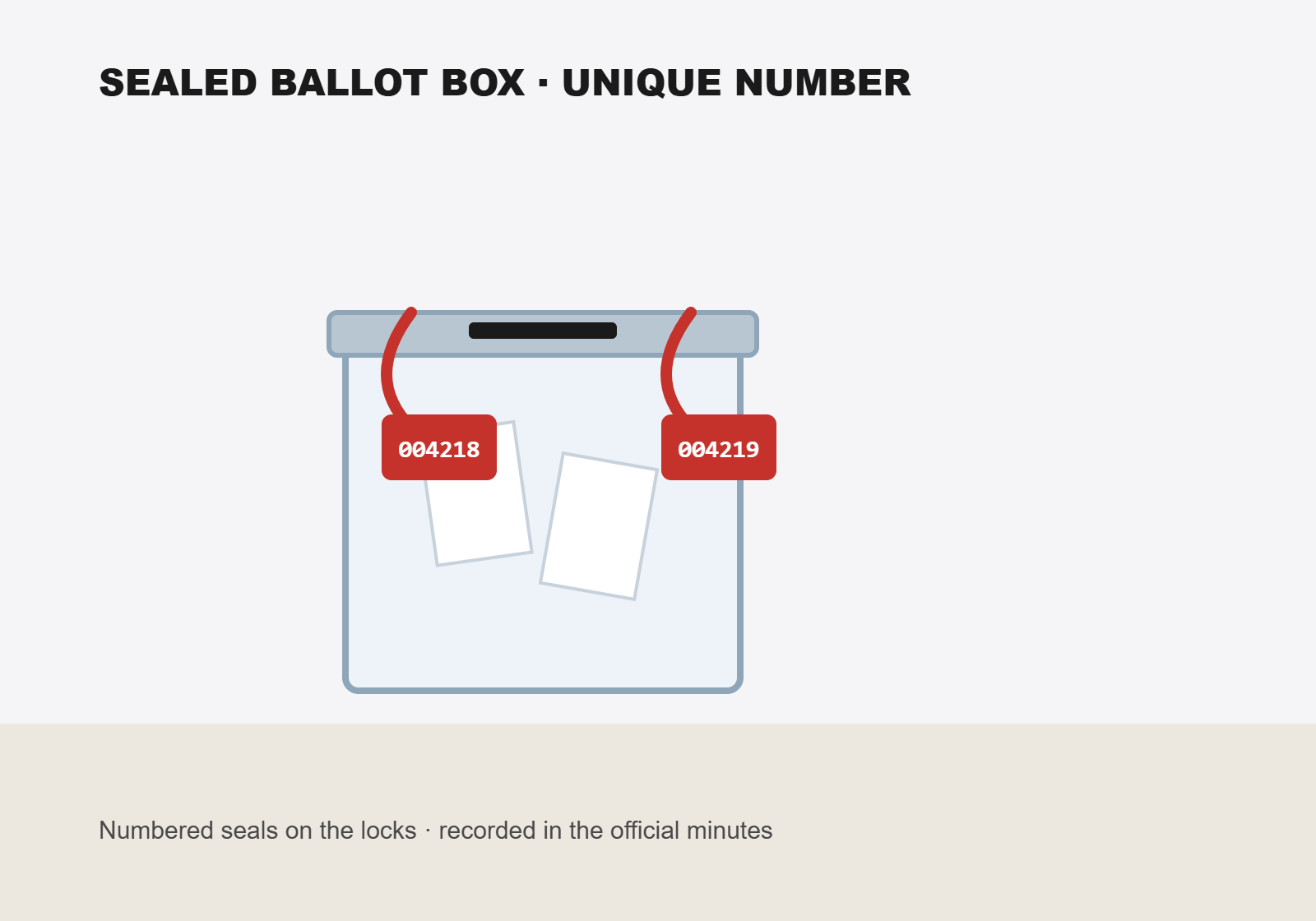
A ballot box security seal is a single-use device that makes any opening attempt visible. Applied to a closure point, it breaks, deteriorates or reveals a tell-tale message as soon as it is handled.

It thus provides physical proof of the integrity, or the breach, of the sealed equipment.

Detecting an Opening or a Tampering Attempt

A seal works by breaking the link, visible deterioration or the appearance of a message on an adhesive, such as the wording OPENED VOID. Its function differs from that of a lock. The lock prevents access; the seal signals that access has taken place. The two are complementary: the lock protects, the seal bears witness.

"A seal only has value once it is logged and checked: the number applied must match the number observed. Without that cross-check, the device is merely decorative," notes the seals product team at SBE Direct.

Identifying the Equipment and Supporting Its Traceability

Each seal carries a unique identifier, usually a serial number, sometimes a barcode or a QR code. This identifier links a specific seal to a given box or container. Numbering only has value if it is recorded at the time of application, then compared during checks. A number logged nowhere provides no guarantee.

Contributing to the Transparency of Electoral Operations

Documented checks make the organisers' work easier and reassure stakeholders. A record linking each identifier to its equipment, time-stamped, is usable evidence in the event of a dispute. A seal does not on its own guarantee the absence of fraud: it strengthens transparency, it does not replace it.

Ballot Boxes and Seals: What Does French Regulation Provide?

Article L63 of the French Electoral Code governs the box, not the seal. It requires a transparent box, a single opening for the envelopes, closure before the vote and two dissimilar locks. The keys are split between the polling station president and a randomly drawn assessor. The seal remains an optional complement.

A Transparent Box Closed by Two Dissimilar Locks

Under Article L63 of the French Electoral Code, the box must meet four requirements:

  • →a transparent box, which allows anyone to check at any time that it contains nothing but the envelopes;
  • →a single opening, for the passage of the voting envelopes;
  • →closure carried out before the start of the vote;
  • →two dissimilar locks, whose keys cannot be interchanged.

Who Holds the Keys to the Ballot Box?

The text splits the two keys between two distinct people. One stays in the hands of the polling station president. The other is entrusted to an assessor drawn at random from among all the assessors. This separation ensures that no single person can open the box during the vote.

What Happens When a Key Is Missing at the Close of the Vote?

If, at the close, the president does not hold both keys, they take the necessary measures to open the box immediately. Continuity of operations comes first: a missing key does not suspend the count, it triggers a suitable opening procedure, recorded in the minutes.

Are Security Seals Mandatory on Ballot Boxes?

Article L63 sets no general obligation to add a security seal to a ballot box. The seal is intended as a complementary control, compatible with the organising authority's instructions, and not as a substitute for the two regulatory locks. Some organisations add it to strengthen traceability and transparency; others keep to the legal device.

Which Types of Seal Should You Choose for a Ballot Box or Election Equipment?

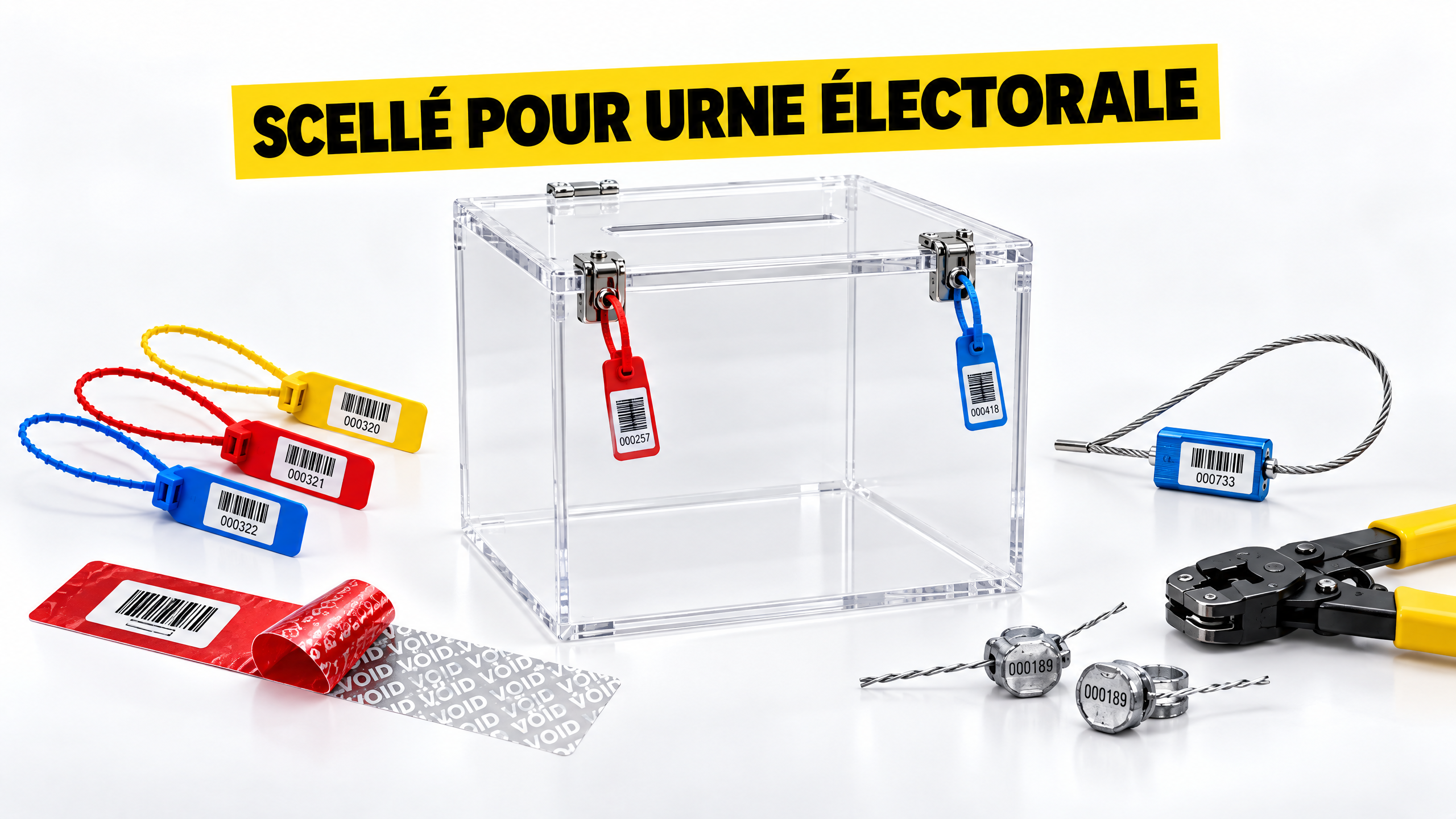
Four seal families cover the securing of a ballot box and election equipment: plastic seals for eyelet points, adhesive seals for joints, padlock seals for padlock points and lead seals for wire devices. Compatibility is always checked on the actual equipment. Compatibility must be checked on the actual equipment before any order. A seal suited to a ballot box will not necessarily fit a case or a transport bag.

01 · Plastic

Plastic Seals for Eyelet Closure Points

  • PrinciplePlastic seals work by progressive tightening: the strap passes through the eyelet, then locks at the desired length, with no slack.
  • Selection criteriaPassage diameter, strap length and strength.
  • ModelsThe Apollo seal is highly customisable: logo, serial number, barcode or QR code, 220 N tensile strength, 315 and 425 mm formats. The Demetra seal meets the opposite need: low strength, below 4 kN, designed for quick manual breaking during frequent checks.

02 · Adhesive

Adhesive Seals to Control a Joint or an Access Point

  • PrincipleAdhesive seals reveal an opening through a message or pattern that appears on peeling.
  • Two technologiesAdhesives with transfer leave a mark on the surface. No-residue models leave nothing but carry an irreversible witness.
  • ApplicationA compatible, clean and dry surface, and precise positioning over the opening area. An adhesive applied to a dusty surface loses its revealing power.

03 · Padlock

Padlock Seals for Compatible Closures

  • PrinciplePadlock seals attach to a padlock point via a clip or a hook. Single use, they break on opening, unlike a reusable keyed padlock.
  • FixingsEyelets, hasps and cable passages.
  • High securityUnder the ISO 17712:2013 standard, high-security cable seals meet defined levels of strength and tamper resistance; the SBE Direct cable seal comes in several diameters for these uses.

04 · Lead

Lead Seals for Devices With a Sealing Wire

  • PrincipleLead seals close a device with a wire passed through the closure points, then held fast by a lead crimped with pliers.
  • UsesA proven principle, still used for meters and certain containers.
  • AccessoriesThe sealing wire, smooth or beaded, and the sealing pliers, sometimes fitted with a marking block to print an imprint.

SBE Direct field feedback. Based on SBE Direct deployment feedback with local authorities and public administrations, numbered progressive-tightening plastic seals account for most requests to secure ballot boxes and ancillary equipment, ahead of adhesives reserved for joints and cases.

Type of sealCompatible fixingBenefitPoints to check
Plastic eyelet sealEyelet closure points, padlock holesProgressive tightening, numbering, strong customisationPassage diameter, strap length, strength
Adhesive sealFlat joints, lids, accesses to coverVisual opening witness, quick applicationClean and dry surface, transfer type, format
Padlock sealHasps, eyelets, cable passagesRobust fixing, single usePassage diameter, length, target standard
Lead sealWire devices, meters, older containersProven solution, marking possibleWire type, suitable pliers, marking imprint

Which Criteria Should You Check Before Choosing a Seal for an Election?

Four criteria guide the choice of a seal for an election: compatibility with the box and its closure system, numbering and marking legibility, strength and removal conditions, and finally the quantities to plan for. A prior test on the actual equipment avoids nasty surprises on polling day.

Compatibility With the Box and Its Closure System

The passage dimensions, the eyelet configuration and, for an adhesive, the surface characteristics drive the choice. The seal must never hinder the box's operation, the passage of the envelopes or the working of the locks. Compatibility comes before strength.

Numbering and Marking Legibility

An individual number, easy to log and compare, determines the seal's usefulness. Depending on the reference, customisation ranges from a simple sequential number to a logo, via a barcode or a QR code. Legible, contrasted and durable marking speeds up checks and reduces logging errors.

Strength and Removal Conditions

Strength adapts to the use, not the other way round. A very strong device such as the Zeus seal, at 530 N, suits a container that only opens with a tool. For a box opened at each close, a manual-break model makes removal easier. A stronger seal is not necessarily the most suitable.

Quantities and Stock Organisation

Plan needs per point to secure, add a reserve for re-applications and manage unused seals. A prior test on the equipment, before any large order, validates compatibility and ease of application.

How Do You Apply and Check a Seal on a Ballot Box?

Applying and checking a seal on a ballot box follows five stages: prepare and share responsibilities, apply without hindering the vote, record the identifiers, check the condition and the number, then report any anomaly.

These steps are good practice to adapt to the instructions for the vote, not a procedure imposed by Article L63.

Before Application: Define Responsibilities and Prepare the Equipment

Identify the people in charge of application and checks according to the applicable procedure. Check the compatibility, the condition of the seal and its identifier before applying it. A seal that is already damaged or has an illegible number is set aside.

During Application: Secure the Opening Point Without Hindering the Vote

Follow the manufacturer's instructions. Position the device to make any opening of the secured point visible, without obstructing the passage of the envelopes or hindering the regulatory closures. The seal complements the locks, it must never obstruct them.

After Application: Record the Useful Information

Keep a record linking the seal's identifier to the equipment concerned, with the date and the tracking information defined by the organisation. This record turns a number into usable evidence.

During Checks: Examine the Seal's Condition and Its Number

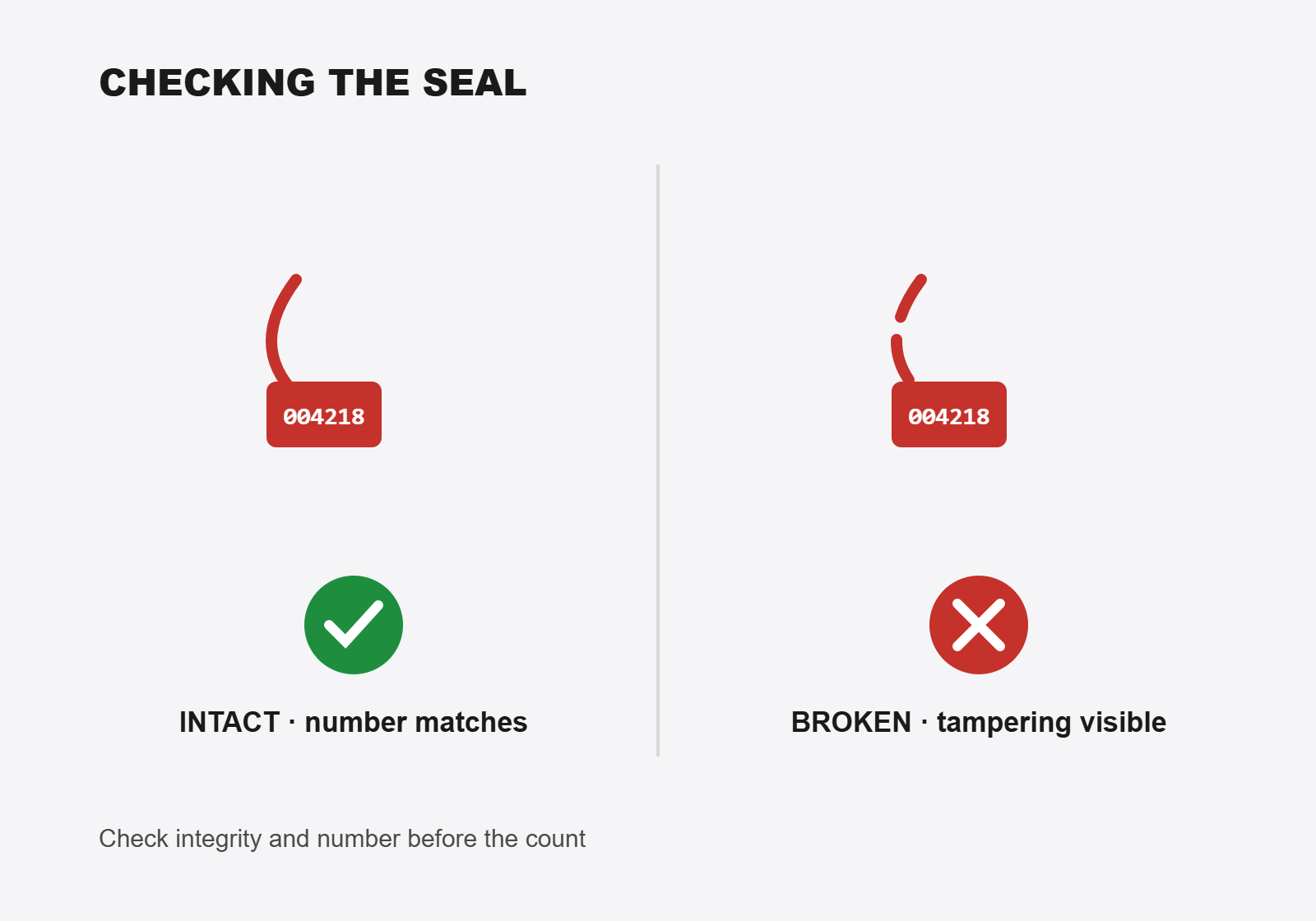
Check that the identifier matches the initial record, then look for signs of anomaly: breakage, peeling, deterioration or apparent replacement. An intact seal with the right number attests to continuity; a discrepancy triggers the reporting procedure.

In Case of Anomaly: Report and Document the Finding

Alert the competent manager and keep a written record of the facts, according to the applicable procedure. Do not quietly replace a damaged device. Do not automatically equate an anomaly with fraud: a seal can break accidentally. The finding is documented, it is not judged on the spot.

How Do You Secure the Documents and Equipment Linked to Elections?

Beyond the box, securing extends to the bags, crates and cases that transport or store the equipment. The choice of seal depends on their closure and on handling constraints. Complementary seals never replace the envelopes, signatures, stamps or packaging prescribed for electoral documents.

Adapt Seals to Bags, Crates and Cases

Extend the logic of the box to the containers used for storage or authorised transfers. A hasp case calls for a padlock seal; a zip bag, a pull-tight seal or an adhesive; a crate, a lead seal or a tape. The choice depends on the closure and the opening frequency.

Check Identifiers When Equipment Changes Hands

Log the numbers at departure, then check they match on receipt, where this organisation is in place. This double log, at dispatch and on arrival, secures equipment handovers between departments or providers.

Follow the Procedures Specific to Electoral Documents

Complementary seals do not replace the prescribed envelopes, signatures, stamps or packaging. For transport and storage, the numbered security adhesive tape provides an opening witness on cartons and crates, with a unique non-duplicable code and a revealing message such as OPENED VOID. The security seals for transportation range brings these solutions together. Transporting a full ballot box before counting is not general practice in France: these devices mainly target the ancillary equipment and documents.

Choose Your Security Seals With SBE Direct

Choosing a ballot box security seal means matching the device to the fixing, the dimensions and the closure constraint. SBE Direct offers all four seal families, numbered and customisable, with support to check compatibility before deployment.

Recall the available families: plastic, adhesive, padlock, lead. Specify the fixing, the dimensions and the closure constraints before ordering. Anticipate the needs for numbering, customisation and quantity.

Check compatibility on the actual equipment before any deployment. To study a solution suited to your election equipment, explore the SBE Direct seal ranges or request a free express quote within 4 hours. Well chosen, applied and checked, the ballot box security seal turns a plain box into traced, incontestable equipment.

FAQ on Ballot Box Security Seals

Can a Security Seal Replace the Locks of a Ballot Box?▾

No. Article L63 of the French Electoral Code requires two dissimilar locks, whose keys are split between the president and an assessor. The seal does not replace this device: it adds to it. The lock prevents opening, the seal reveals it. A seal alone, without the two regulatory locks, does not make a ballot box compliant.

Who Is Responsible for Applying and Checking the Seals?▾

Application and checking fall to the people appointed by the organising authority, according to the procedure for the vote. In practice, these are often the polling station members or the local authority's staff. The key principle remains separation: the person who applies the seal and the person who checks it each record their finding, so that traceability does not rest on a single person.

Can an Ordinary Cable Tie Replace a Numbered Seal?▾

No. An off-the-shelf cable tie offers neither a unique identifier nor a reliable tamper witness. It can be cut and replaced without leaving any usable trace. A numbered seal carries a recorded serial number, impossible to reproduce identically, which proves it is indeed the original device. It is this traceability that makes the difference, not the tightening.

Can a Seal Be Reused After Opening?▾

No. A security seal is designed for single use. Its breakage, peeling or revealing message is irreversible: that is precisely what makes it a reliable witness. A seal reopened and then reapplied no longer guarantees anything. Each application requires a new seal, with the number recorded.

How Many Seals Should You Plan Per Ballot Box?▾

The number depends on the points to secure on the box and the ancillary equipment, plus a reserve for re-applications. Plan at least one seal per opening point to check, then a margin for intermediate checks and replacements after a legitimate opening. A prior test on the actual equipment lets you set the right quantity before a large order.

Does a Damaged Seal Prove Fraud?▾

No, not on its own. A seal can break accidentally, during handling or transport. A damaged seal triggers a check and a documented report, not an automatic conclusion. It is the cross-check between the logged identifier, the observed condition and the circumstances that allows the anomaly to be interpreted. The finding is documented, the analysis falls to the competent manager.

See the author's articles
Melissa Oumaouche

With over 5 years of experience in creating content optimized for search engines, Mélissa is currently Marketing & Product Manager at SBE Direct, where she leads the product catalogue positioning across the e-commerce website and marketplaces, as well as the SEO content strategy in coordination with the marketing team she oversees.

We use cookies to improve your experience.