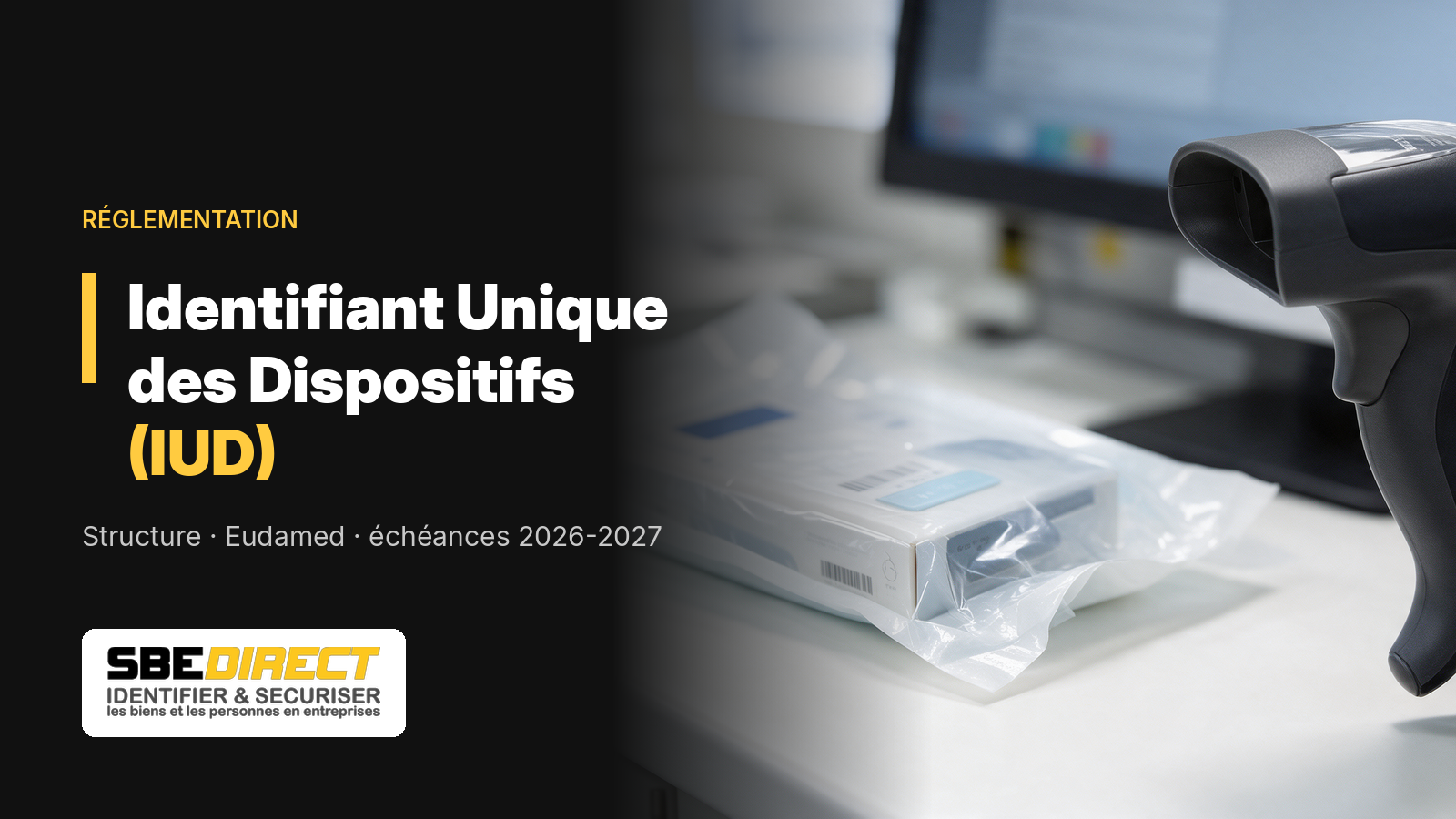
Unique Device Identification (UDI): Definition, Regulations, and Implementation

Unique Device Identification (UDI): Definition, Regulations, and Implementation

The Unique Device Identifier (UDI), called IUD in French, is the code that formally identifies each medical device placed on the European market and makes it possible to follow its path, from manufacture to use on the patient. The regulation does not only require this code to be assigned: it requires the code to stay readable, by machine and by the human eye, for the whole service life of the device.

This article details the technical structure of the UDI, its regulatory framework, the deadlines in force, and the practical means to use it in a healthcare facility. For SBE Direct, which supports professionals in identification and traceability, this requirement for durable readability is a daily matter: technical labels, printing, reading and RFID.

What is Unique Device Identification (UDI)?

The UDI is a unique numeric or alphanumeric code linked to a medical device. It gives clear identification, both for the single unit and for its packaging, and makes traceability easier across the whole life cycle. Key point: the UDI adds to the existing labelling requirements, it does not replace them.

UDI or IUD: What Is the Difference?

There is no difference in substance. “IUD” (Identifiant Unique des Dispositifs) is the French term used in the French version of the European regulation, and “UDI” (Unique Device Identification) is its English equivalent. Both acronyms name the same system.

The System and the Code: Two Notions to Separate

UDI names both the standardised identification system and the code assigned to a given device. The vehicle registration plate analogy works well: on one side there is the regulatory system that organises registration, on the other side the number carried by each vehicle. In daily practice, the two notions serve the same objective: to identify and follow each product.

What Is the UDI For? Objectives and Benefits

The UDI has one central objective: to make patient care safer. Several practical benefits come with that purpose.

Improve Traceability and Patient Safety

By linking each device to its history, the UDI guarantees that the correct device is used for the correct patient. This accuracy lowers the risk of errors and makes the care chain more reliable.

Make Batch Recalls and Device Vigilance Easier

When a defect is identified, the UDI makes it possible to locate the devices concerned immediately. Batch withdrawals become targeted and fast, where a manual search used to take days of work.

Optimise Stock Management and Purchasing

The UDI makes the supply chain smoother: stock level monitoring, replenishment, expiry date control, disposal management. These logistic gains rest on one simple condition, often underestimated: to have reading and labelling equipment that matches the inventory.

The Structure of the UDI: UDI-DI and UDI-PI

The UDI code is based on two complementary components.

The Device Identifier (UDI-DI)

The UDI-DI is a code specific to one manufacturer and one device model. It gives access to the product information and has one version for each packaging level.

The Production Identifier (UDI-PI)

The UDI-PI identifies the production unit: batch number, serial number, manufacturing date, expiry date, software identifier. These data are variable by nature.

Direct practical consequence: the UDI-DI can be pre-printed in series, the UDI-PI cannot. The batch and the expiry date require variable printing, and therefore on-demand printing capability.

The Basic UDI-DI

The Basic UDI-DI is an identifier with a purely regulatory purpose. It appears in the technical documentation, the declaration of conformity and the certificates, and it works as the access key in the Eudamed database. It is not applied to the packaging.

When Must the UDI-DI Be Changed?

According to MDCG guidance, only a major change that affects the intended use justifies it:

  • →a change of name or brand;
  • →a new version or generation;
  • →a change in the number of devices per package;
  • →a move to single use or to sterile;
  • →new contraindications or clinical warnings.

The Regulatory Framework of the UDI

European Regulation (EU) 2017/745 (Article 27)

The Medical Device Regulation introduces the UDI system through its Article 27. Regulation (EU) 2017/746 applies an equivalent system to in vitro diagnostic devices through its Article 24.

The Implementation Timetable

The obligation to apply the UDI carrier on the label and the packaging was deployed in stages, according to the class of the device. For reusable devices that must carry a marking directly on the product, each deadline is two years later.

Device classUDI carrier on the labelDirect marking (reusable)
Class III and implantable26 May 202126 May 2023
Class IIa and IIb26 May 202326 May 2025
Class I26 May 202526 May 2027

For in vitro diagnostic devices, the same principle applies with its own timetable: class D, then classes B and C, then class A.

Note: UDI labelling is now mandatory for all classes. The only marking deadline still ahead concerns the direct marking of class I reusable devices, on 26 May 2027.

Eudamed: What Changed on 28 May 2026

Regulation (EU) 2024/1860 introduced a progressive roll-out of Eudamed: each module becomes legally mandatory six months after the publication in the Official Journal of the notice that confirms its full functionality.

Decision (EU) 2025/2371, published on 27 November 2025, declared the first four modules functional: Actors, UDI/Devices registration, Notified bodies and certificates, Market surveillance. Their use is therefore mandatory since 28 May 2026 for all economic operators.

Two deadlines follow directly from this:

  • →28 November 2026: devices subject to the registration obligation and already on the market before 28 May 2026 must be registered in Eudamed.
  • →28 May 2027: MDR/IVDR certificates issued before 28 May 2026 must have been uploaded into the Certificates module by the notified bodies.

The Vigilance and Clinical investigations modules are still in development. Until they go live, vigilance continues to go through the national systems.

History: From the 2006 Decree to the UDI

Traceability of implantable medical devices has been mandatory in France since the decree of November 2006. With no unique code, facilities used paper traceability or in-house relabelling, methods that were heavy and not very reliable. The UDI is precisely the answer to that problem.

UDI Worldwide: FDA, Canada, Brazil, Japan

The United States were the pioneers with the FDA GUDID database, followed by Canada, Brazil (ANVISA), Japan and Australia. This convergence is driven by IMDRF, the international forum of regulatory authorities.

The Entities Entitled to Assign UDI Codes

GS1, HIBCC, ICCBBA and IFA

Four issuing entities were designated by the European Commission following implementing decision (EU) 2019/939: GS1, HIBCC, ICCBBA and IFA. The manufacturer freely chooses its operator according to the target market and the costs. Implementing decision (EU) 2024/2120 of 30 July 2024 renewed their designation for five years, until 27 June 2029.

GS1 and HIBCC: The Two Main Players

GS1 and HIBCC dominate the medical device sector. The UDI code takes the form of a GTIN with GS1 and of a UPN with HIBCC. Their structures are completely different, and each operator assigns a unique company code to its members.

Understanding the Structure of a UDI Barcode

The Role of Application Identifiers

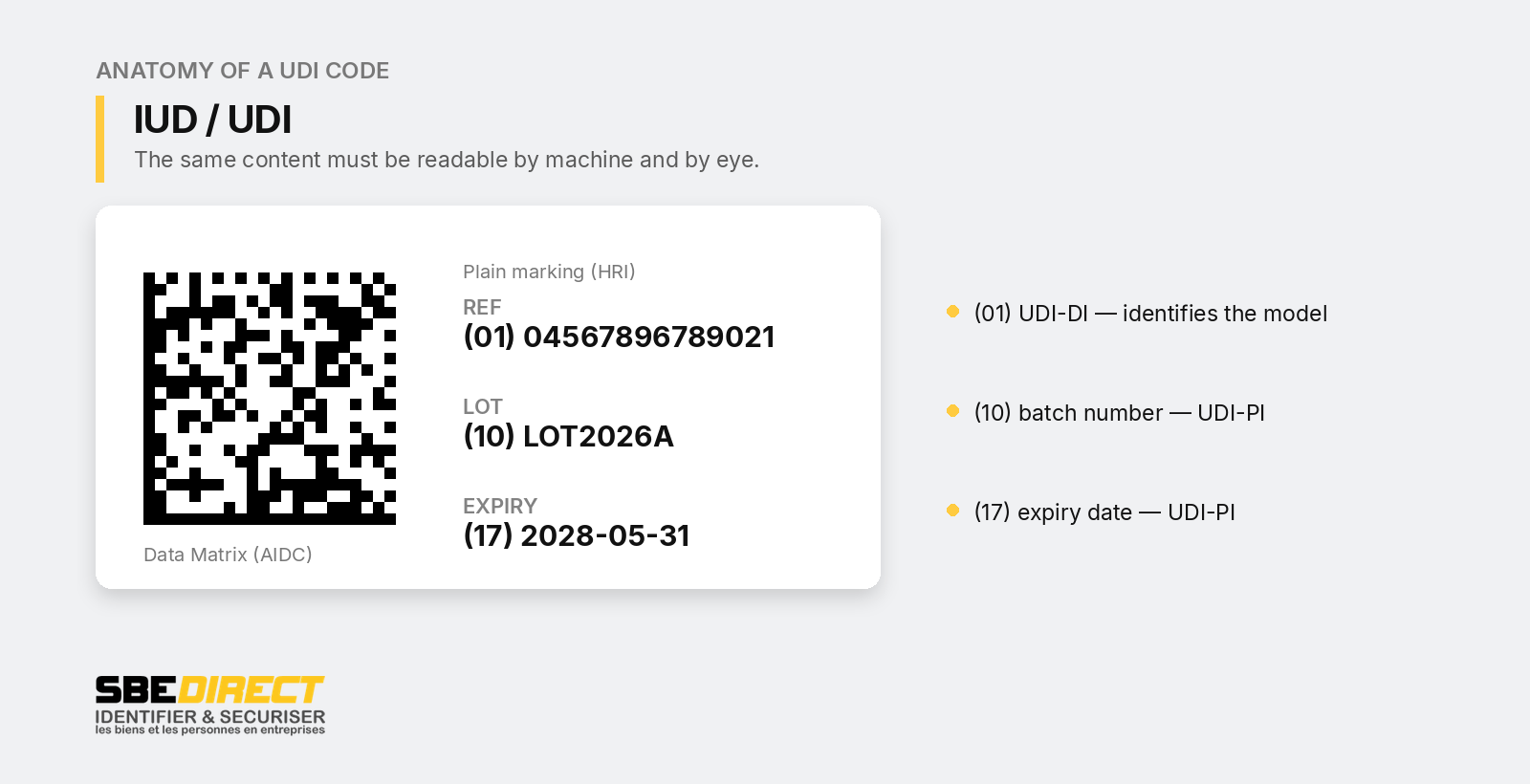
A code is read thanks to its application identifiers, which announce the nature of the information that follows. With GS1, identifier (01) holds the UDI-DI, (10) the batch number and (17) the expiry date. With HIBCC, the symbol + introduces the UDI and $$ the other data.

Practical Example of UDI Code Generation

Take a bipolar cup made by the company HTS (GS1 code: 4567896; HIBCC code: H345), reference AZERT6. The HIBCC UDI becomes H345AZERT68 and the GS1 UDI 456789678902. By adding identifiers (10) and (17), batch and expiry date fit into the same code.

Carrier Formats: 1D Barcode, Data Matrix and QR Code

The UDI can be encapsulated in a linear barcode, a Data Matrix or a QR code (AIDC format), always together with a plain marking readable by the naked eye (HRI format). This double requirement has a physical consequence: the label surface needed is larger than expected, which rules out many standard formats.

In practice, the Data Matrix is the choice for small packaging and low surface devices, because of its higher information density. The format decides both the type of barcode labels to select and the printer able to produce them with sufficient resolution.

The Master UDI-DI for Highly Individualised Devices

For highly customised devices, a solution called Master UDI-DI groups under one common identifier the devices that share similar design parameters. The objective: to avoid multiplying the UDI-DIs to declare in Eudamed.

Contact Lenses and Optics

Delegated Regulation (EU) 2023/2197 of 10 July 2023 introduced the Master UDI-DI for contact lenses, by grouping those that share at least the same base curve and the same diameter. Its date of application, first set at 9 November 2025, was postponed to 9 November 2026 by Delegated Regulation (EU) 2025/788.

Delegated Regulation (EU) 2025/1920 of 12 June 2025 extended the principle to spectacle frames, spectacle lenses and ready-made reading glasses. Position paper MDCG 2025-7 gives the implementation timetables for these two families.

The Role and Obligations of the Manufacturer

Before any placing on the market, the manufacturer assigns a UDI to the device and to each packaging level, applies the UDI carrier on the label, sends the required information to the UDI database and assigns the Basic UDI-DI.

At this stage comes a decision that is purely industrial but has heavy regulatory consequences: the choice of the carrier. A UDI code that becomes unreadable after a few cleaning or sterilisation cycles is a non-compliant code. Paper labels are excluded straight away; synthetic carriers (polyester, polypropylene, polyimide) combined with a resin ribbon are the standard answer for laboratory and medical environments.

How Do You Implement the UDI in a Healthcare Facility?

Record and Keep the UDI Codes

Healthcare facilities and professionals must record and keep the UDI codes of the devices, IVDs and accessories used, to guarantee continuous traceability.

Integrate the UDI Codes into Your Software (Asset Management, Electronic Patient Record)

Integration requires data qualification: each device present in the management software is recognised, then linked to its UDI code. APIs make it possible to collect these data automatically. In the field, data capture relies on standalone mobile terminals able to work on the move in the wards and the storerooms.

Trace a Medical Device from a UDI Code

During scanning, the reader turns the symbol into identifiable data fields. The UDI-DI links the device to the database, while the batch and expiry fields are sent automatically into the system at goods receipt or during patient traceability.

Which Technology Solutions to Use the UDI?

This is the most often underestimated part of a UDI project: the code can be perfectly compliant and still be unusable if the reading equipment or the printing carrier do not follow.

1D Scanner or 2D Reader: Will Your Current Equipment Read a UDI?

This is the first blocking point met in facilities. A 1D laser reader will never read a Data Matrix. Linear codes and two-dimensional codes rest on two different optical principles: the laser sweeps a line, the imager captures an image.

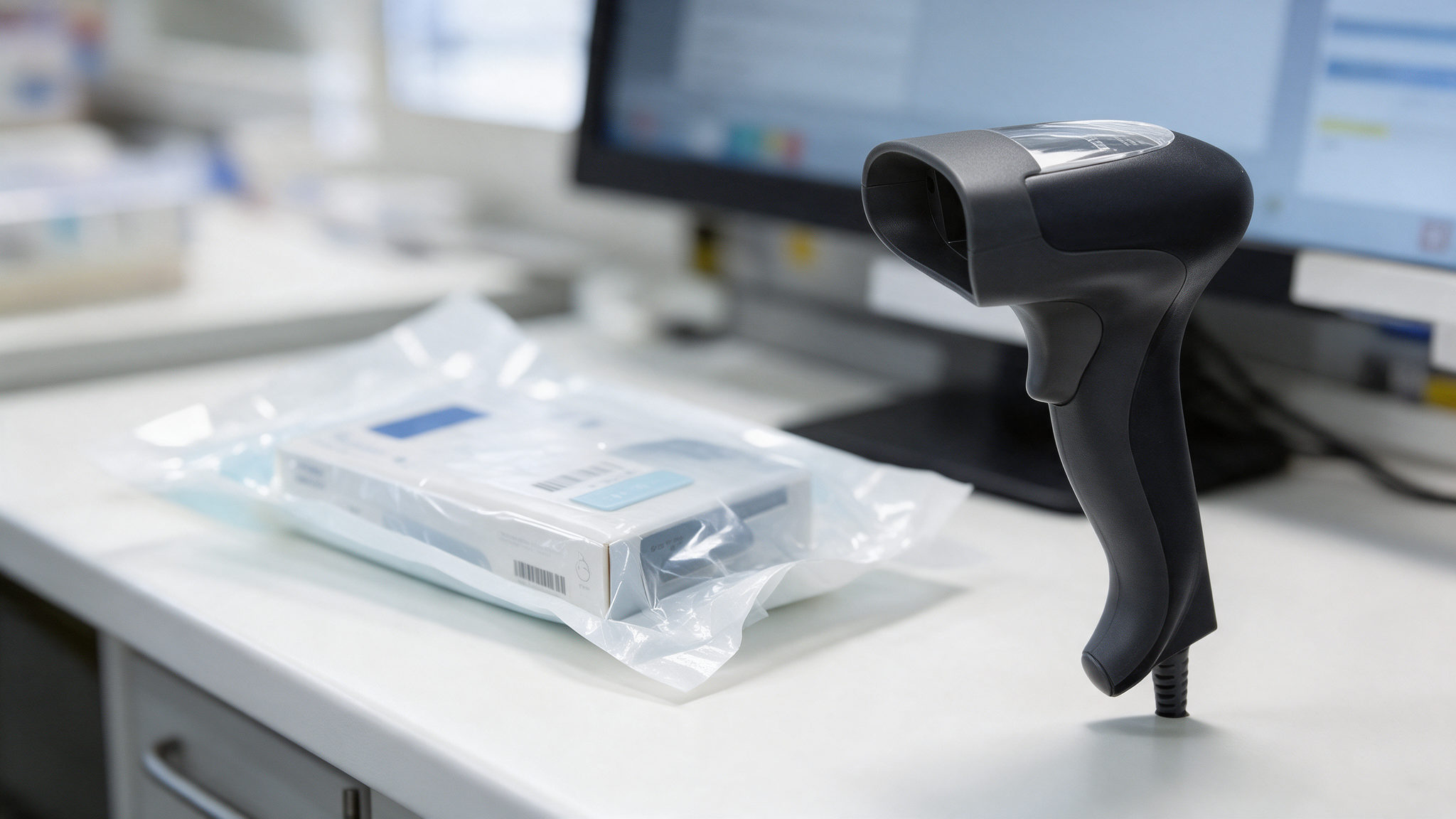
In practice, if your equipment base uses older generation laser scanners, you must move to imager readers. Our corded barcode scanners suit fixed workstations (goods receipt, pharmacy, counter), with immediate USB connection and no configuration. To find your way between the technologies, our guide details how to choose the reader that matches your codes.

Goods Receipt Control and Mobile Inventory

Away from the fixed workstation, reading happens at the trolley, in the storeroom or in the operating theatre. Wireless readers give a Bluetooth range above 10 metres and a drop resistance suited to care environments. Standalone mobile terminals store the scans and then transfer them to the management system, which removes any manual re-entry.

RFID and UDI: A Complement, Not a Substitute

RFID allows reading with no direct line of sight, in batches and at a distance: useful for the inventory of a fleet of reusable devices or for monitoring secured cabinets. But it does not replace the UDI carrier required by the regulation, which must stay readable in AIDC and in plain characters. The two technologies work on top of each other: RFID labels bring the logistic performance, the Data Matrix carries the compliance.

The Label Carrier Must Outlive the Device

A reusable device goes through washing, disinfection and the autoclave. It is generally not the sterilisation that erases the code, but the repetition of cleaning cycles and the rubbing in the basket.

Three trade-offs decide the durability:

  • →The material: vellum paper excluded, polyester or polypropylene according to the thermal and chemical constraint.
  • →The printing technology: direct thermal fades with heat and UV, which rules it out on any sterilised device. Thermal transfer is the choice.
  • →The ribbon: wax, wax-resin or resin, and resin is the only one that resists solvents and repeated rubbing.

Integration with the Patient Record and Business Intelligence

Integrated into electronic patient records and analytical tools, UDI data feed real management: use monitoring, scrap rate, device performance and profitability by department.

The Symbols and Pictograms Linked to the UDI on the Labelling

Standard ISO 15223-1, updated in 2021, defines the standardised symbols linked to the identification and traceability of medical devices. These pictograms come with the UDI code on the labelling for an understanding that is independent of the language. Their faithful reproduction is subject to the same contrast and resolution requirements as the code itself.

Do You Need to Equip Your Identification Chain?

SBE Direct supports more than 16,000 companies and facilities in their identification and traceability projects.

  • →Free samples: test how a label holds in real conditions, autoclave included, before you order.
  • →Custom manufacturing: formats, materials and printing from your databases, in small as well as large runs.
  • →Volume pricing from the first quantities.
  • →Dispatch within 24/48 h on references in stock.

Conclusion

Unique Device Identification has durably changed traceability in the medical sector. From its structure (UDI-DI and UDI-PI) to its regulatory framework, through its registration in Eudamed and its use in software, it stands as a pillar of modern device vigilance.

UDI labelling is now mandatory for all device classes, and the first four Eudamed modules have been mandatory since 28 May 2026. The immediate deadlines concern the registration of devices already on the market, on 28 November 2026, then the direct marking of class I reusable devices, on 26 May 2027.

One question remains, the most practical one and often the last to be handled: the carrier. A compliant code on a label that does not hold is a lost code. This is exactly where SBE Direct comes in, from the technical label to the printer, from the 2D reader to the mobile terminal.

FAQ

Which devices are concerned by the UDI?▾

All medical devices, IVDs and their accessories placed on the European market, except custom-made devices. The latter are not registered in the UDI/Devices module of Eudamed.

Does the UDI replace the other labelling codes?▾

No. The UDI adds to the existing labelling requirements, it does not take their place.

What is the difference between UDI-DI and UDI-PI?▾

The UDI-DI identifies the device model, common to all units produced. The UDI-PI identifies the individual item: batch, serial number, manufacturing or expiry date. The first can be pre-printed, the second requires variable printing.

Must a distributor register in Eudamed?▾

Not at European level: the actor registration obligation targets manufacturers, authorised representatives and importers. Some Member States may however require a national registration from distributors operating on their territory.

Which label resists autoclave sterilisation?▾

A synthetic carrier (most often polyester), combined with a high temperature adhesive and thermal transfer printing with a resin ribbon. Paper and direct thermal do not hold through repeated cycles.

What is the risk if the UDI code becomes unreadable?▾

An unreadable UDI carrier is the same as no carrier: the device no longer meets the identification requirements of the regulation, and traceability in the facility becomes impossible to guarantee.

What is the difference between the UDI and the CIP/UCD codes for medicines?▾

For medical devices, the UDI plays a role comparable to the CIP and UCD codes for medicines: a standardised identifier that serves traceability and management.

Test Your UDI Labels in Real Conditions

Free samples, autoclave included, before you order.

Request a sample →

We use cookies to improve your experience.