EN 361 Standard: Everything You Need to Know About Fall Arrest Harnesses

EN 361 Standard: Everything You Need to Know About Fall Arrest Harnesses

EN 361:2002 sets out the requirements for fall arrest harnesses: design, static and dynamic tests, attachment points and marking. It does not certify the complete fall arrest system, the anchor point, or the service life of the equipment.

A compliant harness only stops a fall if it is part of a complete, correctly sized system. This guide explains what the standard actually requires, how to read the markings, how to calculate the clearance distance needed, and which inspection duties apply to the employer in France.

What the EN 361 Standard Covers and What It Does Not

The Official Definition

EN 361:2002 is titled “Personal protective equipment against falls from a height - Full body harnesses”. It sets the requirements, the test methods, the marking, the manufacturer's information notice and the packaging of harnesses intended to arrest a fall.

A fall arrest harness is a body holding device made of straps that enclose the shoulders, the chest, the pelvis and the thighs. It is designed to hold the user during and after the arrest of a fall, and to spread the forces over the body areas that can carry them.

Three Common Misconceptions to Correct Before You Buy

  • →“EN 361 means my fall arrest system is approved.” No. The standard assesses the harness alone. The connecting device, the connectors, the anchor point, the available clearance distance and the rescue plan come under other standards and under your own risk assessment.
  • →“The 4-metre drop test allows a 4-metre free fall on site.” No. This is a laboratory procedure used to qualify the product. On site, the free fall height must be kept to a minimum and the clearance distance must be calculated (see below).
  • →“The 100 kg dummy sets the maximum user weight.” No. The maximum permissible mass is given in the manufacturer's notice, and it includes clothing, tools and equipment carried.

Is EN 361:2002 Still in Force?

Yes. Despite its date, it remains the harmonised reference for fall arrest harnesses under Regulation (EU) 2016/425 on personal protective equipment. An old standard is not an obsolete standard: its validity depends on its reference published in the Official Journal of the European Union. Check the current harmonised list before any declaration of conformity for a specific model.

The Technical Requirements: the Figures to Know

Static Test: 15 kN and 10 kN

The harness undergoes two tensile tests on its fall arrest attachment points:

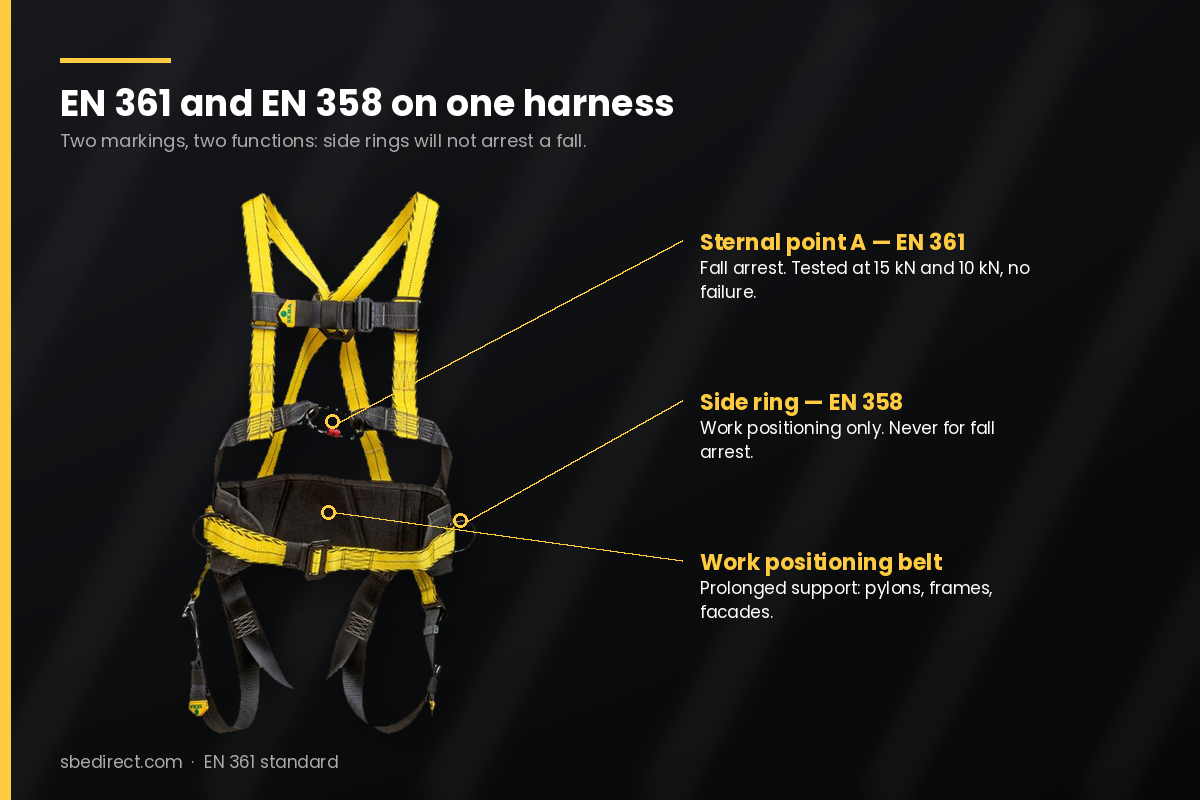
  • →15 kN for 3 minutes, dummy in the normal position;
  • →10 kN for 3 minutes, dummy in the inverted position (head down).

No failure is allowed after these tests.

Beware of approximate conversions. Several online sources translate these values as “1,500 kg” and “1,000 kg”. This is a misleading simplification: the kilonewton measures a force, not a mass. 15 kN is about 1.53 tonne-force. The confusion has no practical effect for the buyer, but it points to a source that has not worked from the texts.

Dynamic Test: the Controlled Fall

The dynamic test is the most demanding one. A 100 kg mass is connected to the attachment point with an 11 mm dynamic rope, and dropped over a height of 4 metres at fall factor 2.

The test is done feet first and then head first, on each fall arrest attachment point the model has. The harness must show no failure, and the dummy must not come out of it.

The 50° Angle: the Criterion Nobody Explains

After the fall is arrested, the dummy must return to a suspended position with a tilt of 50° or less from the vertical, head up.

This criterion is not cosmetic. Suspension head down or strongly tilted increases the risk of trauma and makes evacuation much harder. This is exactly what sets a full body harness apart from a simple belt with a ring.

Webbing, Stitching and Buckles

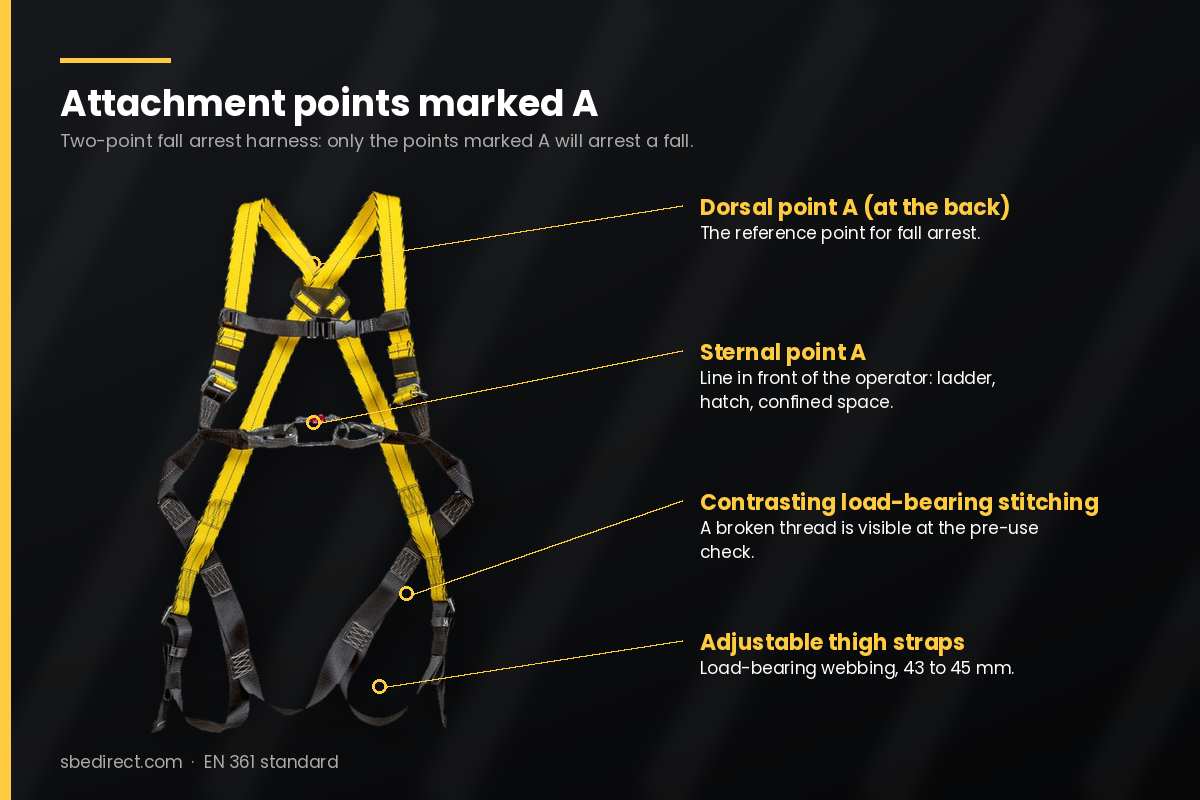
The standard sets minimum widths: the load-bearing straps, which carry the load when the fall is arrested, are clearly wider than the secondary straps, which only hold the assembly in position. Models on the market generally use main straps of 43 to 45 mm and secondary straps of 20 mm.

Two other requirements deserve attention when buying:

  • →The load-bearing stitching must contrast with the colour of the webbing. This is not an aesthetic choice: it is what makes a broken thread visible during the pre-use check.
  • →Buckles must not be able to open accidentally and must open only through two separate movements. Slippage of the adjustment devices under load is also limited.

Summary of the EN 361 Tests

TestWhat is checkedPass criterion
Static strengthTensile load on the fall arrest attachment points15 kN and 10 kN for 3 min, no failure
Dynamic strength4 m fall, 100 kg mass, factor 2No failure, dummy held
Position after the fallSuspension postureHead up, 50° maximum from the vertical
Webbing and stitchingWidths, thread contrast, strengthDimensional and mechanical conformity
Buckles and adjustmentsAccidental opening, slippageTwo movements required, limited slippage
Marking and noticeIdentification, attachment points, instructionsComplete and legible

Attachment Points: A, A/2 and the Rings That Are Not Attachment Points

The A Marking

Every attachment point intended for fall arrest carries the capital letter A. This is the only reliable indicator: neither the shape, nor the position, nor the apparent strength of a ring shows that it is intended for fall arrest.

The A/2 Marking: Two Loops to Be Joined

Some front attachment harnesses have two textile loops marked A/2 or A2. They form a fall arrest attachment point only once they are joined together by the connector.

This is a frequent and serious use error: connecting the lanyard to only one of the two loops means using an attachment point that has never been tested in that configuration.

Dorsal or Sternal: Which One to Use?

The dorsal point, between the shoulder blades, is the reference point for fall arrest. It keeps the line away from the work area, limits the risk of entanglement and gives the best suspension posture.

The sternal point is preferred when the line must stay in front of the operator: climbing a ladder with a guided type fall arrester, access through a hatch, confined spaces. It also gives a slightly shorter fall height.

Two-point attachment harnesses cover both configurations and are the default choice as soon as work positions vary.

Side Rings Are Not Fall Arrest Points

The rings at hip level come under the EN 358 standard and are used for work positioning: they support the operator standing on their feet while working, with both hands free. They are not designed to arrest a free fall and have not undergone the matching tests.

A fall arrest harness with a work positioning belt therefore carries two markings at once, EN 361 and EN 358, with separate attachment points for each function. Using one instead of the other is a safety failure, not a shortcut.

EN 361, EN 358, EN 813, EN 1497: the Table That Prevents the Mistake

StandardFunctionAttachment pointFall arrest?
EN 361Fall arrest harnessDorsal and/or sternal, marked AYes, that is its purpose
EN 358Work positioning and restraint beltSide (hips)No
EN 813Sit harness, rope access workVentral (low)No
EN 1497Rescue harnessRescue pointsNo, for evacuation only

One harness can carry several of these markings. Each attachment point still keeps its own function.

An EN 361 Harness Is Not Enough: the Complete System

Worn on its own, a harness protects against nothing. The EN 363 standard defines the fall arrest system as one inseparable set.

The Components and Their Standards

ComponentStandardRole
Fall arrest harnessEN 361Holds and supports the body
LanyardEN 354Provides the connection
Energy absorberEN 355Dissipates the energy, limits the arrest force
Retractable type fall arresterEN 360Self-locking retractable unit
Guided type fall arrester on an anchor lineEN 353 seriesSlider on a vertical line or rail
ConnectorsEN 362Join the components
Anchor deviceEN 795Fixing point, verified strength
General requirementsEN 365Marking, notice, inspection, traceability

The Arrest Force Limited to 6 kN

This is the most important figure in the system and the least often quoted. The force transmitted to the body when a fall is arrested must not exceed 6 kN. Above that, internal injuries become likely even if the harness holds perfectly.

It is the energy absorber that guarantees this ceiling, not the harness. A lanyard without an absorber connected to a fixed anchor can generate a much higher force. This is why a 2-metre lanyard used on a fixed anchor point must always include an energy absorber.

Calculating the Clearance Distance: the Four-Term Method

The clearance distance is the free height needed under the operator's feet for the fall to be arrested before impact. It is the most frequent failure point of fall arrest systems: the equipment works, but the operator hits the ground or an obstacle.

The calculation adds up four values:

  • →The length of the connecting system: up to 2 m for a lanyard.
  • →The tear-out of the energy absorber: up to 1.75 m depending on the model.
  • →The distance between the feet and the dorsal attachment point: about 1.5 m depending on body size.
  • →A safety margin: 1 m minimum.

So, in a common configuration: 2 + 1.75 + 1.5 + 1 = 6.25 m of free height required under the work point. In practice, an operator working 5 metres above the ground with a standard energy absorbing lanyard is not protected, even with a fully compliant harness.

You must then switch to a retractable type fall arrester, whose clearance distance is much shorter, or raise the anchor point above the work position.

The values above are indicative: refer to the notice of your own equipment, which gives the exact clearance distance for the model.

The Rescue Plan: the Blind Spot of Fall Arrest Systems

An arrested fall is not a solved situation. An operator hanging motionless in a harness is exposed to suspension trauma, caused by blood pooling in the lower limbs. Response times are counted in minutes, not tens of minutes.

The evacuation plan must be drawn up before work starts, with the equipment available on site and at least one trained operator. Working alone at height must be prohibited.

Choosing an EN 361 Harness According to the Work Position

One Point, Two Points or a Harness with a Belt

ConfigurationTypical use
1 dorsal pointOccasional work with a retractable unit or a lifeline, aerial platform, simple access
2 points (dorsal + sternal)Versatile configuration: construction, roofing, maintenance, ladder climbing
Fall arrest + work positioning beltWork positions with prolonged support: pylons, structural frames, facades, work needing both hands free

The choice comes from the risk assessment of the work position, not from the budget. A two-point harness poorly suited to the position protects less than a simple model set up correctly. The full range is available in our catalogue of fall protection equipment.

Comfort Is Not a Minor Specification

An uncomfortable harness is left loose, badly adjusted, or not worn. Thigh strap padding, automatic buckles, back pad breathability and the adjustment range directly set the real level of protection over a shift of several hours.

Also check the size range: a correctly sized harness keeps its load-bearing straps in position and does not move when the fall is arrested.

Read the Label Before Buying

Fall protection PPE comes under category III of Regulation (EU) 2016/425, which covers fatal or irreversible risks. This means two things when buying:

  • →The CE marking is followed by a four-digit number, that of the notified body involved in production control. A bare CE marking, without those four digits, should raise a flag.
  • →The label must carry the manufacturer's name, the model, the serial or batch number, the EN 361:2002 reference, the identification of the attachment points and the size. The notice must be supplied in French.

A “CE certified” claim on a product page is not proof: the supporting documents must cover the exact model, not a range.

Inspection and Service Life: What French Regulations Require

This is the part most often missing from online guides, and yet the only one directly enforceable during a labour inspection.

The Periodic General Inspection: Less Than 12 Months

The French order of 19 March 1993 lists personal fall protection systems among the PPE subject to periodic general inspection. In practice:

  • →The inspection must be less than twelve months old at the time of use.
  • →It covers equipment in service and in stock. A new harness left two years in a cupboard must be inspected before first use.
  • →It covers the whole system: harnesses, lanyards, absorbers, retractable units, connectors, anchor devices.
  • →It is carried out by a qualified person, internal or external, competent on this equipment.
  • →The result is recorded in the establishment's safety register.

The general duties to keep equipment in a compliant condition are set out in articles R4323-99 to R4323-103 of the French Labour Code.

The Check Before Every Use

It does not replace the periodic inspection: both are required and serve different purposes.

The pre-use check means running the whole length of the webbing through your hands, on both faces, to find cuts, abrasion, burns, glazing marks or chemical attack. You then examine the load-bearing stitching, the buckles, the attachment D-rings and the adjusters, and check that the label is still legible.

An illegible label means the equipment must be withdrawn: without identification, traceability and conformity can no longer be established.

After a Fall: Immediate Disposal

A harness that has arrested a fall is withdrawn from service without exception, even if no damage is visible. The stresses on the webbing and the stitching are not always visible to the eye.

The same rule applies if the history is unknown, if the check fails or if traceability is lost. Withdrawn equipment must be made unusable to prevent any accidental return to service.

Service Life and Storage

The EN 361 standard sets no universal expiry date. The service life is set by the manufacturer and depends on how intensively the harness is used, on exposure to UV and chemicals, and on the inspection results. Stated service lives are commonly between 5 and 10 years from first use.

Store harnesses away from light, dry, away from solvents, acids and heat sources, hung up rather than folded under load.


What Training Adds to the Equipment

Supplying a compliant harness does not release the employer from the duty to train. Wearing the harness, connecting it, checking it before use and what to do after a fall are covered by specific training, with refresher training generally recommended every three years.

Finally, remember the order of priority set by the French Labour Code: collective protection (guardrails, nets, secured platforms) comes before personal protection. Fall protection PPE is used when collective protection is technically impossible, or to protect the people who install it.

Equip Your Teams with Fall Protection

SBE Direct supports more than 16,000 companies in their purchases of safety equipment.

  • →Free quotation within 24 h, with advice on the right configuration for your work positions
  • →Volume pricing from the first quantities, to equip a complete team
  • →Shipping within 24/48 h on items in stock
  • →Complete range: harnesses, lanyards, absorbers, connectors and accessories

Conclusion

The EN 361 standard guarantees that a harness can hold a body when a fall is arrested and keep it in an acceptable posture afterwards. It guarantees nothing else.

Three checks set the real level of protection:

  • →is the attachment point used marked A?
  • →is the available clearance distance sufficient?
  • →is the periodic inspection less than twelve months old?

These three points belong to site organisation, not to the product. For the rest, the choice of model comes from the work position: one point for simple work, two points for versatility, a harness with a belt for work with prolonged support.

FAQ

Is the EN 361 standard mandatory?▾

Harmonised standards are voluntary; it is the essential requirements of Regulation (EU) 2016/425 that are mandatory. In practice, EN 361 is the normal route to demonstrate conformity for a fall arrest harness, and every harness sold in the Union refers to it.

What is the difference between EN 361 and EN 358?▾

EN 361 covers fall arrest: the harness holds the operator during and after the fall. EN 358 covers work positioning and restraint: the belt supports the operator standing on their feet, or prevents them from reaching the fall zone. EN 358 side rings must never be used as a fall arrest point.

How often should a fall arrest harness be inspected?▾

A visual check before every use by the wearer, and a periodic general inspection less than twelve months old by a qualified person, in line with the French order of 19 March 1993. This duty applies to equipment in service and in stock.

Does an EN 361 harness have an expiry date?▾

Not under the standard. The service life is set by the manufacturer, generally between 5 and 10 years, and depends on actual use. Withdrawal is immediate after a fall, a failed check or a loss of traceability.

Can a harness be used after a fall?▾

No, never. It is withdrawn from service and made unusable, even with no visible damage.

What clearance distance should be allowed under a work position?▾

In a common configuration with an energy absorbing lanyard, allow about 6.25 m of free height: lanyard length, absorber tear-out, feet-to-attachment-point distance and safety margin. A retractable type fall arrester greatly reduces this requirement.

What does the A/2 marking on a harness mean?▾

It marks two textile loops that form a fall arrest attachment point only once they are joined together by the connector. Connecting the lanyard to only one of the two loops makes the attachment point non-compliant.

Is a harness enough to protect against a fall?▾

No. It is the body holding element of a system that must also include a connecting device with an energy absorber and an anchor point compliant with EN 795. Worn on its own, a harness offers no protection.

Equip your teams with EN 361 harnesses

Free quotation within 24 h, with advice on the right configuration for your work positions.

View fall protection equipment →

We use cookies to improve your experience.