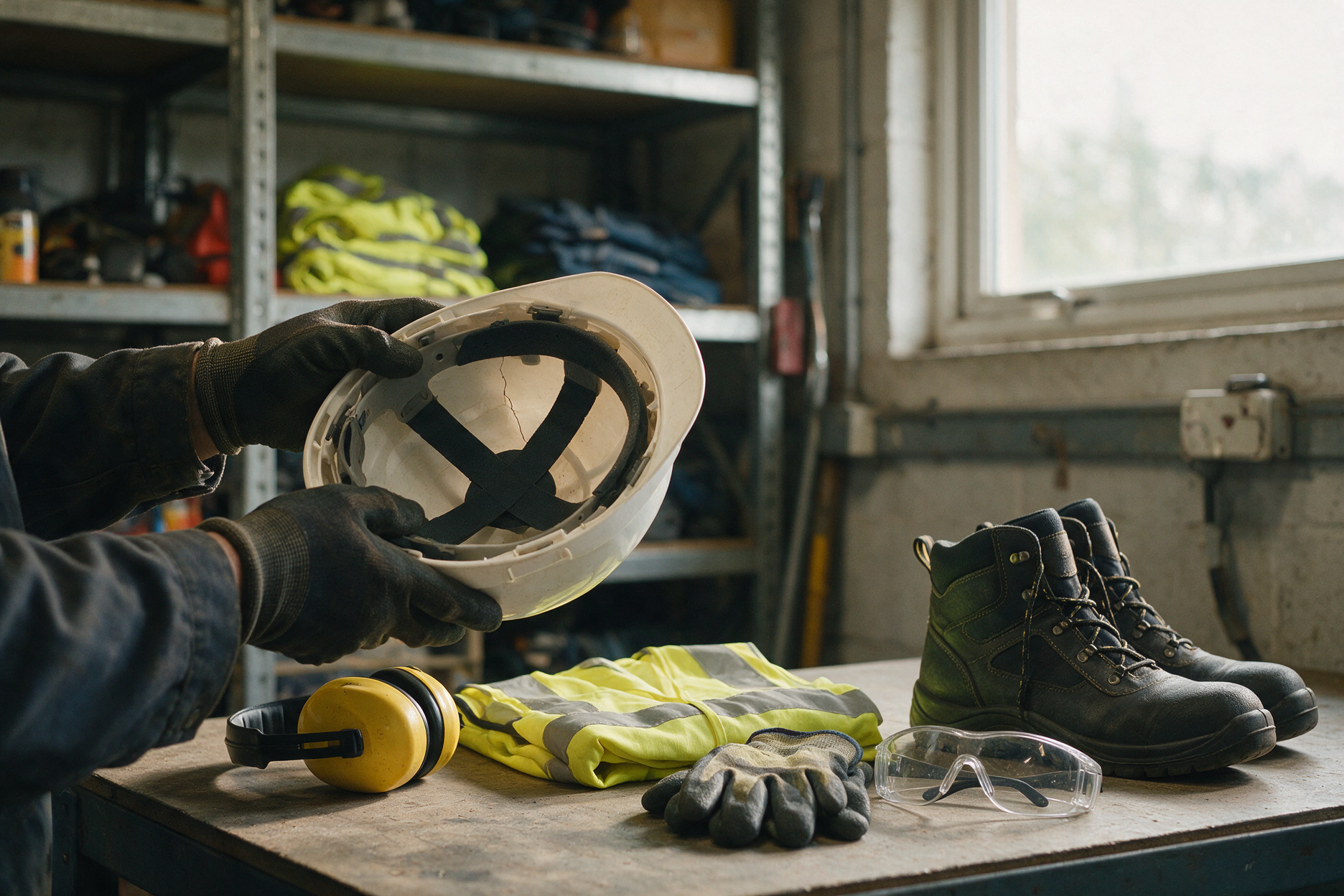
Brushcutting protection is not a lighter version of forestry kit. It is a distinct outfit, dictated by a tool that spins fast and throws whatever it meets. A hand-held brushcutter reaches 6,000 to 9,000 rpm according to the agricultural and forestry machinery safety sheet issued by the French Ministry of Agriculture (Cemagref, 2010). Nylon line, three-tooth blade or circular saw blade: each cutting head shifts the risk, and therefore the kit. Which items are genuinely mandatory? Which visor holds up against flying debris? Does chainsaw cut-protection stop a rotating blade? This guide answers item by item, standard by standard, and links through to the matching personal protective equipment ranges.

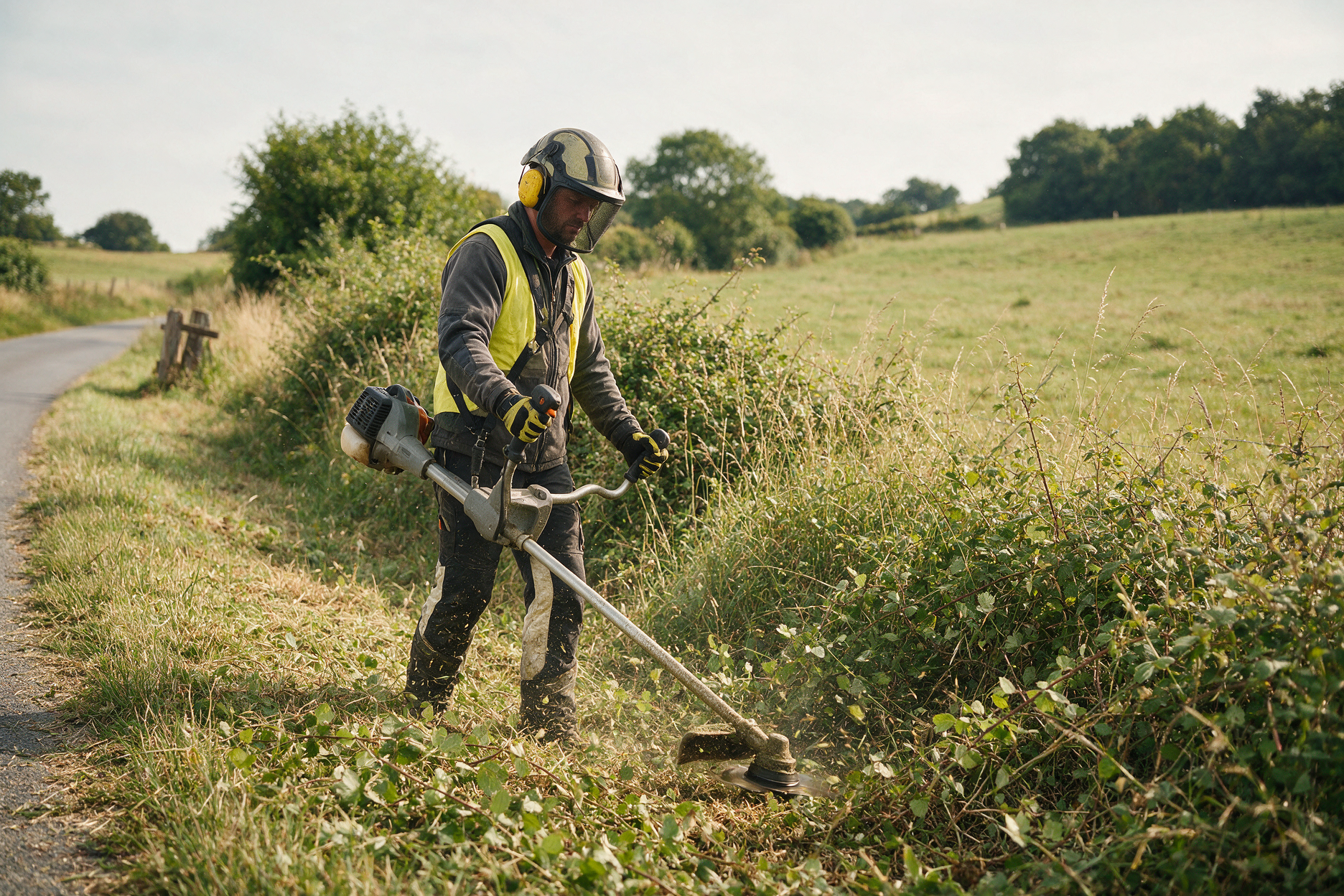
Operator in full brushcutting protection on a roadside verge.

Key points

  • Seven items make up brushcutting protection: helmet or headband defender, visor, safety spectacles, hearing protection, high-visibility top, reinforced trousers, gloves and S3 ankle boots.
  • No European standard measures cut resistance against a brushcutter. EN ISO 11393 targets the chainsaw, not the rotating head.
  • The employer supplies PPE free of charge, maintains it, replaces it and trains staff to wear it, under articles R. 4321-4, R. 4323-95 and R. 4323-106 of the French Labour Code.
  • A professional petrol brushcutter produces 101 dB(A): the target is a protector rated SNR 25 to 30 dB, never more.
  • A visor alone does not protect the eye: EN 166 spectacles are worn underneath.
  • Fifteen metres of clear radius surround a running machine, and more if a colleague is working downhill.
  • Pre-use inspection and traceable issue records decide how much the equipment actually protects.

Why brushcutting demands specific PPE

Brushcutting stacks five risk families onto one job: high-speed projectiles, noise above 100 dB(A), hand-arm vibration, cuts from the rotating head, and musculoskeletal disorders caused by carrying the machine. No single item covers all five. Brushcutting protection is therefore built by assembly, never bought as one product.

The five risks: projectiles, noise, vibration, cuts, MSDs

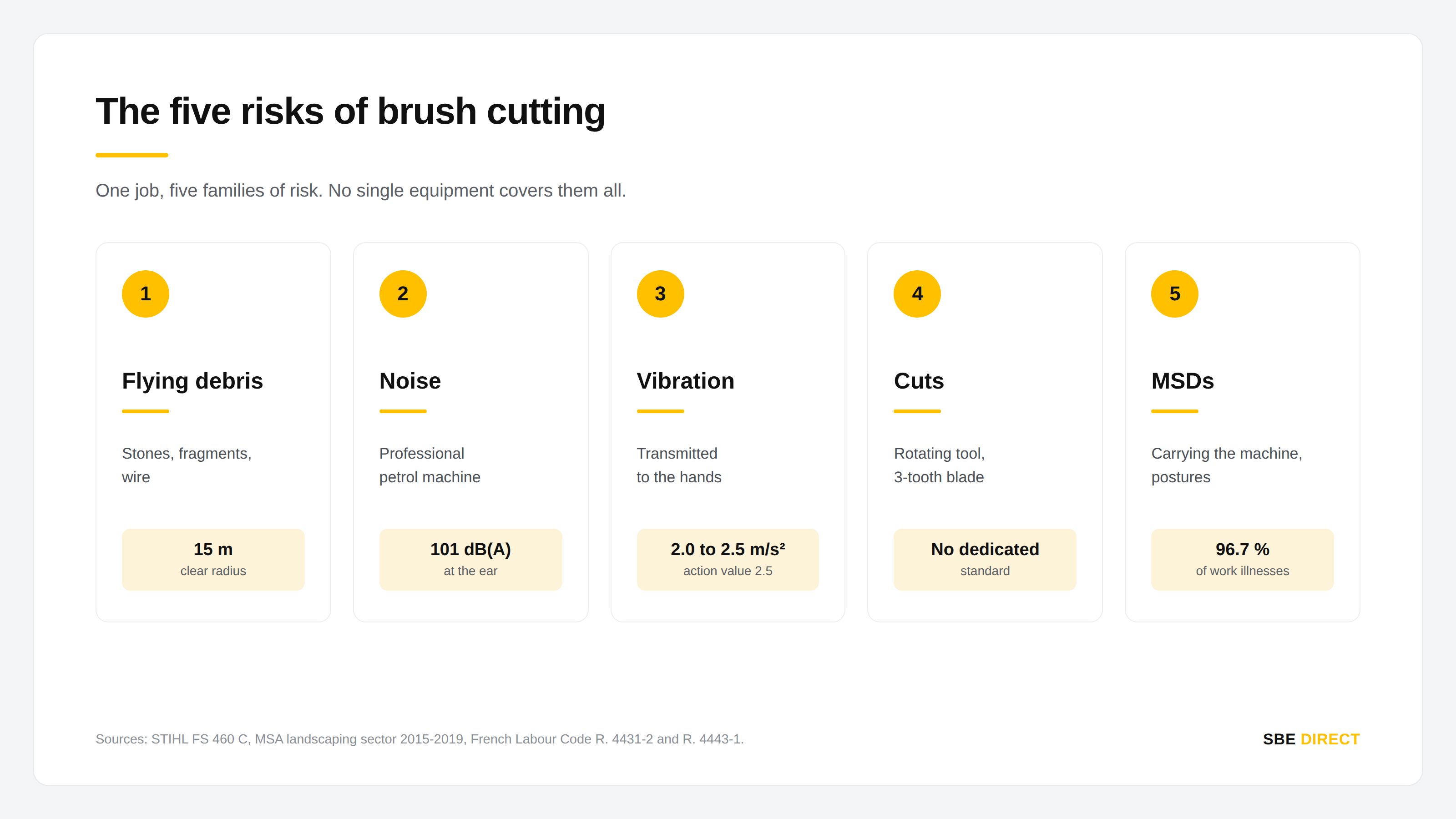
Flying debris is the most visible risk. The STIHL operating manual for the FS 460 and 490 C-M requires a clear radius of 15 metres around a running machine, while stating that stones and pieces of metal can be thrown beyond that distance. Fifteen metres is a floor, not a guarantee.

Noise comes next. A 2.2 kW professional petrol brushcutter produces 101 dB(A) sound pressure and 113 dB(A) sound power (STIHL FS 460 C technical sheet). The MSA, the French agricultural social insurance body, classes the machine above 85 dB(A). French law sets the lower action value at 80 dB(A) over eight hours and the exposure limit value at 87 dB(A), under article R. 4431-2 of the Labour Code.

The five risk families combined on a single brushcutting job.

Vibration is the most underrated risk. Declared values on the same machine range from 2.0 to 2.5 m/s² depending on the handle and the cutting head fitted. The daily action value is 2.5 m/s² over eight hours and the limit value 5 m/s² (articles R. 4443-1 and R. 4443-2). In other words, the machine sits at the action threshold from the first hour of calculation.

Musculoskeletal disorders close the list and weigh heaviest over time. According to the MSA study of workplace accidents in the landscaping sector from 2015 to 2019, published in 2022, MSDs account for 96.7% of the sector's occupational illnesses, at an average cost of 34,600 euros per case. The same study records 35,708 workplace accidents over the period, 13% of them head injuries.

What French law requires of the employer

Three duties frame the kit. Article R. 4321-4 requires the employer to provide appropriate PPE and to ensure it is actually worn. Article R. 4323-95 states that it is supplied free of charge by the employer, who is also responsible for its condition, maintenance, repair and replacement. Article R. 4323-106 adds adequate training, including practical training in wearing the equipment, renewed as often as necessary.

These duties flow from the general principle in article L. 4121-2: collective protection takes precedence over individual protection. Reduce the risk at source before issuing kit. Site marking, choice of cutting head, rotation planning to cap vibration exposure time: PPE comes last, not first.

Note: PPE is not an anonymous consumable. A named issue register, a service start date and individual identification of each item make periodic checks and post-impact withdrawal traceable. A barcode label or an RFID tag on the helmet is enough to make that record usable.

Brushcutter or chainsaw: two protection levels not to confuse

This is where most guides on the market get it wrong. Standard EN ISO 11393, which replaced the older EN 381 series, qualifies protective clothing against hand-held chainsaws. Its speed classes match chain speed: class 0 for 16 m/s, class 1 for 20 m/s, class 2 for 24 m/s, class 3 for 28 m/s. Parts 2 (leg protectors), 4 (gloves), 5 (gaiters) and 6 (upper body) are all written for that tool.

A brushcutter does not cut like a chainsaw. The long fibres in cut-protection clothing are designed to pull free, wrap around the saw's drive sprocket and stall the chain. A rotating blade or a three-tooth head has no sprocket to stall. There is currently no European cut-resistance standard specific to a brushcutter's rotating head.

The practical consequence: trousers marked EN ISO 11393-2 provide a genuine physical barrier against brambles, debris and accidental contact, but their performance level has never been measured against a brushcutter. Choose them for coverage and durability, not for their speed class. An operator who alternates between brushcutter and chainsaw in the same day remains covered by the chainsaw standard and must keep certified clothing.

Protecting the head, face and eyes

The head accounts for 13% of injuries in the landscaping sector (MSA, 2022). Three functions overlap here: impact, projectiles and noise exposure. A forestry combination of helmet, visor and earmuffs handles all three in one item and guarantees the three parts fit together.

Helmet or headband: when is a helmet required?

A helmet becomes necessary as soon as there is a risk of falling objects or head strikes: work under tree cover, embankments, tall hedge lines, sites shared with tree surgery. On open, flat ground with nothing overhead, a headband-style ear defender combined with eye protection meets the need.

The reference is EN 397, whose current version dates from April 2025. It requires a chin strap that releases under load, to prevent strangulation. Do not confuse it with EN 12492, the mountaineering helmet standard, whose chin strap does not release: that belongs to work at height and rope access tree surgery, not ground-level brushcutting. The safety helmet range sets out the distinction reference by reference.

Mesh visor or polycarbonate screen: which to choose?

The mesh visor wins for routine brushcutting. It does not fog, lets sweat evaporate, shrugs off wet soil and sap, and keeps a clear field of view across a full day. Its known weakness: fine dust, tiny fragments and liquids pass through.

A solid polycarbonate screen stops those fine projectiles but fogs under effort and scratches quickly against branches. It earns its place in dusty conditions, on dry stony ground, or where plant protection products are in use.

Why a visor alone is not enough

A visor protects the face. It does not protect the eye in the sense the standards mean. Mesh protectors fall under EN 1731, and spectacles under EN 166, whose impact classes are measured by firing a 6 mm steel ball: F at 45 m/s, B at 120 m/s, A at 190 m/s. The S marking covers increased robustness tested at 5.1 m/s.

Wearing safety spectacles under the visor is the only configuration that covers fine projectiles. That is what local authority and landscaping teams do on roadside work. The eye protection range covers wraparound models designed to be worn under a visor.


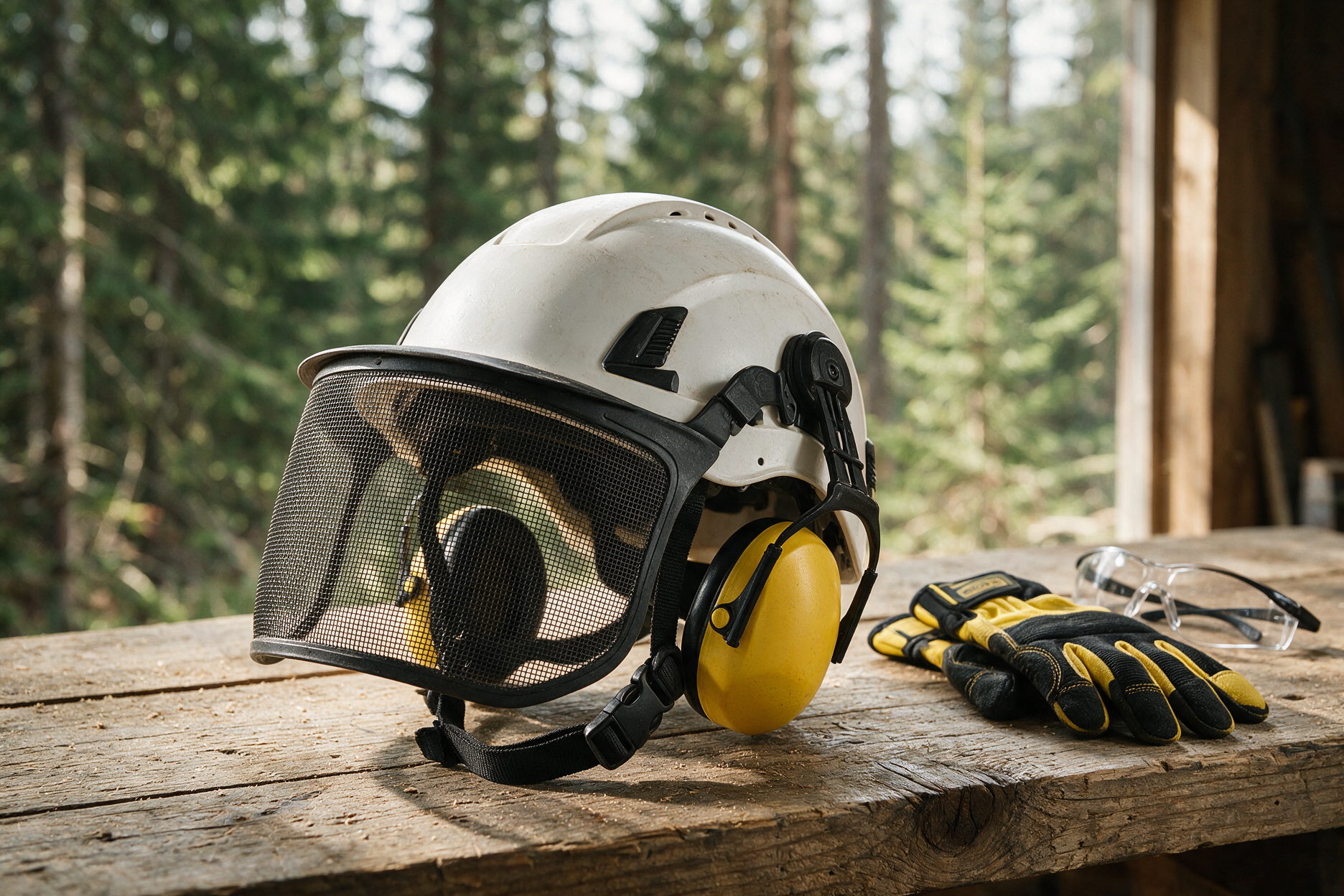
The helmet, mesh visor and ear defender combination, with gloves and safety spectacles.

Standards note for buyers: AFNOR has withdrawn EN 166 (2002) and EN 1731 (2007), replaced by the EN ISO 16321 series published in 2022. On the market, the vast majority of protectors still carry EN 166 marking. Check certificate validity with your supplier before renewing a fleet.

Hearing protection: preserving your operators' hearing

At 101 dB(A) measured at the operator's ear on a professional machine, hearing protection is not optional. The effective level at the protected ear is calculated simply: C-weighted ambient noise level minus the protector's SNR rating. The target is to drop below 87 dB(A), the eight-hour exposure limit value.

What attenuation level for a petrol brushcutter?

For a 101 dB(A) machine, a protector rated SNR 25 to 30 dB brings exposure into a 71 to 76 dB(A) band. That is the target. An SNR above 35 dB produces the opposite effect: the operator stops hearing warnings, vehicles and colleagues, and ends up lifting a cup. Over-protection is a risk in its own right.

The calculation method comes from EN ISO 4869-2, 2018 version, which also defines the H, M and L partial ratings by frequency band. France's INRS sets out the method in its ED 868 guide to individual hearing protectors.

Cups, headbands or earplugs: selection criteria

Three configurations, three uses.

  • Headband ear defenders fall under EN 352-1, November 2020 version. On and off in a second, which suits broken-up work with frequent machine stops.
  • Helmet-mounted cups fall under EN 352-3, also revised in November 2020, whose scope now covers head and face protection devices more broadly. This is the answer for brushcutting under tree cover.
  • Earplugs fall under EN 352-2. They slip under any helmet, cope with summer heat and cost little. They work well as a supplement and are marginal as sole protection on a petrol machine.

Checking helmet and hearing protector compatibility

A standard headband defender will not mount on a helmet: the arms clash with the shell and break the acoustic seal. An EN 352-3 cup is certified with a given helmet model, not with every helmet. The helmet and cup pairing must be validated together, which a combined product guarantees by design. The hearing protection range lists compatible helmets for each reference.

Protective clothing for brushcutting: jacket and upper body

Protective clothing for brushcutting does three jobs at once: barrier against thorns and debris, heat evacuation, and visibility. General requirements come from EN ISO 13688, September 2013 version, which governs innocuousness, marking, sizing and ageing for all protective clothing.

The four criteria of a brushcutting jacket

Judge a brushcutting jacket on four points, in this order.

  • Fit. A loose jacket snags on branches and drifts into the cutting zone. Cuffs must close at the wrist, the hem must stay close to the body.
  • Breathability. Brushcutting is sustained physical effort, often in peak season heat. A jacket that does not breathe is a jacket the operator takes off within the hour.
  • Thorn resistance. Brambles, blackthorn, hawthorn: a tight weave and forearm reinforcement prevent repeated micro-injuries.
  • Nothing loose. No dangling cords, no upward-facing pockets, no free hood. Anything that hangs can be caught.

The safety jacket range covers these configurations in professional cuts.

High visibility: required on roadsides and shared sites

As soon as the work area borders a road open to traffic, high-visibility clothing becomes mandatory. EN ISO 20471, July 2013 version, defines three classes by material area. Class 1 requires a minimum of 0.14 m² of fluorescent material and 0.10 m² of retroreflective material. Class 2 rises to 0.50 and 0.13 m². Class 3, the only one suited to fast roads and night work, requires 0.80 m² of fluorescent and 0.20 m² of retroreflective material.

For verge clearance on a rural road, class 2 is the sensible floor. The safety tops range covers high-visibility waistcoats, t-shirts and polo shirts for teams working permanently on the highway. A waistcoat is worn over the outfit and adds to the kit rather than replacing any part of it.

Forestry cut-protection jacket: when is it justified?

A cut-protection jacket earns its place in one case: the operator also uses a chainsaw. For brushcutting alone it adds weight and heat with no demonstrated standards benefit, since its certification targets the saw chain. It is the right call for mixed teams alternating undergrowth clearance and light felling in the same day.

Brushcutting trousers: the most technical item in the outfit

Brushcutting trousers protect the most exposed zone. Legs take the cutting head, ground-level debris and brambles. They are also the most demanding item to wear, because they must stay breathable while presenting a continuous physical barrier.

What separates brushcutting trousers from ordinary work trousers

Four structural differences, independent of any cut class.

  • A reinforced front face, from upper thigh to lower leg, absorbing accidental contact and direct projectiles.
  • High-density weave on vegetation contact zones, where ordinary work trousers fail after one season.
  • A fitted or adjustable leg opening, preventing snagging and stopping debris entering the boot.
  • A cut designed for the working posture: pre-shaped knee, open crotch, high waistband compatible with the machine harness.

The safety pants range groups these models. Teams that also handle a chainsaw need chainsaw-certified leg protection covering both uses.

Trousers or apron: which, according to frequency of use?

The rule is simple and hinges on exposure time. An apron, or wrap-around leg protectors, suits occasional use: a few hours a month, one-off intervention, a multi-skilled operative who brushcuts alongside other duties. It goes over the work outfit, comes off fast and avoids a full kit issue.

Trousers become necessary from regular use, meaning half a day a week and above. They stay in place, do not shift under effort, and let the operator work without thinking about them. A poorly adjusted apron that rotates during the day leaves a whole zone uncovered: that is the most common failure mode of this option.

Brushcutting gloves

A brushcutting glove arbitrates three conflicting demands: protect, keep machine feel, and filter vibration. Hands and fingers account for 37.7% of injuries linked to agricultural work equipment, according to MSA data for 2019-2023, ahead of every other body zone.

Cut reinforcement, non-slip palm, anti-vibration structure

Mechanical resistance comes from EN 388, 2016 version amended in 2018. Its six-position marking reads in order: abrasion, blade cut, tear, puncture, TDM cut to EN ISO 13997 rated A to F, and impact rated P. For brushcutting, target a TDM cut level of B or C minimum, and abrasion level 3 or 4: gloves wear out first by rubbing on the handle. Our article on European standards for safety gloves sets out the full pictogram reading.

General requirements now come from EN ISO 21420, March 2020 version, which replaced the old EN 420. It tightens innocuousness requirements, aligned with REACH, and rates dexterity from 1 to 5. A glove that is too thick costs machine control: do not go below dexterity 4.

The palm must stay grippy on a wet handle. Nitrile or neoprene coating holds better than smooth leather after two hours of sweat. The full safety gloves range lists these markings reference by reference.

Vibration and MSDs: the most underrated criterion

This is where the long term is decided. Anti-vibration gloves fall under EN ISO 10819, 2013 version, which measures vibration transmissibility to the palm in third-octave bands from 25 to 1,250 Hz. Two criteria are assessed: one on the mid-frequency band, one on the high-frequency band.

One limit must be stated plainly: these gloves do not act below 200 Hz, where a significant share of a petrol engine's vibration energy sits. An anti-vibration glove reduces exposure, it does not remove it. It complements work organisation that caps continuous machine time, which alone can bring daily A(8) exposure below the 2.5 m/s² action value.

Footwear and lower leg protection

The foot faces three distinct hazards: a dropped tool or log, puncture by a stump or wire, and slipping on wet sloping ground. A reinforced street shoe answers none of them.

S3 boots: toecap, penetration-resistant sole, slip resistance

The S3 marking, defined by EN ISO 20345, combines the three useful functions: protective toecap, penetration-resistant midsole and cleated outsole. The 2022 version changed the markings. The old SRA, SRB, SRC slip triptych has been reworked: the base requirement now applies to all footwear and the SR marking corresponds to the tile and glycerine test. Penetration resistance splits into P for a metal insert, PS and PL for textile inserts by test nail diameter. Two new categories, S6 and S7, add water resistance.

For brushcutting, an ankle-height upper is not a comfort feature: it supports the ankle on uneven ground and closes the top of the boot to debris. The safety shoe range covers ankle boots suited to outdoor work.

Transition period to know about: the 2011 and 2022 versions of the standard coexist on the market. A model marked to the older version remains valid, but its slip marking does not compare directly with a recent model.

Gaiters and shin guards: a supplement, not a substitute for trousers

Brushcutting gaiters protect the shin and ankle zone, the area trousers cover least well in the working posture. They also close the top of the boot against debris, thorns and insects.

A usage warning: a gaiter covers a band, not a leg. It does not replace brushcutting trousers on the thigh or the front of the knee, which stay exposed to contact and projectiles. Certified gaiters fall under EN ISO 11393-5, July 2019 version, which requires a minimum height of 200 mm and a maximum ground clearance of 25 mm, in classes 1 to 3 only. Here again, certification targets the chainsaw: for brushcutting, a gaiter counts for its physical barrier and its closure, not for its class.

How do you maintain and inspect PPE before use?

PPE only protects while it is in condition. A visual check before each use takes under a minute and catches what matters: a cracked shell, a broken mesh strand, a hardened ear cushion, an open seam, a punctured sole. Article R. 4323-95 of the French Labour Code places maintenance, repair and replacement on the employer.

The pre-use check, item by item

Six points, in the order of the outfit.

  • Helmet: no crack, no deformation. The shell is replaced after any impact, even with no visible mark. The manufacturing date is moulded under the peak and is compared against the service life stated in the manufacturer's instructions.
  • Visor: mesh with no broken strand and no deformation. A polycarbonate screen deeply scratched in the field of view is replaced.
  • Hearing protection: cushions soft, neither hardened nor split, and a headband that keeps its tension. A hardened cushion leaks noise and cancels the stated attenuation.
  • Gloves: closed seams, an unglazed palm, no perforation. Crushed anti-vibration padding filters nothing.
  • Clothing: seams and reinforcements intact, no tear on the front face, fastenings working.
  • Footwear: no punctured sole, no smoothed cleats, no toecap deformed by an impact.

Cleaning and care: what destroys the protection

Four rules are enough to preserve certified performance.

  • Washing follows the manufacturer's instructions, temperature and drying mode included. Cut-protection clothing washed too hot or tumble-dried loses the swelling capacity of its fibres.
  • Hydrocarbons degrade textile fibres and polycarbonate. Chain oil, fuel and solvents come off with lukewarm water and mild soap, never with a degreaser.
  • Storage is away from sunlight and heat. Ultraviolet light weakens the helmet shell and the visor screen with no visible sign.
  • Repair is ruled out on PPE. A re-stitched reinforcement, a straightened headband or a glued screen falls outside its certification and is no longer compliant.

Periodic verification and traceable issue records

Article R. 4323-99 provides that orders determine which PPE is subject to general periodic verification. Article R. 4323-100 places those verifications under the employer's responsibility, carried out by a qualified person, with a list kept available to the labour inspectorate.

Visual check of the kit before use: shell, cups, gloves, high-visibility top and boots.

In practice, traceability rests on three elements. An individual identifier on each item, a barcode label or an RFID tag. A service start date recorded at issue. A named register linking the item to its wearer. A scan at inspection time stamps the check and automatically flags items that have reached end of life. That is what turns a declarative duty into evidence that holds up, and what stops a six-year-old helmet staying in service out of habit.

Check table: body zone, standard, marking to verify

ZoneStandardMarking to verify
HeadEN 397, April 2025 versionReleasing chin strap, manufacturing date moulded into the shell
FaceEN 1731, replaced by EN ISO 16321-3 since 2022Compatibility with the helmet model
EyesEN 166, replaced by EN ISO 16321-1 since 2022Impact class F minimum, optical class 1 for continuous wear
EarsEN 352-1, -2 or -3, 2020 versionSNR between 25 and 30 dB, validated helmet-cup pairing
Upper bodyEN ISO 13688, EN ISO 20471Class 2 minimum on roadsides
HandsEN 388 (2018), EN ISO 21420 (2020), EN ISO 10819TDM cut level, dexterity 4 minimum
LegsEN ISO 11393-2 (2019) if chainsaw use combinedOtherwise: front coverage and weave density
FeetEN ISO 20345, 2022 versionS3 or S7 marking, ankle-height upper

Conclusion

A complete outfit comes down to seven items: helmet or headband defender, visor, eye protection, hearing protection, upper body with appropriate visibility, reinforced trousers, gloves and S3 ankle boots. Three criteria drive the choice: the cutting head fitted to the machine, the site environment, and daily exposure time.

Two habits prevent most of the failures seen in the field. Validate that items fit together, helmet and cups first, rather than buying them separately. And inspect the kit before every use, backed by an individual identifier and a named register. An end-of-life item worn out of habit reassures more than it protects.

SBE Direct supports local authorities, landscaping firms and technical services in building and tracking these kits, with express quotes within 4 hours and free samples to confirm sizing before a series order. Chosen well, maintained well and tracked properly, brushcutting protection turns a five-risk job into a controlled one.

Updated September 2026.

FAQ

Which PPE is mandatory for brushcutting?

French law publishes no PPE list by machine. Article R. 4321-4 requires equipment appropriate to the assessed risk, which for a petrol brushcutter leads to a consistent kit: eye and face protection, hearing protection, gloves, reinforced trousers and S3 ankle safety boots. An EN 397 helmet is added wherever there is a falling-object risk. A class 2 high-visibility garment is added on roadsides. This equipment is supplied free of charge by the employer under article R. 4323-95, who also maintains and replaces it.

What are the new brushcutting obligations in France?

The law of 10 July 2023 on wildfire risk prevention produced three major changes. The decree of 29 March 2024 simplified procedures and exempted clearance cuts from prior planning declaration. The order of the same date defined a minimum scope of works, amended by an order of 1 April 2025. The decree of 29 April 2024 made buyer and tenant information mandatory from the property listing onwards, integrated into the risk statement since 1 January 2025. Finally, an order of 13 April 2026 raised the number of departments concerned in whole or in part to 52, up from 48, adding Corrèze, Haute-Loire, Essonne and Seine-et-Marne.

What safety distance applies when using a brushcutter?

Fifteen metres. This value converges across three independent sources: the STIHL operating manual for the FS 460 and 490 C-M, the MSA Ain-Rhône Pic Vert sheet, and the Haute-Corse local authority management centre guidance. No person and no animal should be within that radius while the machine runs. Two qualifications matter. STIHL states that stones or pieces of metal can be thrown beyond 15 metres: it is a floor, not a guarantee. And the distance must be increased if a colleague is working downhill, as slope extends the reach of projectiles. Article R. 4321-3 of the Labour Code requires a sufficient distance without putting a figure on it.

What are the brushcutting deadlines in France?

There is no national statutory date. The legal clearance obligation is permanent: land must be kept cleared all year round, as confirmed by the Ministry for Ecological Transition's guidance for mayors and by the National Forestry Office. In practice, heavy work is done in autumn and winter, regrowth maintenance in spring. Summer is best avoided: prefectoral orders may ban the use of fire and restrict spark-generating work according to risk level or wind speed. The distances are fixed: 50 metres around buildings, measured from each corner regardless of property boundaries, extendable to 100 metres by prefectoral order or mayoral decision.

Equip your brushcutting teams

Free samples and express quotes within 4 hours.

View the PPE range →

We use cookies to improve your experience.