EN 420 was withdrawn by CEN on 30 September 2020 and replaced by EN ISO 21420:2020. It nevertheless retains legal effect: under Regulation (EU) 2016/425, gloves marked EN 420 keep their presumption of conformity until 16 December 2027.

This article tells you whether your protective gloves are still compliant, setting out the real status of EN 420, the exact differences with EN ISO 21420 and the regulatory deadlines you need to plan for. You will find a full comparison of both standards and a stock audit checklist you can use straight away.

EN 420 remains one of the most quoted references in PPE tenders and procurement specifications. Yet it has been withdrawn since 2020. That contradiction creates an uncomfortable grey area for the health and safety managers responsible for personal protective equipment: should gloves marked EN 420 be pulled from stock? Is a supplier still shipping EN 420 gloves at fault? Which standard should a new contract specify? The answer rests on a distinction almost nobody documents: the date a standard is withdrawn and the date its legal effects end are not the same. This guide answers those questions, with the dates and the legal texts.

EN 420: what was it?

EN 420 (EN 420:2003+A1:2009) set out the general requirements common to all protective gloves: innocuousness of materials, sizing, dexterity, marking and information notice. It measured no protective performance at all. It was the baseline every glove had to meet before claiming any performance standard.

This is the point most often misunderstood. EN 420 did not say whether a glove resisted cutting or heat. It said a glove had to be harmless to the wearer, correctly sized, flexible enough to work in, and supplied with usable information. Performance standards such as EN 388 or EN 407 came afterwards, on top of that baseline.

That logic has not changed with EN ISO 21420. Only the content of the requirements has evolved. Our range of safety gloves covers every one of these configurations, from light handling models to high-performance cut-resistant gloves.

Is EN 420 still valid in 2026?

Yes, but not for much longer. EN 420 has been withdrawn from the standards catalogue since 30 September 2020, while keeping its presumption of conformity under the PPE Regulation until 16 December 2027. A glove marked EN 420 today therefore remains legally compliant. After that date, only EN ISO 21420 will confer presumption of conformity.

Two timelines run in parallel, and the confusion comes from the gap between them.

The standards timeline (CEN and AFNOR). EN ISO 21420 was published in March 2020, adopted from ISO 21420:2020. 30 September 2020 was the date of withdrawal of conflicting national standards: NF EN 420+A1 moved to "cancelled" status in the AFNOR catalogue. An amendment, EN ISO 21420:2020/A1:2024, completed the framework in 2024.

The regulatory timeline (Official Journal of the European Union). A standard only confers presumption of conformity if it is cited in the OJEU. Commission Implementing Decision (EU) 2023/941 of 2 May 2023 still listed EN 420:2003+A1:2009 in Annex I, with no mention of EN ISO 21420. Only Commission Implementing Decision (EU) 2026/1279 of 12 June 2026, in force since 16 June 2026, finally added EN ISO 21420:2020 and its A1:2024 amendment to Annex I, and moved EN 420 to Annex II with an end of presumption of conformity set at 16 December 2027.

In plain terms: according to Commission Implementing Decision (EU) 2026/1279, published in the OJEU on 16 June 2026, gloves certified to EN 420:2003+A1:2009 cease to benefit from presumption of conformity with Regulation (EU) 2016/425 from 16 December 2027. You do not need to scrap your stock: you have a deadline to plan for.

EN 420 or EN ISO 21420: the full comparison

EN ISO 21420 keeps the architecture of EN 420 but tightens innocuousness requirements, adds four controlled substances, removes two requirements and substantially expands the information notice. The comparison below covers each requirement, with the measured values.

RequirementEN 420EN ISO 21420Change
pH3.5 < pH < 9.5 (leather and textile)Retained, extended to rubber and plastic, each material tested separatelyTightened
Chromium VI< 3 mg/kgRetained, each leather type and each colour tested separatelyTightened
DMFa (dimethylformamide)Not covered< 1,000 mg/kg on polyurethaneAdded
PAHNot covered< 1 mg/kg on plastic and rubberAdded
NickelNot covered< 0.5 µg/cm²/week on metal partsAdded
Azo dyesNot covered< 30 mg/kg or non-detectableAdded
DexterityMandatory, pin testStill mandatory, 5-second hold at the fingertipsRevised
SizingFixed range 6 to 11Sizes 4 to 13 + half sizes; proprietary system allowed if documentedRelaxed
Minimum lengthGeneral requirementRemoved, except application standard (welding, firefighting)Removed
Water penetrationPerformance levels presentPerformance levels removedRemoved
Multi-layer glovesNot coveredLiner must not pull out on removalAdded
Electrostatic protectionReference to EN 1149Reference to EN 16350Updated
TraceabilityWeakBatch number and date of manufacture requiredAdded
Information noticeGenericExpanded: storage, obsolescence, latex, donning/removal, check, careTightened

SBE note: you will often read that the water vapour permeability test was removed by EN ISO 21420. That is inaccurate. The test was already optional under EN 420 and remains so. What disappeared are the performance levels for water penetration resistance. The distinction matters when drafting a specification.

The general requirements of EN ISO 21420, one by one

EN ISO 21420 rests on five cumulative requirements: innocuousness of materials, sizing, dexterity, marking and information notice. A glove that fails any one of them cannot claim any performance standard, however strong its mechanical or thermal resistance.

Innocuousness of materials

The glove must not harm the person wearing it. The standard controls pH, chromium VI in leather, and since 2020 DMFa, PAH, nickel and azo dyes. Each material and each colour is tested separately, which increases the testing burden for manufacturers but makes the result more reliable for the user. The chromium VI control applies directly to full grain leather protective gloves, and the nickel limit to models with metal parts such as steel mesh safety gloves.

Sizing and length

The range now runs from size 4 to size 13, half sizes included. A manufacturer may use its own sizing system provided hand circumference and length are documented in the notice and the technical file. The minimum glove length requirement disappears, except where an application standard imposes it: that is the case for safety gloves for chainsaws, covered by EN 381-7. For cold environments, our low temperature safety gloves meet these dimensional criteria.

Dexterity

The test remains mandatory and still relies on picking up pins of decreasing diameter, with performance levels from 1 to 5. The protocol has changed: the operator must hold the pin at the fingertips for five seconds. A high dexterity level determines whether operators accept the glove, and therefore whether they actually wear it. Nitrile cut-resistant gloves illustrate this trade-off between protection and grip precision.

Marking

The glove must carry the manufacturer's name, the product designation, the size, the CE marking, the pictograms of the applicable standards, and now the batch number and date of manufacture. Annex C introduces new pictograms: date of manufacture or batch, obsolescence date, electrostatic protection, and heat without flame.

Information notice

This is the heaviest change for employers. The notice must state storage conditions, a reasonable obsolescence date, donning and removal instructions, the integrity check to carry out before use, permitted or prohibited cleaning methods, and an explicit warning where natural latex is present, because of the allergy risk.

EN ISO 21420, the mandatory baseline for performance standards

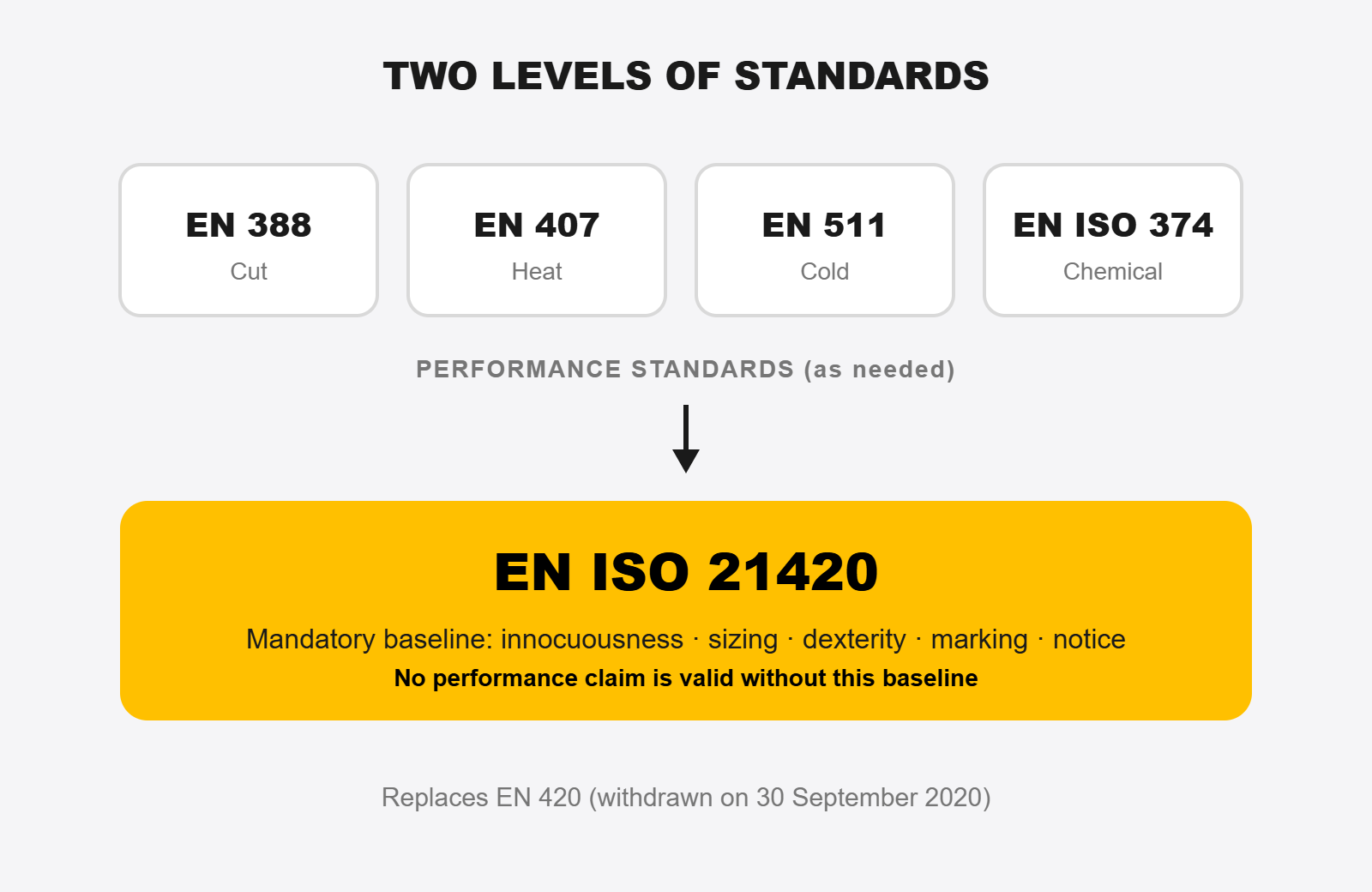
EN ISO 21420 is a prior and cumulative requirement, never an alternative. No glove can claim EN 388, EN 407, EN 511, EN ISO 374 or EN 16350 without first meeting the general requirements of EN ISO 21420. A performance pictogram on its own, without compliance with the baseline, has no value.

This structure governs how any glove marking should be read.

  1. EN ISO 21420 validates the baseline: innocuousness, sizing, dexterity, marking, notice.
  2. EN 388 measures mechanical risks: abrasion, cut, tear, puncture, impact.
  3. EN 407 covers heat and fire.
  4. EN 511 addresses convective and contact cold.
  5. EN ISO 374 governs chemical risks and micro-organisms.
  6. EN 16350 concerns electrostatic properties.

To go further into performance pictograms, our guide all about European standards for safety gloves covers each of these standards, and our dedicated article on the EN 388 standard and cut-resistant gloves decodes the six ratings of the mechanical pictogram. For the most exposed workstations, level 5 cut-resistant gloves combine the EN ISO 21420 baseline with high EN 388 ratings.

Checklist: auditing your glove stock before December 2027

A PPE stock audit comes down to six checks, on the glove itself and on its documentation. This checklist is designed for a health and safety or procurement manager who has to make a call on existing stock and secure future orders.

  1. Which general standard is marked? Look at the marking on the glove and the notice. EN ISO 21420: compliant for the long term. EN 420: usable until 16 December 2027.
  2. Are the batch number and date of manufacture present? Look at the marking or the packaging. Their absence points to certification predating 2020.
  3. Does the notice state an obsolescence date? Look at the information notice. If it is missing, ask the supplier for an updated notice.
  4. Is natural latex flagged where relevant? Look at the information notice. A latex glove without a warning is not compliant with EN ISO 21420.
  5. Is the EU type-examination certificate still valid? Look at the supplier file. Check the expiry date and the notified body.
  6. Do your next orders specify EN ISO 21420? Look at your procurement specification. Update the standard reference now.

Check 6 costs the least and prevents the most. Many procurement specifications still quote EN 420 out of habit. Correcting the standard reference in your template documents settles the matter for every future order, without waiting for the deadline.

SBE note: before changing any reference, our free samples let the operators concerned validate sizing and dexterity at their actual workstation. A glove that is compliant but rejected by the team protects nobody. Our team issues an express quote within 4 working hours and will help you update your references.

What to take away

The question is not whether EN 420 is dead, but when it stops producing legal effects. Withdrawn by CEN since September 2020, it keeps its presumption of conformity until 16 December 2027. Until then, your gloves marked EN 420 remain compliant and usable. After that, they will not.

Three actions are enough to secure the transition. Audit your stock using the checklist above. Correct the standard reference in your procurement specifications today. Require an information notice compliant with EN ISO 21420 from your suppliers, particularly on the obsolescence date and the latex warning. That anticipation will spare you a rushed replacement in late 2027, and brings you into line with the standard that definitively replaces EN 420.

Updated August 2026.

Renew your gloves before the 2027 deadline

Handling, cut-resistant and high-performance gloves compliant with EN ISO 21420. Express quote within 4 hours and free samples.

View the safety gloves →

Continue reading...
These articles too might interest you.

Label printer: the right choice

You need to print your own labels, but with the different printing technologies, roll sizes, compatible software, and types of ribbons, it’s often difficult to know where to start. No worries: by answering just a few simple questions, you’ll know exactly which label printer is right for you.

SBE advise you
Tanya Bicki
5462 views

All about European standards for safety gloves

Did you know that European standards for safety gloves are crucial for ensuring the safety and protection of your colleagues and employees? If you are a professional in the building or artisan sector concerned about the safety of your employees, don’t miss out on this article.

Product News
6984 views

The ISO 7010 standard: unified safety signals on a European scale

In recent years, the term "iso standard" has tended to emerge, particularly in relation to ISO 9001. ISO standards are diverse and varied and cover a wide range of standardised concepts to protect users by conforming manufacturers to strict restrictions on manufacture and use. Due to globalisation, the ISO organisation wishes to standardise and unify rules to ensure safety.

SBE advise you
13107 views

FAQ

Which standard replaces EN 420?

EN ISO 21420:2020 replaces EN 420:2003+A1:2009 for the general requirements of protective gloves. Published in March 2020, it triggered the withdrawal of conflicting national standards on 30 September 2020, including NF EN 420+A1. An amendment, EN ISO 21420:2020/A1:2024, completes it. It keeps the architecture of EN 420 but tightens innocuousness requirements and expands the information notice.

Are my gloves marked EN 420 still compliant?

Yes, until 16 December 2027. Under Commission Implementing Decision (EU) 2026/1279, EN 420:2003+A1:2009 appears in Annex II with an end of presumption of conformity on that date. You can therefore use and distribute existing stock without any compliance risk. After that deadline, only gloves certified to EN ISO 21420 will benefit from presumption of conformity with Regulation (EU) 2016/425.

What is the main difference between EN 420 and EN ISO 21420?

Innocuousness of materials. EN ISO 21420 adds four controlled substances absent from EN 420: DMFa below 1,000 mg/kg on polyurethane, PAH below 1 mg/kg, nickel below 0.5 µg/cm² per week and azo dyes below 30 mg/kg. It also extends pH control to rubber and plastic, and requires testing per material and per colour. The information notice is substantially expanded as well.

Is EN ISO 21420 mandatory?

It is not mandatory in the strict sense, but it is unavoidable in practice. Regulation (EU) 2016/425 sets essential health and safety requirements, and a harmonised standard such as EN ISO 21420 confers presumption of conformity with them. A manufacturer could in theory demonstrate compliance by another route, but that requires a heavy technical demonstration. In practice, every protective glove placed on the European market relies on EN ISO 21420.

Can a glove carry EN 388 without complying with EN ISO 21420?

No. EN ISO 21420 is a prior and cumulative baseline. A glove must meet the general requirements for innocuousness, sizing, dexterity, marking and information notice before it can claim a performance standard such as EN 388 for mechanical risks, EN 407 for heat, EN 511 for cold or EN ISO 374 for chemical risks. A performance pictogram shown on its own, without baseline compliance, has no regulatory value.

See the author's articles
Melissa Oumaouche

With over 5 years of experience in creating content optimized for search engines, Mélissa is currently Marketing & Product Manager at SBE Direct, where she leads the product catalogue positioning across the e-commerce website and marketplaces, as well as the SEO content strategy in coordination with the marketing team she oversees.

We use cookies to improve your experience.