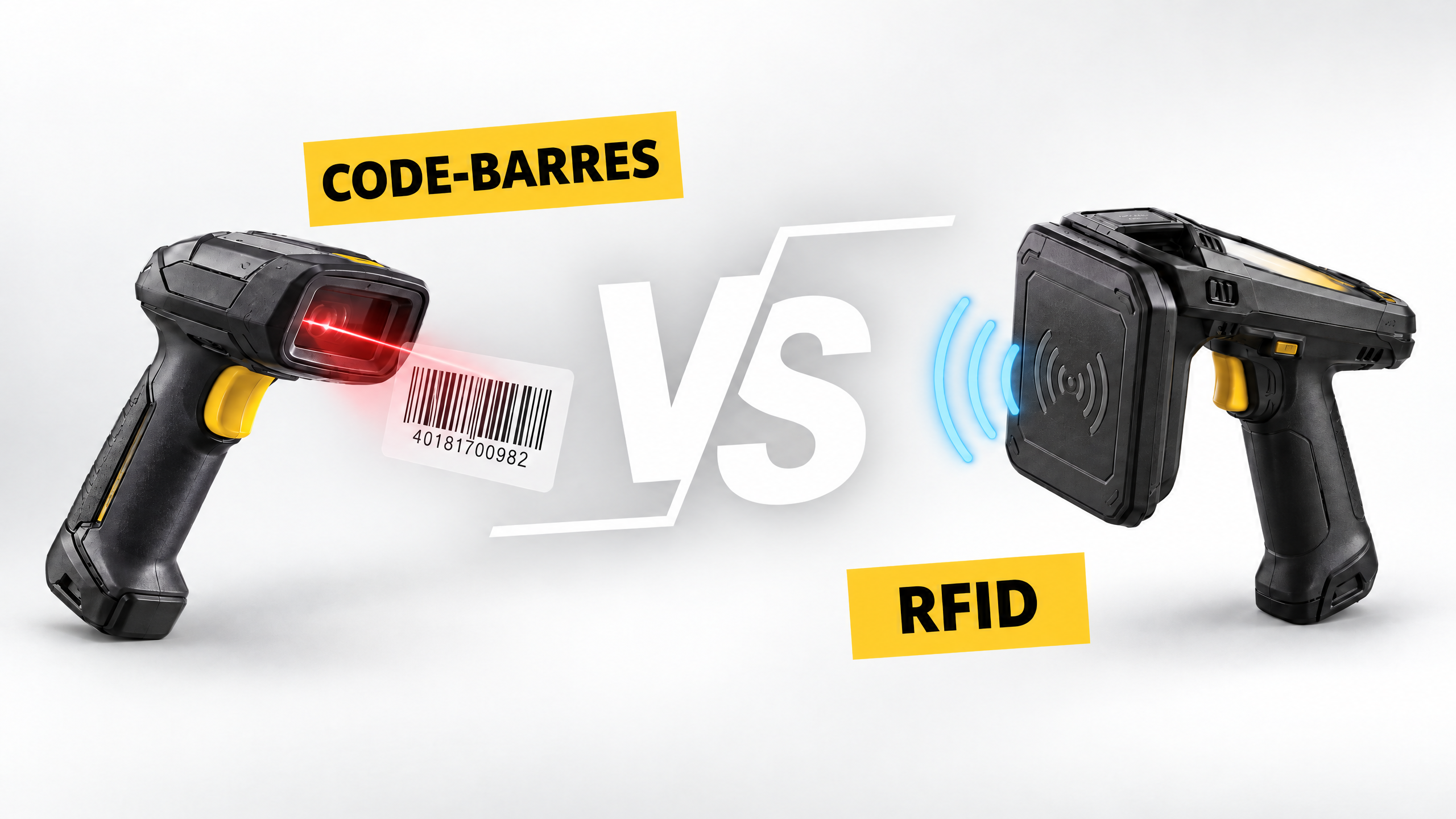
This guide compares RFID and barcode to help you choose the right identification technology based on your volumes, your field constraints and your budget. You will find how each solution works, a figures-based comparison table, their benefits and limits, concrete use cases and a ready-to-use decision checklist.
Choosing between RFID or barcode shapes the performance of your entire identification chain: inventories, equipment tracking, fixed-asset management. Both technologies identify an object from a label, but they do not read the information in the same way, nor at the same cost. Do you need a direct line of sight to read the label? How many objects must you identify at once? What budget should you plan for at the start? This complete guide answers all these questions and gives you a clear decision framework to arbitrate by sector. To go further on asset tracking, see our pages on RFID technology and traceability and asset management.
How Does a Barcode Work?
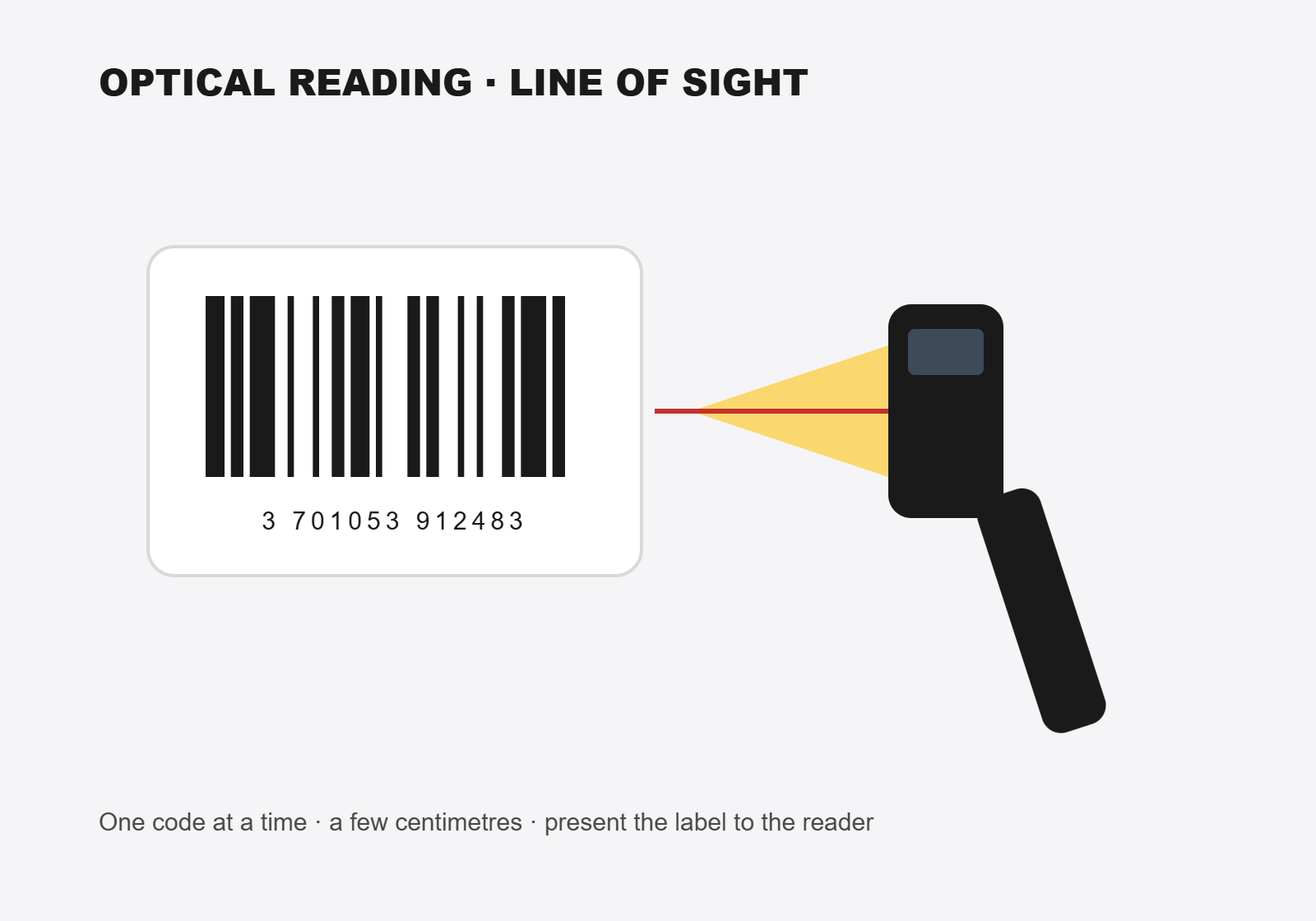
A barcode is a label that encodes information (product reference, serial number, batch number) in graphic form, read optically by a scanner. The reader lights the code, measures the light reflected by the bars and spaces, then translates that pattern into data your software can use. Reading requires a direct line of sight between the code and the reader.
In practice, an operator presents the label to a handheld scanner or terminal, the code is read in a fraction of a second, and the reference flows into your management system. It is simple, fast and universally recognised.
1D and 2D Barcodes: Two Families
A 1D (linear) code encodes a string of characters in parallel bars: the retail EAN-13 holds 13 digits, while Code 128 and Code 39 serve logistics and internal identification. A 2D code (QR Code, DataMatrix) spreads data across two axes and stores far more. A DataMatrix holds more than 2,000 characters on a few square millimetres and stays readable even when partly damaged, thanks to its error correction.
Encoded Data, Reader and Line of Sight
A barcode can encode a reference, a serial number, a batch or a web address. GS1 standards (EAN, UPC) guarantee reference uniqueness from one country to another. Reading uses a wired scanner, a barcode and RFID mobile terminal or even a smartphone. The key constraint stays optical: you must present the code to the reader, one at a time, and a soiled, creased or poorly printed code becomes hard to decode. To produce your own codes, you will need barcode labels suited to your environment, a label printer and a thermal transfer ribbon for durable printing.
How Does RFID Work?
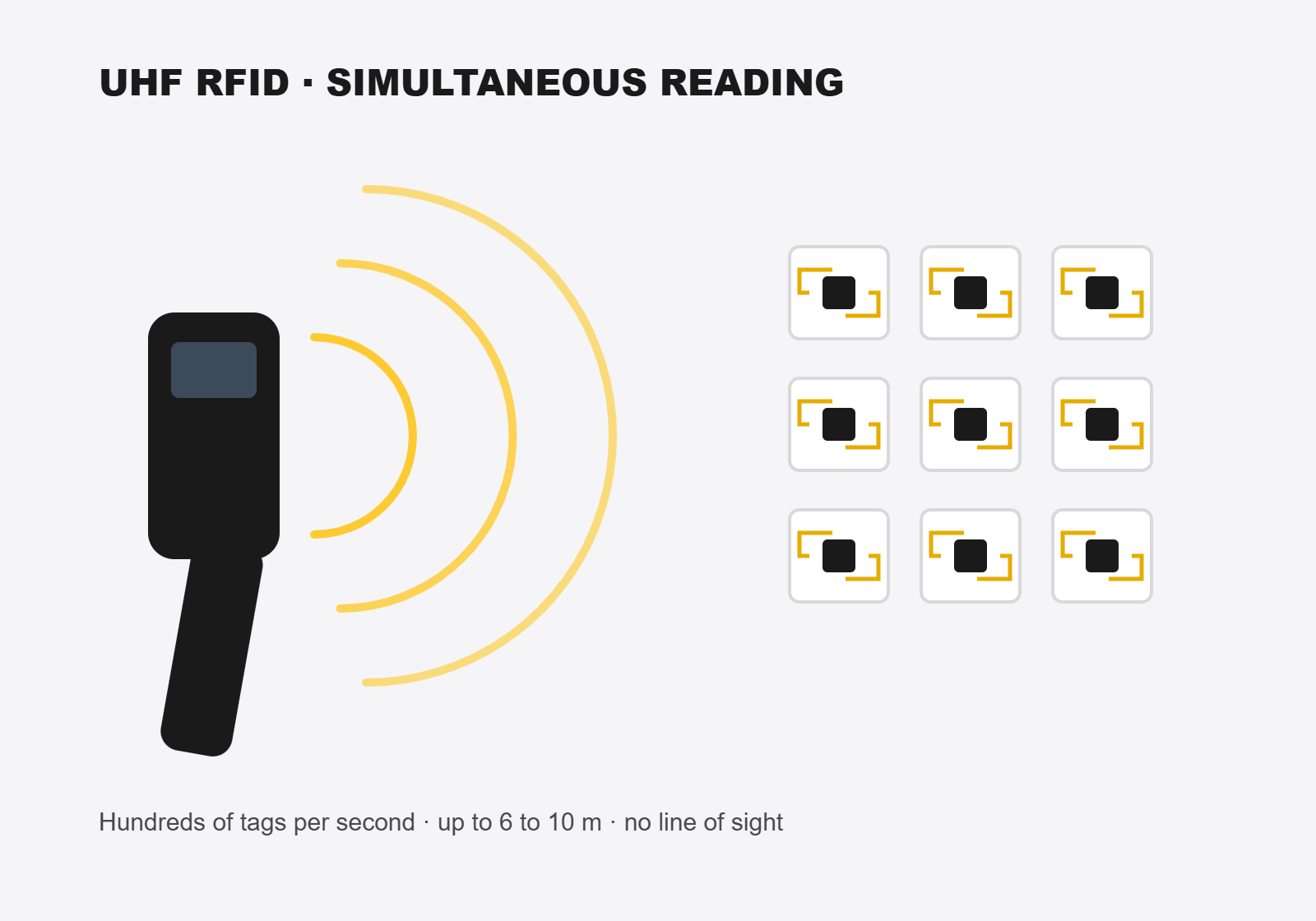
RFID (Radio Frequency Identification) identifies an object by radio waves, with no contact and no line of sight. An RFID label, also called a tag, is made of a chip and an antenna: it stores an identifier that the reader retrieves at a distance. A single reader queries dozens, even hundreds of tags at once, which massively speeds up inventories.
In concrete terms, you move a reader near a shelf or a carton, and every label present answers at the same time, without handling each object. This is the principle that lets you inventory a whole stock in a few minutes.
Tag, Chip, Antenna and Reader
A passive tag holds no battery: it is powered by the radio field emitted by the reader, which makes it very economical and durable. The RFID reader comes as a fixed unit (gate, pass-through antenna) or mobile (terminal, handheld gun). RFID tags vary by the surface to mark: carton, metal, textile, IT asset.
Radio Waves, Frequencies and Reading at a Distance
RFID splits by frequency. HF RFID (13.56 MHz) serves badges and access control, with a range of a few centimetres. UHF RFID (860 to 960 MHz) serves logistics and inventory, with a range reaching 6 to 10 metres in passive mode. In Europe, UHF RFID operates in the 865 to 868 MHz band defined by the ETSI EN 302 208 standard. The EPC Gen2 protocol, standardised as ISO/IEC 18000-63:2022, lets a reader inventory several hundred labels per second at several metres. This simultaneous reading capability is what fundamentally sets RFID apart from the barcode.
RFID vs Barcode: Comparison Table
Both technologies identify an object from a label, but everything separates them once you look at reading: optical principle versus radio waves, one object at a time versus hundreds per second, a few centimetres versus several metres. The table below compares both solutions criterion by criterion.
Criterion
Barcode
RFID (UHF)
Reading principle
Optical (reflected light)
Radio waves
Line of sight required
Yes, mandatory
No
Reading distance
A few centimetres
Up to 6 to 10 metres
Simultaneous reading
One object at a time
Several hundred tags per second
Inventory throughput
Slow, manual
Very fast, automatable
Rewritable data
No (fixed at printing)
Yes, depending on the tag
Resistance / soiling
Sensitive (damaged code unreadable)
Tolerant (reads without visibility)
Label cost
A few cents
From €0.07 to €0.15 at volume
Infrastructure cost
Low
Higher (readers, setup)
Automation level
Limited
High (gates, ERP/WMS)
Typical use
Small volumes, simple uses
Mass inventory, traceability
In short: the barcode stays unbeatable on cost and simplicity for limited volumes and easily accessible objects. RFID takes the lead as soon as you need to read fast, at a distance and in bulk, without handling each item. The right choice does not depend on the most advanced technology, but on your volumes, your field constraints and your budget.
What Are the Benefits and Limits of the Barcode?
Barcode Benefits
→Low cost of the label and the reading equipment.
→Mature, reliable and universally recognised technology.
→Simple to deploy, with no heavy infrastructure.
→Compatible with almost every software and terminal on the market.
→Ideal for simple volumes and uses: checkout, shipping, product labelling.
Barcode Limits
→Direct visibility required: the code must be presented to the reader.
→Frequent human handling, object by object.
→Individual reading, no way to read several codes at once.
→Damaged or soiled codes can be hard to read.
→More limited automation than RFID.
What Are the Benefits and Limits of RFID?
RFID Benefits
→Contactless reading with no direct line of sight.
→Multiple reading: hundreds of labels in one second.
→Fast inventories and presence checks.
→Flow automation (entry and exit gates).
→Fine-grained traceability of assets and movements.
→Direct integration with an ERP or a WMS.
RFID Limits
→Higher initial cost (tags and above all readers).
→Infrastructure to plan: fixed or mobile readers, antennas.
→Setup and calibration needed at the start.
→Constraints tied to certain materials (metal, liquids) and environments.
→Frequency and tag type are decisive for performance.
When Should You Choose the Barcode?
The barcode is the right choice when the budget must stay very low, the volumes to scan are limited and individual reading is not an issue. It suits easily accessible products and organisations that do not need heavy automation.
→The budget must stay very low.
→The volumes to scan are limited.
→Individual reading is not a barrier.
→Products are easy to access and handle.
→The company does not need to automate its flows.
When Should You Choose RFID?
RFID stands out when hundreds or thousands of objects must be inventoried quickly, when several tags must be read at once and when the company wants to automate its traceability. It also sharply reduces manual entry and scanning errors.
→Hundreds or thousands of objects must be inventoried.
→Assets must be identified very quickly.
→Products are not always directly visible.
→Several tags must be detected at once.
→Manual entry or scanning errors must be reduced.
→The company wants to automate its traceability.
According to the Auburn University RFID Lab, moving to RFID raises inventory accuracy from around 65% with manual counting to more than 95%. On the asset identification projects we support at SBE Direct, this reliability gain comes with a clear reduction in the time spent on annual inventories, particularly for IT fleets and technical equipment. An asset management software such as SAM links these reads to your fixed-asset database.
Can You Use RFID and Barcode Together?
Yes, RFID and barcode are complementary and coexist very well. Many labels combine both: a barcode printed on the surface, readable by any scanner, and an embedded RFID chip for bulk reading. This hybrid approach secures reading and allows a gradual migration.
In practice, many companies keep the barcode for simple operations (checkout, single receiving) and add RFID where speed and volume demand it (warehouse inventory, exit control). You do not replace one technology with the other: you make them work together, each on its home ground.
What Criteria Should Guide Your Choice?
Before arbitrating between RFID or barcode, run your project through these ten questions. The answers almost always outline the best-suited solution.
→How many objects must be identified?
→How often are they scanned?
→Must several objects be read at once?
→Are the objects easy to access?
→What reading distance is needed?
→In what environment will the labels be used (metal, cold, humidity)?
→What level of automation is sought?
→What budget can be devoted to the project?
→Must the system talk to an ERP or a WMS?
→What time savings could RFID generate on your inventories?
SBE Direct note: our teams issue a free quote within 4 hours and provide samples so you can test the labels in your real conditions before any deployment.
The question is not which technology is superior in absolute terms, but which one best serves your need. The barcode remains the economical benchmark for limited volumes and accessible objects. RFID becomes essential as soon as speed, volume and traceability automation come into play, and the two combine effectively in a hybrid strategy. To frame your project, rely on your volumes, your reading distances and your budget, then test in real conditions. Whether you lean towards RFID or barcode, the SBE Direct teams support you from choosing the tags to software integration.
Updated October 2026.
FAQ
For stock management: RFID or barcode?▾
For moderate stock volumes and products handled one by one, the barcode is enough and stays the most economical. As soon as the stock grows large, references move fast and you want near real-time inventories, RFID takes the lead thanks to multiple reading. Many warehouses adopt a mixed approach: barcode for single receiving, RFID for the overall inventory.
For inventories: which technology should you choose?▾
RFID is the technology of fast inventory: a reader captures hundreds of labels per second, without taking out each object or presenting it to the scanner. According to the Auburn University RFID Lab, inventory accuracy exceeds 95% against around 65% with manual counting. The barcode stays relevant for one-off inventories on small volumes, where the RFID investment is not yet justified.
RFID or barcode to track equipment and assets?▾
To track a fleet of equipment (IT, tooling, technical gear), RFID paired with asset management software offers fine tracking and fast presence checks. The barcode works if the fleet is small and checked manually. In both cases, choosing the label suited to the surface and environment drives the durability of the marking.
Which system is cheaper: RFID or barcode?▾
The barcode is cheaper to buy: the label costs a few cents and the reading equipment stays affordable. RFID requires a higher initial investment, above all for readers and setup, even though the price of UHF tags falls from €0.07 to €0.15 per unit at volume. The real calculation is in total cost: RFID pays off through the time saved on inventories and the reduction in errors.
What is the cost of an RFID system?▾
An RFID system combines three items: the tags (from a few cents per unit), the readers (from a few hundred to a few thousand euros depending on fixed or mobile) and the management software. An asset inventory solution such as SAM (SBE Asset Manager) starts at €997 excl. VAT and scales with scope and user count. For precise costing, SBE Direct issues a free quote within 4 hours based on your fleet and your volumes.
With over 5 years of experience in creating content optimized for search engines, Mélissa is currently Marketing & Product Manager at SBE Direct, where she leads the product catalogue positioning across the e-commerce website and marketplaces, as well as the SEO content strategy in coordination with the marketing team she oversees.