Do you want to make and sell clothes that comply with the legislation? Then you need to add a textile label, which is mandatory in France, to inform consumers about the composition of the garment and other important information. These textile labels allow you to be more transparent and help people in their purchase. In this article, we give you all the elements that can appear on a textile label.


Mandatory information on a textile label

In France, the composition of the garment must appear on the textile label, giving the percentage of fibres and materials that make up the product. For example: 80% cotton, 20% polyester. You must refer to the EU regulation on textile fibre names. Note that the regulations differ from one country to another, even in the EU. We therefore advise you to find out the rules of each country to which you wish to export your products. In addition, the compulsory information must be written in the language of the countries in which your products are sold.

In addition, the presence of animal fur must be stated on the textile label by declaring the word fur, the name of the animal species(s), the part of the product concerned and the words "Contains non-textile parts of animal origin". This information must be visible and legible.

The composition label must be permanently attached to your products. This can be done by sewing it on or by printing it directly onto the garment using a wash-resistant printing process.


Optional information on a textile label

Contrary to what you might think, the size of the garment, in numbers or letters, is not compulsory but it is nevertheless essential for a customer to be interested in the product and buy it. Attention: if you export your products, find out the sizes of the country or countries where your products will be sold. Indeed, clothing sizes are often different from one country to another.

The second optional information is the origin of the garment. Example: Made in China. Many brands put this on their products in order to be more transparent to the consumer who wants to know where the product was made.

Care instructions are not mandatory either. However, a large number of brands add them after the composition in order to help the user to preserve the garment over time. Care instructions take the form of symbols, determined by the ISO 3758 standard, chosen by the French Committee for Textile Labelling (COFREET) and the International Group for Textile Care Labelling (GINETEX).

Each symbol follows an established order: 

  • Washing - a symbol for a vat, a small basin filled with water. The symbol can indicate the fragility of the fabric, the ideal temperature and special treatment if necessary.
  • Bleaching - symbol of a triangle (white, striped or crossed out) that allows or does not allow bleaching.
  • Drying - symbol of a circle in a square. If the circle contains 2 dots, the garment can be dried normally in the tumble dryer. If the circle contains 1 dot, the use of a tumble dryer at a reduced temperature is recommended and if the symbol is crossed out, drying is forbidden.
  • Ironing - iron symbol. Same system with dots. If 3 dots: ironing at high temperature allowed, especially for cotton or linen garments. 2 dots: ironing at medium temperature recommended for wool, silk, viscose. 1 dot: ironing at low temperature as for acetate, nylon or lyacrylic. Striped symbol: do not iron.
  • Dry cleaning - symbol of a circle with a capital letter inside for professionals who use specific products.

To use these symbols, you must be a member of COFREET, as they are a registered trademark. Applying a care label is highly recommended as you will not be held responsible for any incident related to the care of the product. In addition, you will avoid a large number of product returns.


The different types of textile labels

étiquette textile nylon

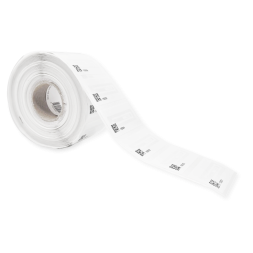
At SBE direct we offer the nylon textile label for sewing. It is resistant to washing and dry cleaning up to 95°C. It is very easy to sew onto all types of clothing and other textiles. 

We also offer the synthetic iron-on textile label, which is stuck on your garment with a hot-melt adhesive label press. It is also very resistant to washing and dry cleaning.

These textile labels are easily customised using a textile thermal transfer printer and a resin ink ribbon.

étiquette textile adhésive

Continue reading...
These articles too might interest you.

Everything you need to know about barcodes and their readers

1948, Norman Joseph Woodland invented the barcode and since then, this revolutionary invention surrounds us daily. Mainly used in the retail industry, barcodes can be used to obtain information about a product: origin, price, weight, unit price, description... What is its history? How do we read it and how do we use it nowadays? We reveal you everything about barcodes! 

SBE advise you
19390 views

All about the textile heat press

When it comes to personalising clothing, a heat press is your best friend. To heat set patches, iron-on labels or other ink transfers on your garments, a heat press is the best option.

Product News
14381 views

Secure your products in shop with security labels

Tools, smartphones, alcohol, razor blades, jewellery and make-up are the products most coveted by thieves because of their high added value. Theft is a scourge for supermarkets and specialist retailers. It accounts for nearly 80% of "shrinkage", which represents all the goods that go missing, including stock management errors, supplier errors, breakage and waste. In Europe, France is one of the countries most affected by shrinkage with 6.5 billion euros lost, including more than 468 million euros for specialised distribution. It is mainly due to external/shoplifting (43%), internal/employee fraud (24%), suppliers (17.5%), then internal errors/administrative losses (16%). (source: 22/10/20, Stackr). To counter theft, it is therefore essential to invest in effective and reliable means such as anti-theft security labels. In this article, you will learn about the different types of anti-theft labels and their advantages.

SBE advise you
7085 views

We use cookies to improve your experience.